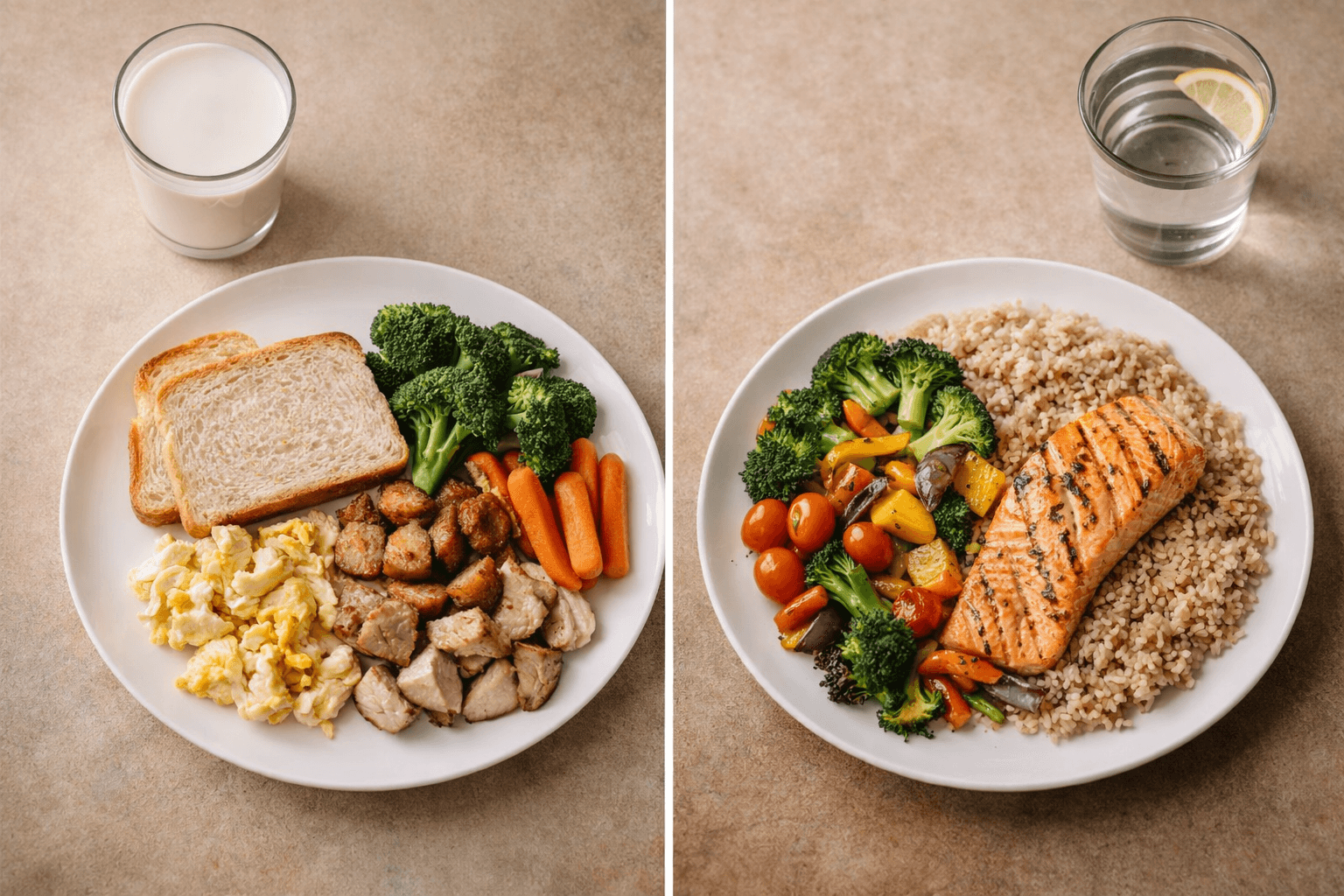
Both the Harvard Plate and USDA MyPlate are visual guides for building a balanced meal. Both use a divided plate format. Both are free, widely available, and designed to make nutrition guidance more accessible than a list of numbers. Beyond that, they diverge significantly — in origin, in specificity, and in the nutritional philosophy behind each section.
Understanding the differences helps you use either framework more effectively, and explains why Eated is built on the Harvard Plate rather than MyPlate.
What Is MyPlate?
MyPlate is the USDA's official dietary guidance tool, launched in 2011 as a replacement for the food pyramid. It shows a plate divided into four sections — fruits, vegetables, grains, and protein — with a small circle beside it representing dairy. The message is visual and deliberately simple: build your meals around these proportions.
MyPlate is produced by the U.S. Department of Agriculture, which has a dual mandate: it both promotes American agricultural interests and provides public nutrition guidance. This creates an inherent tension. The foods recommended by MyPlate reflect both nutrition science and agricultural policy considerations.
What Is the Harvard Plate?
The Harvard Healthy Eating Plate was created in 2011 by nutrition scientists at Harvard T.H. Chan School of Public Health and Harvard Medical School, explicitly in response to the limitations of MyPlate. Harvard stated directly that it was "based exclusively on the best available science and was not subjected to political or commercial pressures from food industry lobbyists."
Walter Willett, professor of epidemiology and nutrition at Harvard who helped develop the plate, put the core criticism plainly: "The main thing is that MyPlate isn't specific enough to really give enough guidance."
The Key Differences, Section by Section
Vegetables and Fruits
MyPlate: Vegetables and fruits together make up half the plate. No guidance on which vegetables or fruits to prioritize. Potatoes are implicitly included as vegetables.
Harvard Plate: Vegetables and fruits together make up half the plate — but with important specificity. The Harvard Plate notes that potatoes don't count as vegetables for this purpose (they spike blood sugar similarly to refined grains). Variety and color are emphasized. Vegetables should dominate the produce half over fruits.
The practical implication: a plate with potatoes and fruit juice meets MyPlate's visual proportions but not the Harvard Plate's. The distinction matters because potatoes and fruit juice have very different metabolic effects than broccoli and whole fruit.
Grains
MyPlate: A quarter of the plate is grains. No specification about which grains. All grains — white bread, white rice, whole wheat, oats — are treated equivalently.
Harvard Plate: A quarter of the plate is whole grains specifically. Refined grains — white bread, white rice, most pasta — are explicitly de-emphasized. The Harvard Plate notes that in the body, refined grains act similarly to sugar in terms of blood glucose response.
This is one of the most nutritionally significant differences. Research consistently shows that following Harvard's Healthy Eating Plate guidelines is associated with lower risk of heart disease and premature death — driven in large part by the whole grains emphasis and other quality distinctions that MyPlate doesn't make.
Protein
MyPlate: A quarter of the plate is protein. No guidance on protein quality or which sources to choose or limit. All protein sources — chicken breast, red meat, processed meat, legumes — are grouped equally.
Harvard Plate: A quarter of the plate is healthy protein. The plate specifically names fish, poultry, beans, and nuts as preferred sources. Red meat is recommended to be limited. Processed meat — bacon, hot dogs, sausages — is recommended to be avoided.
This distinction matters because the evidence on processed and red meat and disease risk is substantial and well-established. A plate that meets MyPlate's protein requirement with a daily serving of processed meat is not nutritionally equivalent to one that meets it with fish and legumes.
Fats
MyPlate: Fats are not represented on the plate and are not directly addressed in the visual framework. The broader USDA guidance has historically promoted low-fat eating.
Harvard Plate: Healthy oils — olive oil, canola oil, and other plant-based oils — are explicitly included and encouraged. The Harvard Plate directly contradicts the low-fat messaging of earlier USDA guidance, noting that the type of fat matters far more than the quantity, and that healthy unsaturated fats are beneficial rather than something to minimize.
Dairy
MyPlate: A glass of dairy (milk) accompanies every meal — a USDA recommendation that reflects decades of dairy industry influence on federal dietary policy.
Harvard Plate: The glass of dairy is replaced with water as the recommended beverage. The Harvard Plate recommends limiting dairy to one to two servings per day at most. The reasoning: evidence doesn't support consuming dairy with every meal as uniquely health-promoting, and making dairy a centerpiece of the plate crowds out more important messaging.
Physical Activity
MyPlate: Physical activity is not incorporated into the plate visual.
Harvard Plate: Physical activity appears at the edge of the plate graphic as an explicit component of healthy eating — acknowledging that movement and eating are not separate variables but interact in producing health outcomes.
Side-by-Side Comparison
MyPlate (USDA) | Harvard Plate | |
|---|---|---|
Origin | USDA — federal dietary policy | Harvard T.H. Chan School of Public Health |
Influenced by | Nutrition science + food industry lobbying | Nutrition science only (self-stated) |
Vegetables | Half plate — no specifics, potatoes included | Half plate — potatoes excluded, variety emphasized |
Grains | Quarter plate — all grains equal | Quarter plate — whole grains only, refined limited |
Protein | Quarter plate — all sources equal | Quarter plate — fish, legumes, nuts preferred; red meat limited; processed meat avoided |
Fats | Not represented; historically low-fat emphasis | Healthy oils explicitly included and encouraged |
Dairy | Glass of milk with every meal | Water as main beverage; dairy limited to 1-2 servings/day |
Physical activity | Not included | Included at plate edge |
Specificity | Broad categories | Specific guidance on quality within categories |
Why the Difference Matters in Practice
The practical implication of these differences becomes clear when you imagine two people both following their respective plates for a year.
Person A follows MyPlate: a portion of grains (often white bread or pasta), a protein (often red or processed meat), some vegetables (including potatoes), fruit, and a glass of milk with each meal. They're meeting every visual criterion of MyPlate.
Person B follows the Harvard Plate: whole grains (brown rice, oats, quinoa), fish or legumes as the primary protein, a varied array of non-starchy vegetables, healthy oils used in cooking, water as the primary beverage.
Both plates look similar at a glance. The nutritional composition — and the long-term health outcomes — are substantially different. The Harvard Plate's specificity is what closes that gap.
Which One Does Eated Use, and Why?
Eated is built on the Harvard Plate Method for this reason: it offers specific, evidence-based guidance on food quality within categories, not just broad group proportions. The goal is not just a balanced plate visually — it's a nutritionally substantive one.
The visual composition assessment in Eated's plate scan feature evaluates whether meals approximate Harvard Plate proportions: enough vegetables, the right protein sources, whole grains where grains are present. The daily insights and weekly reports build on this compositional framework to help users develop the habits that make it automatic.
For a complete overview of the Harvard Plate Method and how to use it, see our full guide to the Harvard Plate.
Frequently Asked Questions
Is the Harvard Plate better than MyPlate?
The Harvard Plate provides more specific guidance on food quality within each category — distinguishing whole grains from refined, healthy proteins from processed meat, healthy fats from the absence of fat guidance. Harvard explicitly states that the plate is based on nutrition science without food industry influence, which MyPlate cannot claim. For practical nutrition guidance, the Harvard Plate's specificity makes it more useful.
What is the main difference between Harvard Plate and MyPlate?
The most important differences are: (1) Harvard specifies whole grains rather than all grains equally; (2) Harvard distinguishes between healthy and unhealthy protein sources; (3) Harvard replaces the dairy glass with water; (4) Harvard explicitly includes healthy fats rather than promoting low-fat eating; (5) Harvard excludes potatoes from the vegetable category. Together these distinctions reflect meaningful differences in nutritional quality, not just visual proportion.
Why does MyPlate include dairy but Harvard Plate doesn't?
The USDA's dairy recommendation reflects decades of dairy industry lobbying influence on federal dietary guidelines. Harvard's nutrition scientists concluded that the evidence doesn't support consuming dairy with every meal as a health priority, and that the dairy recommendation displaces more important guidance. Water is the recommended beverage on the Harvard Plate.
Can I use MyPlate instead of the Harvard Plate?
Yes — MyPlate provides useful broad guidance and is significantly better than no framework at all. It's a reasonable starting point, particularly for people new to thinking about meal composition. The Harvard Plate builds on that foundation with specificity that makes a meaningful difference in nutritional quality over time.
Does Eated use MyPlate or Harvard Plate?
Eated uses the Harvard Plate Method as its compositional framework. The plate scan feature and daily insights are built around Harvard Plate proportions and quality guidance — not just broad food group categories.
The Bottom Line
MyPlate and the Harvard Plate look similar at first glance — both divide a plate into proportional sections. The differences lie in specificity: Harvard distinguishes whole grains from refined, healthy proteins from processed, water from dairy, and healthy fats from a low-fat directive. These distinctions are not cosmetic. They reflect meaningful differences in how different foods within the same broad category affect health over time.
The Harvard Plate is the framework Eated is built on — because specificity about food quality is what makes the difference between a plate that looks balanced and one that actually is.
To start building the eating habits that bring the Harvard Plate Method into your daily routine automatically, try the free Habit Wheel. Or download Eated on the App Store and begin your 7-day free trial.