Boredom eating is not the same as emotional eating, stress eating, or habit eating — though all four can happen in the same evening. Boredom has a specific neurological signature that drives food-seeking in a distinct way, and the interventions that work for stress or emotion don't fully address it. This post covers what boredom eating actually is, why it's so hard to interrupt, and what the evidence says about stopping it.
What Boredom Actually Is (Neurologically)
Boredom is not simply the absence of stimulation. It's an aversive state — the brain actively signals that the current situation is understimulating and pushes toward something more rewarding. The neurological mechanism involves the same dopamine reward circuitry that drives motivation, attention, and pleasure-seeking.
A 2022 study published in Behavioral Sciences examining food choice motivation during the COVID-19 pandemic found that boredom was a significant predictor of eating behavior changes — people who reported higher boredom consumed more and made worse nutritional choices — independently of stress and emotional states. Boredom operates as its own eating trigger, not just a variant of emotional eating.
The mechanism: boredom reduces dopamine tone in the brain's reward system. Food — particularly highly palatable, high-sugar, high-fat food — provides a rapid dopamine spike that temporarily relieves the aversive understimulation. The brain learns this association quickly. Boredom → food seeking becomes a conditioned response that operates below the level of conscious decision-making.
Why Boredom Eating Is Different From Emotional Eating
Emotional eating is driven by negative affect — anxiety, sadness, frustration, loneliness. The food serves as a regulation tool for an unpleasant emotional state.
Boredom eating is driven by understimulation — the absence of engagement, not the presence of distress. It doesn't require feeling bad. It just requires feeling nothing much. This distinction matters because:
Telling yourself "I'm not stressed, I have nothing to worry about, why am I eating?" doesn't help — because boredom eating isn't stress-driven. The logic doesn't apply. The craving persists regardless.
The interventions are also different. Emotional eating responds to emotional regulation tools — identifying feelings, stress reduction, self-compassion practices. Boredom eating responds to stimulation substitution — replacing the food-based dopamine hit with something else that delivers comparable engagement.
The Habit Loop Layer
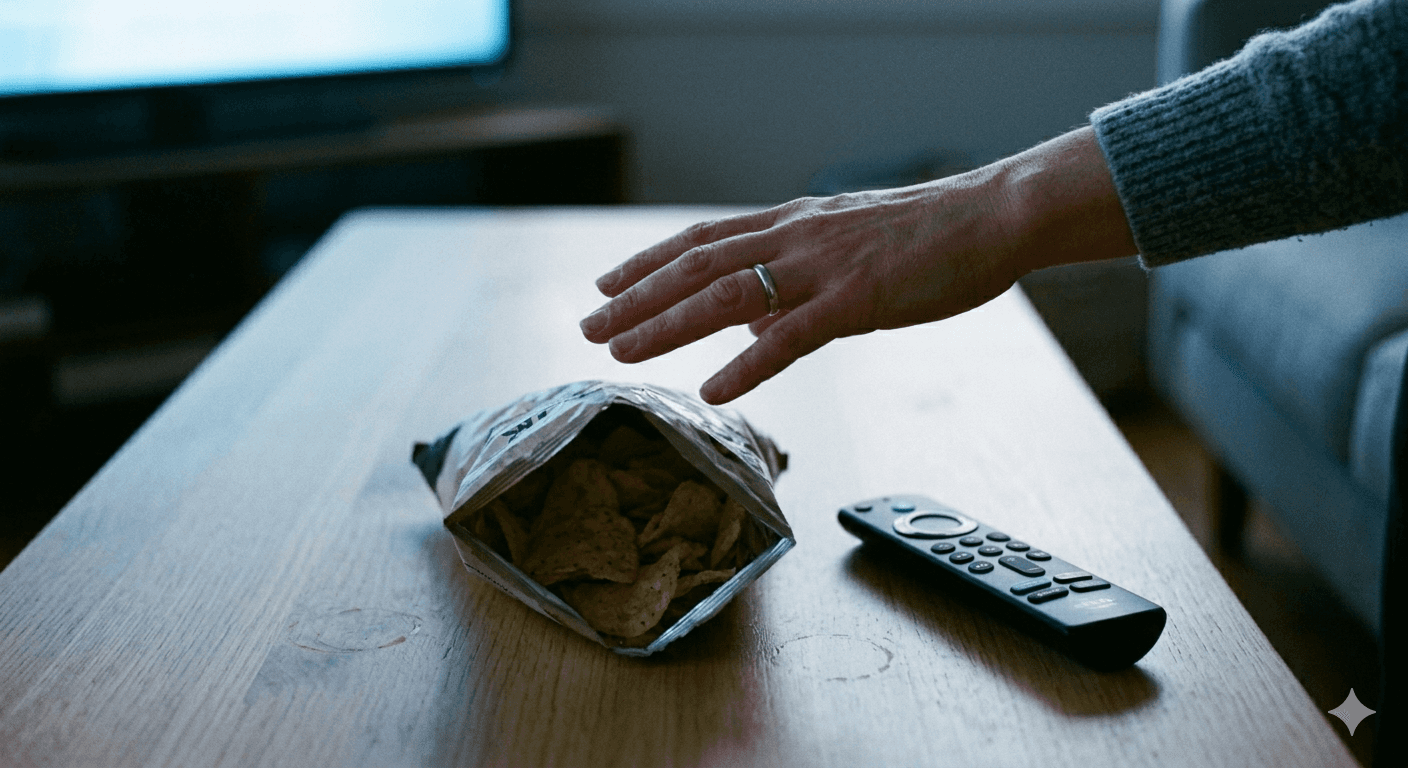
Most boredom eating is also a habit by the time someone notices it's a problem. The cue isn't just boredom in the abstract — it's specific: the couch after dinner, a particular time of evening, a specific room, the act of opening a streaming service. These environmental cues have been paired with eating so many times that the food-seeking behavior has become automatic.
The habit loop — cue, routine, reward — runs the sequence without deliberate intention. Recognizing boredom as the cue is only the first step. The loop also needs a new routine that delivers a comparable reward.
This is why willpower-based approaches to boredom eating fail. The loop is running automatically. Trying to suppress the routine without replacing it leaves the loop intact — cue fires, reward is absent, the drive intensifies.
What Boredom Proneness Predicts
Not everyone experiences boredom eating equally. Boredom proneness — a stable individual difference in how frequently and intensely people experience boredom — is a significant predictor of emotional eating across studies.
A 2022 study published in Appetite found that boredom proneness was a significant predictor of emotional eating even when controlling for broad dimensions of negative and positive affect. Critically, the association held independently of stress and negative mood — confirming that boredom operates as a distinct eating trigger.
People higher in boredom proneness also tend to have lower interoceptive awareness — meaning they're less accurate at sensing internal states including hunger and fullness. This creates a compounding effect: they experience more boredom-driven eating urges, and they're less able to distinguish those urges from genuine hunger.
What Actually Works: Three Evidence-Based Approaches
1. Stimulation Substitution — Match the Reward Profile
The boredom eating loop works because food delivers dopamine under low-stimulation conditions. The replacement behavior needs to also deliver dopamine — not relaxation, not rest, not "something healthy." Engagement.
This is why "just go for a walk" fails as boredom eating advice for most people. A walk provides mild stimulation but not the acute reward hit the dopamine-deficient brain is seeking. Activities that work: something novel, creative, social, or cognitively engaging. The activity needs to feel genuinely interesting, not virtuous.
Practically: identify two or three activities that genuinely absorb your attention — not ones you think you should enjoy — and keep them accessible in the specific context where boredom eating happens. If the pattern is TV + snacking in the evening, the replacement needs to be in the same context, not a different room or a different time.
2. Environmental Restructuring
Because boredom eating is heavily cue-driven, changing the physical environment disrupts the conditioned cue-routine association. Specific changes that are documented to reduce automatic eating:
Remove food from the primary boredom context — the couch, the TV room, the desk. Food that requires getting up, going to another room, and actively choosing to eat interrupts the automaticity. You're not restricting access; you're adding friction to an automatic behavior.
Keep engaging non-food alternatives in the same location where snacking typically happens: a book, a puzzle, headphones with a podcast, something that delivers stimulation without food. The goal is to make the alternative the path of least resistance, not food.
3. The Pre-Commitment Check-In
Before eating in a boredom context, a 5-second check: am I physically hungry? Where am I on the hunger-fullness scale?
A rating of 5 or above (neutral to full) confirms the drive isn't physical hunger. At that point, the question shifts from "should I eat this" to "what am I actually looking for right now?" — which opens the door to a non-food response.
This isn't a willpower tool. It's an awareness tool — inserting a moment of conscious recognition before the automatic habit runs. Over time, that gap between cue and routine widens, and deliberate choice becomes more available.
The Evening Timing Problem
Boredom eating clusters heavily in the evening — after dinner, during passive entertainment, in the hours before sleep. This is partly habitual and partly biological: cognitive control resources deplete throughout the day, making automatic behaviors harder to override by evening. The brain is also dopamine-depleted after a full day of decision-making and stimulation, which makes the understimulation of a quiet evening feel more aversive.
This overlap with nighttime overeating is significant. If evening eating is a pattern — whether boredom-driven, habit-driven, or medication-related — the full behavioral framework for stopping it covers the multiple drivers and their specific fixes.
"The clients who say they 'eat out of boredom' are usually describing something very specific: same couch, same time, same snacks. It's a loop, not a character flaw. When we map the loop — what the actual cue is, what reward the food is providing — the fix becomes obvious. Usually it's not about the food at all. It's about needing something engaging and not having it available."
— Irene Astaficheva, PN1, PN-SSR, GGS-1
Honest Limitations
Boredom eating exists on a spectrum. Occasional boredom snacking is normal and not worth pathologizing. The interventions in this post are relevant for patterns that are consistent, unwanted, and producing outcomes the person doesn't want — not for every instance of eating a snack while watching TV.
If boredom eating consistently leads to large amounts of food consumed rapidly with a sense of loss of control, that's closer to binge eating territory and warrants clinical evaluation rather than self-directed behavioral change.
The research on boredom eating specifically is less robust than the emotional eating literature. Most studies are correlational, many rely on self-report, and controlled intervention trials targeting boredom eating specifically are limited. The mechanisms described here are well-supported; the specific intervention evidence is less so.
FAQ
Is boredom eating the same as emotional eating? Related but distinct. Emotional eating is driven by negative affect — a specific unpleasant emotion. Boredom eating is driven by understimulation — the absence of engagement. They can co-occur, but the drivers and effective interventions differ. Boredom eating doesn't require feeling bad; it just requires feeling nothing much.
Why do I always go for junk food when bored, not healthy food? Because the dopamine hit from highly palatable food (high sugar, salt, fat) is significantly larger than from low-calorie whole foods. The boredom-driven brain is seeking maximum reward under low-stimulation conditions, and ultra-processed food is optimized to deliver exactly that. It's not a preference for junk food in the abstract — it's the brain seeking the highest-reward option available.
Does mindfulness help with boredom eating? Partially. Mindfulness builds the interoceptive awareness that helps distinguish boredom-driven urges from physical hunger, and it trains the ability to notice the automatic cue-routine sequence before it completes. But it doesn't address the understimulation itself — the underlying boredom still needs a non-food outlet to resolve.
I'm bored because my life genuinely isn't engaging enough. Is that a food problem? Not primarily. Chronic boredom eating that resists behavioral interventions is often signaling that something in daily life lacks genuine engagement — work, relationships, hobbies. Treating the food behavior without addressing the underlying lack of stimulation produces limited results. This is worth taking seriously as a lifestyle question, not just a nutritional one.
How long does it take to break the boredom eating habit? The habit loop itself — cue to routine — takes an average of 66 days to rewire with a new behavior, based on habit formation research. The boredom trigger doesn't go away; the automatic response to it can change. Expect 6–8 weeks of consistent replacement behavior before the new routine feels more natural than the food-seeking one.
Bottom Line
Boredom eating is a dopamine-seeking behavior running on a conditioned habit loop. The boredom itself triggers the reward-seeking, the food provides the dopamine hit, the loop gets reinforced. Willpower doesn't interrupt it — awareness, stimulation substitution, and environmental restructuring do.
Start with the check-in (am I actually hungry?), identify the specific cue in your context, and build one genuinely engaging alternative that's available in that exact situation. The boredom still needs addressing — food just can't be the answer to it indefinitely.
Download Eated
If you want to map your specific eating patterns and build one replacement habit at a time, the Eated app is free to download on iOS.