
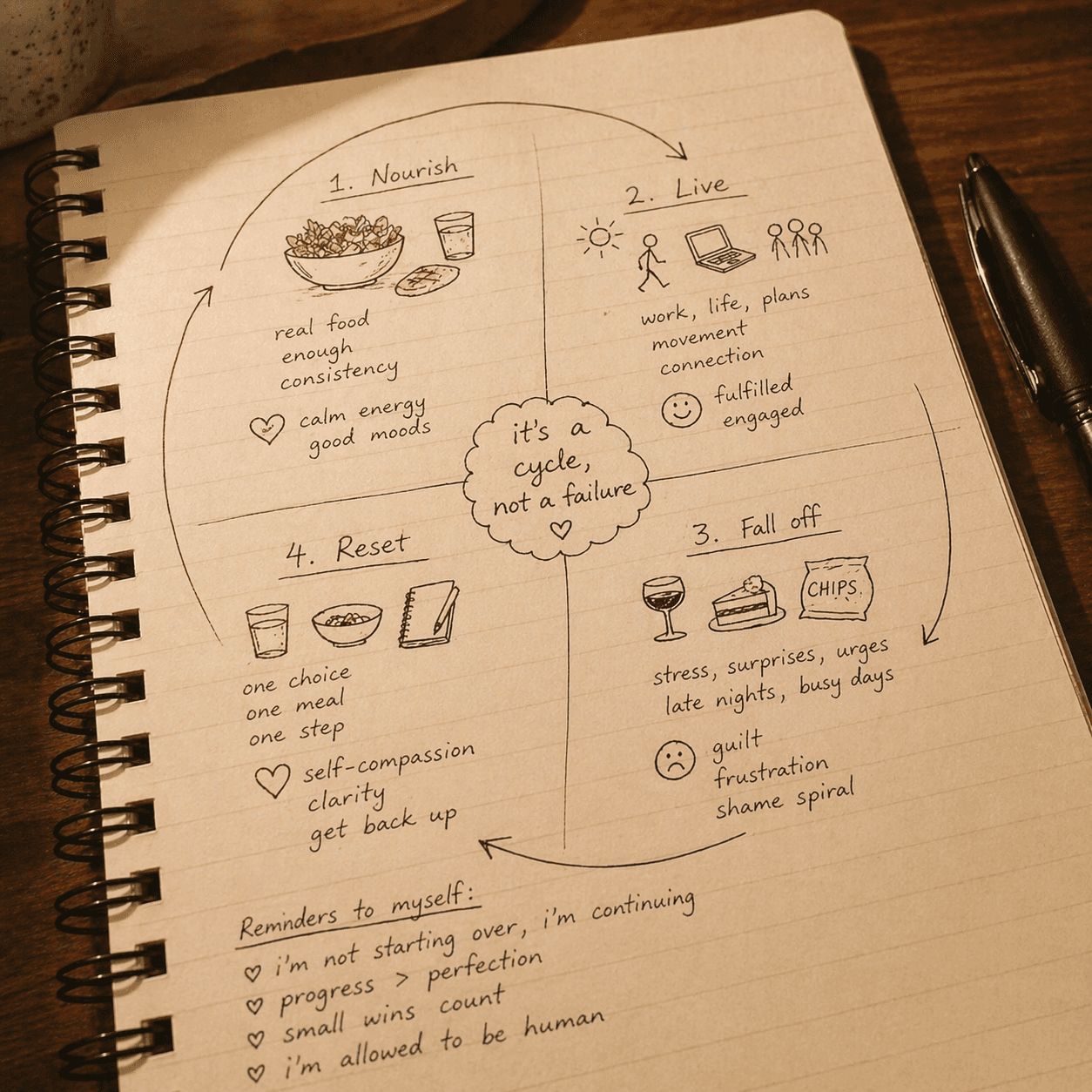
If you eat more in the two weeks before your period and less in the week after, you're not imagining it and you're not failing at self-control. The hunger variation across the menstrual cycle is hormonally driven, measurable, and well-documented. Understanding the mechanism doesn't just validate the experience — it changes how you respond to it. This post explains what's actually happening and what it means practically for how you eat.
The Four Phases and What They Do to Hunger
The menstrual cycle has four phases, each with a distinct hormonal profile that affects appetite regulation differently.
Menstrual phase (days 1–5 roughly) Estrogen and progesterone are both low. Energy needs are moderate. Many women report reduced appetite early in this phase, though cramping and discomfort can complicate eating patterns.
Follicular phase (days 1–13, overlapping with menstrual) Estrogen rises steadily. High estrogen has an appetite-suppressing effect — it enhances the release of cholecystokinin (CCK), a satiety hormone from the small intestine, and attenuates ghrelin (the hunger hormone). A 2023 narrative review of dietary energy intake across the menstrual cycle found that hunger is, on average, lower during the follicular phase than other cycle points — corresponding with lower energy intake. Most women feel least hungry and most energized in this phase.
Ovulatory phase (around day 14) Estrogen peaks briefly, then drops. Hunger is typically at its lowest here — the "fertile window" effect is a real hormonal suppression of appetite.
Luteal phase (days 15–28 roughly) This is where it gets physiologically interesting. After ovulation, progesterone rises significantly alongside moderate estrogen. Progesterone increases basal metabolic rate — your body is burning slightly more energy at rest — and drives increased appetite to compensate. A 2024 study in Appetite measuring satiety hormones across cycle phases found meaningful hormonal differences between phases, with ghrelin and appetite-stimulating signals elevated in the luteal phase compared to follicular.
Historically, food intake changes across the menstrual cycle may be more than 2.5 MJ (roughly 600 kcal) per day between lowest and highest points — with a mean reported change of approximately 1.0 MJ/day across 19 studies. That's a meaningful physiological shift.
The Progesterone Mechanism: Why the Luteal Phase Is Different
The luteal phase hunger increase isn't random — it has a clear biological mechanism.
Progesterone drives biosynthesis and increases energy expenditure through cell growth regulation. To compensate, appetite and food intake increase. This is the same mechanism that makes pregnancy hunger so intense — progesterone is elevated throughout pregnancy, and the appetite response follows.
In the late luteal phase, declining serotonin levels specifically increase carbohydrate cravings. Research on luteal phase eating patterns found carbohydrate intake was highest during the luteal phase across multiple studies — not coincidentally, but because carbohydrate consumption temporarily raises serotonin. The craving for sweet or starchy foods before a period is, in part, a neurochemical self-regulation attempt.
Estrogen's appetite-suppressing role compounds the effect when it drops. High estrogen during the follicular phase suppresses ghrelin. When estrogen falls after ovulation, that suppression lifts — and hunger increases not just because progesterone is up, but because the estrogen brake on appetite is removed simultaneously.
The combination produces the characteristic pre-period pattern: elevated hunger, specific carbohydrate cravings, reduced satiety sensitivity, and a modest increase in actual caloric need.
What the Resting Metabolic Rate Data Shows
The luteal phase hunger increase isn't purely psychological — it corresponds to a real increase in energy expenditure. Resting metabolic rate (RMR) is elevated in the luteal phase compared to the follicular phase, with most research estimating the increase at roughly 100–300 kcal per day.
This matters for how you interpret pre-period hunger. Some of the additional caloric intake in the luteal phase is the body responding accurately to increased energy need — not a loss of control. Eating somewhat more in the two weeks before your period is physiologically appropriate, not something to override with restriction.
The problem arises when the luteal phase hunger is treated as a diet failure and met with stricter restriction — which tends to intensify the cravings rather than reduce them, and can deepen the restriction-compensation cycle for women who are already dieting.
What This Means Practically
Don't diet harder in the luteal phase. The biological drive to eat more is real and partly reflects increased energy need. Treating elevated hunger as a willpower problem leads to the restriction-compensation pattern that makes the whole cycle feel worse.
Expect more hunger and plan for it. Knowing that days 15–28 will bring stronger hunger allows you to plan meals that address it — specifically, higher protein and fibre intake that produces genuine satiety rather than cycling through carbohydrate spikes and crashes.
Understand carbohydrate cravings without being controlled by them. The pre-period craving for carbohydrates and sweets is neurochemically driven. It doesn't have to be suppressed entirely — but it can be met more strategically. Complex carbohydrates (oats, sweet potato, whole grain bread) raise serotonin similarly to refined carbohydrates but with more sustained satiety and less blood sugar volatility.
Track your cycle alongside your hunger. The most practical tool is awareness. If you know you're entering the luteal phase, you can interpret elevated hunger as expected physiology rather than a problem to solve. The hunger-fullness scale becomes more useful, not less, in the luteal phase — the signals are stronger and easier to read when you're not fighting them.
Adjust meal structure, not calorie targets. The luteal phase doesn't require calculating new calorie targets. It requires building meals that keep you full longer — specifically, meals higher in protein and fibre that dampen the hunger signal without requiring restriction. The Harvard Plate structure works well here for the same reasons it works generally: protein and volume produce satiety, which means the increased hunger is met with food that satisfies rather than food that amplifies craving.
"One of the first things I track with new clients is cycle phase relative to eating patterns. The women who feel like they 'ruin' their diet every month before their period are almost always in the luteal phase — and they're fighting normal physiology with willpower. Once they understand the mechanism, the shame goes away and we can actually work with the pattern instead of against it."
— Irene Astaficheva, PN1, PN-SSR, GGS-1
What About Hormonal Contraceptives?
Women using hormonal contraceptives have a different hormonal environment — and the research on appetite regulation in this group is distinct.
The 2024 JPTCP study measuring satiety hormones across cycle phases found that hormonal contraceptive users had lower ghrelin and higher leptin and GLP-1 levels compared to non-users — suggesting a generally more stable hunger signal across the month. The cyclical hunger variation described above is primarily a feature of naturally cycling women.
This means women on hormonal contraceptives may experience less dramatic appetite fluctuation across the month — but also means the cyclical framework described here applies less directly. If you're on hormonal contraceptives and still notice consistent pre-period or cycle-related hunger patterns, other factors (placebo week hormone withdrawal, individual response variability) may be relevant.
Honest Limitations: Where the Research Is Inconsistent
The honest version of this topic requires acknowledging that the research is not entirely consistent.
A 2025 study published in Appetite comparing objectively measured dietary intake and RMR between follicular and luteal phases in healthy premenopausal women found that appetite sensations and energy intake were largely consistent across phases under controlled conditions — contradicting the larger pattern in the literature.
This inconsistency in the research reflects real individual variability. The cyclical hunger pattern is well-documented as an average across populations — but individual experience varies significantly based on hormone levels, cycle regularity, stress, sleep, and other factors. Some women experience dramatic hunger variation across their cycle. Others notice minimal difference.
The mechanism is real. The magnitude is variable. Using cycle tracking as a framework for understanding your hunger is useful precisely because it allows you to notice your own pattern rather than assuming you'll match the average.
FAQ
Is it normal to be hungrier before my period? Yes — it's physiologically expected. The luteal phase elevation in progesterone, drop in estrogen, and reduction in serotonin all drive increased appetite. Increased hunger in the 1–2 weeks before menstruation is a normal hormonal response, not a diet failure.
Why do I specifically crave sweet and carby foods before my period? Declining serotonin in the late luteal phase drives carbohydrate cravings because carbohydrates temporarily raise serotonin levels. It's a neurochemical mechanism, not a character weakness. Complex carbohydrates produce the same serotonin response as refined ones but with more sustained satiety — which makes them a more useful way to meet the craving without the blood sugar crash that amplifies it.
Should I eat more in the luteal phase or try to maintain the same intake? Eating somewhat more in the luteal phase is physiologically appropriate — RMR is elevated and your body's energy needs are genuinely higher. The practical goal is meeting that need with satisfying food rather than restriction or unmanaged overeating. Restricting harder in the luteal phase tends to intensify cravings and increase the risk of compensatory overeating.
Does the menstrual cycle affect weight on the scale? Yes — but mostly through water retention, not fat gain. Progesterone causes fluid retention in the luteal phase, which can add 1–3 kg on the scale in the week before menstruation. This weight disappears with menstruation. Treating luteal phase scale increases as fat gain and responding with restriction is one of the most common and counterproductive patterns in women who are trying to manage their weight.
How can I use this information if I have irregular cycles? Tracking symptoms alongside eating patterns over several cycles — hunger level, food preferences, energy, mood — will eventually reveal your personal pattern even without clockwork regularity. Cycle tracking apps that include nutrition and hunger data are more useful than those that track dates only.
Bottom Line
Hunger variation across the menstrual cycle is real, hormonal, and measurable. The luteal phase brings elevated appetite, specific carbohydrate cravings, and modestly increased energy needs — all driven by progesterone, shifting estrogen, and declining serotonin.
The useful response is not stricter restriction. It's understanding the mechanism, planning meals that produce genuine satiety, and treating the increased hunger as expected physiology rather than a personal failure. The cycle doesn't undermine healthy eating — but fighting it without understanding it often does.
Download Eated
If you want to build eating habits that work with your biology rather than against it, the Eated app is free to download on iOS.