Portion control is one of the most consistently recommended strategies in nutrition — and one of the most consistently abandoned. The tools it usually requires — food scales, measuring cups, calorie databases — add friction to every meal, require you to know the weight of everything you eat, and collapse entirely in restaurants, at social events, or when someone else is cooking.
The palm method solves this by replacing external measurement tools with something you always have with you: your hand. It's a portion size estimation system that's self-calibrating (larger people have larger hands and need larger portions), genuinely portable, and accurate enough for everyday eating goals. It's also directly compatible with the Harvard Plate Method — in fact, it's one of the most practical ways to implement plate-based eating without any measuring.
Why Not Weigh Food?
Weighing food is more precise than visual estimation — that's not in dispute. But precision and usefulness are not the same thing.
The main problems with food scales as a long-term strategy:
They only work at home. A scale doesn't travel to restaurants, family dinners, or work lunches. Any portion system that requires a scale stops working the moment you're not in your own kitchen.
They make eating feel like a laboratory task. The cognitive load of weighing everything — looking up database entries, entering weights, recalculating — is significant. For most people, it's sustainable for a few weeks and then abandoned, because the effort exceeds the motivation available at the end of a normal day.
Calorie database accuracy is often overstated. Research on hand-based portion estimation from the University of Sydney found that hand measures provided acceptable accuracy for portion size estimation — comparable to household measures — and significantly more practical for real-world use. Importantly, calorie counting itself carries measurement error: food databases rely on average values, home-cooked meals vary, and restaurant portions are not standardized. The precision of a food scale is partially negated by the imprecision of the database it feeds.
For everyday eating with general health goals — rather than competitive bodybuilding or clinical nutrition monitoring — the palm method provides sufficient accuracy with dramatically less effort.
The Four Core Hand Measures
The palm method uses four different hand configurations, each corresponding to a different food category.
The Palm — Protein
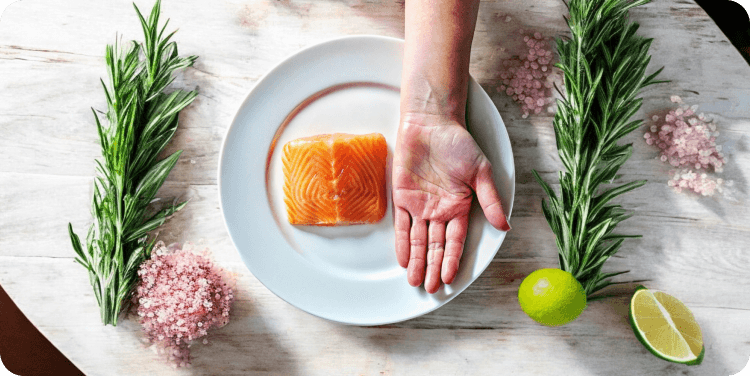
What it measures: A palm-sized portion of protein — the flat surface of your palm, excluding fingers, roughly the width and thickness of your hand.
What it represents: Approximately 85-110g of cooked protein — chicken, fish, beef, pork, tofu. This delivers roughly 20-30g of protein depending on the source.
Practical equivalents:
One palm = one chicken breast fillet (medium)
One palm = one piece of salmon fillet
One palm = two whole eggs (eggs are roughly palm-equivalent in protein terms)
One palm = a generous scoop of legumes (lentils, chickpeas, beans)
Why it's self-calibrating: Larger people have larger hands. A larger hand corresponds to a larger body with higher protein requirements. The palm method automatically adjusts for body size in a way that a fixed gram target does not.
The Fist — Vegetables and Fruits
What it measures: A closed fist — approximately one cup of non-starchy vegetables or one medium piece of whole fruit.
What it represents: The vegetable and fruit component of a meal. Non-starchy vegetables (leafy greens, broccoli, cauliflower, peppers, cucumber, zucchini, tomatoes) are low in caloric density and high in fiber and micronutrients — they can be consumed in larger quantities than other food groups without concern.
Practical use: The Harvard Plate Method asks for half a plate of vegetables and fruits. In hand terms, this corresponds to at least one to two fists of vegetables per meal, ideally more. The fist measure is a floor, not a ceiling, for vegetables.
For fruits: One fist = approximately one medium apple, pear, or orange. For berries or grapes, a fist is roughly what fits in a cupped hand.
The Cupped Hand — Grains and Carbohydrates
What it measures: A cupped hand — the palm curved upward to hold dry or cooked food — approximately half a cup of cooked grains or starchy carbohydrates.
What it represents: Cooked brown rice, quinoa, oats, whole wheat pasta, sweet potato, legumes used as carbohydrates. This is the grain quarter of the Harvard Plate.
Practical equivalents:
One cupped hand = approximately half a cup of cooked rice or quinoa
One cupped hand = one medium potato or sweet potato (roughly)
One cupped hand = half a cup of cooked pasta
Note on legumes: Legumes (lentils, chickpeas, beans) count in both the protein and carbohydrate categories. A cupped hand of legumes contributes to both. This is why a meal built around legumes as the protein source often feels more filling — you're getting protein and carbohydrate in one food.
The Thumb — Healthy Fats
What it measures: One thumb — from base to tip — approximately one tablespoon of fat.
What it represents: Oils, nut butters, nuts, seeds, avocado, cheese. Fats are calorie-dense, so a small volume carries significant nutritional and caloric weight.
Practical equivalents:
One thumb = approximately one tablespoon of olive oil
One thumb = approximately a tablespoon of nut butter
One thumb = approximately 10-12 whole almonds or cashews
Two thumbs = approximately one quarter of an avocado
The thumb measure is where most people under-count without realizing it. A generous drizzle of olive oil, a large spoonful of nut butter, or a handful of nuts can represent two to three thumb-sized portions in practice. This doesn't mean fats should be restricted — they're essential — but it's worth applying the thumb measure deliberately when using calorie-dense fat sources.
How the Palm Method Maps to the Harvard Plate
The palm method and the Harvard Plate Method are directly compatible — the hand measures provide a practical implementation tool for the plate proportions.
Harvard Plate Section | Palm Method | Target per meal |
|---|---|---|
Half plate — Vegetables & Fruits | Fist | 1-2+ fists of vegetables, 1 fist of fruit |
Quarter plate — Whole Grains | Cupped hand | 1-2 cupped hands |
Quarter plate — Protein | Palm | 1-2 palms |
Healthy fats (side) | Thumb | 1-2 thumbs |
In practice, a meal assembled with these measures will reliably approximate the Harvard Plate proportions — without measuring anything, without opening an app, and without knowing the caloric content of any individual food.
Why the Palm Method Is Self-Calibrating
One of the most practically significant properties of the palm method is that it automatically adjusts for body size.
A larger person has a larger hand. A larger hand produces larger portions. A larger body has higher caloric and nutritional requirements. The relationship between hand size and body size means that the palm method naturally delivers more food to people who need more, and less to people who need less.
This is the opposite of fixed gram targets (e.g., "eat 150g of protein per day"), which require calculation to adjust for body weight, and don't travel well because the gram amount varies by person. The palm method requires no calculation and produces appropriate portions by design.
A 2025 study in a free-living population found moderate to strong correlations between hand-based portion estimates and actual food consumption across multiple food categories, concluding that the hand scale can serve as an appropriate portion size estimation tool for nutrition education and practical dietary assessment.
"The palm method is what I teach almost every client as a starting point — not because it's perfect, but because it works in the real world. You can use it at a restaurant, at a family dinner, traveling, anywhere. That portability is what makes it actually useful for building lasting habits, rather than something that only works in controlled conditions." — Irene Astaficheva, certified nutritionist, co-founder of Eated
How Many Hand Portions Per Day?
The number of portions needed varies by body size, activity level, and goals. General starting points:
Women: 4-6 meals or eating occasions per day, each containing:
1 palm of protein
1 fist of vegetables
1 cupped hand of grains
1 thumb of healthy fats
Men: 4-6 meals or eating occasions per day, each containing:
2 palms of protein
2 fists of vegetables
2 cupped hands of grains
2 thumbs of healthy fats
These are starting frameworks, not fixed rules. More active people need more. Less active people may need less. The hand method provides a structure to adjust from — add a palm of protein if energy is low, reduce a cupped hand of grains if fat loss is a goal — without requiring calorie counting.
Using the Palm Method at Restaurants and Social Meals
This is where the palm method has its clearest advantage over weighing or tracking.
At a restaurant, before eating, do a quick visual scan: Is there roughly a palm of protein? A fist or more of vegetables? A cupped hand of grains? A thumb of visible fat? Adjust by adding or leaving food accordingly — ask for extra vegetables, leave some of the grain, add a side salad.
At a social meal, the same scan applies. You can't weigh the food, you can't look up the caloric content of someone's home-cooked stew — but you can roughly assess whether the plate has protein, vegetables, and grains in appropriate proportions, and eat accordingly.
This is why the palm method and the Harvard Plate work particularly well for communal eating — a context that calorie tracking handles poorly and that accounts for a significant proportion of real-world eating for most people.
Common Mistakes With the Palm Method
Using it as a calorie restriction tool. The palm method is a composition framework, not a calorie restriction framework. Restricting portion sizes to very small amounts in the name of "portion control" misuses the method. A palm of protein should actually be the size of your palm — not a deliberately small version of it.
Forgetting to apply it to all food groups. People tend to remember the protein palm and forget the fat thumb. The fat category is where unintentional over-consumption most commonly happens — oils added during cooking, nuts eaten directly from a bag, nut butter added by generous spoonfuls. Applying the thumb measure to fat sources is one of the highest-leverage applications of the method.
Treating it as all-or-nothing. The palm method doesn't require measuring every portion of every meal perfectly. Applying it to some meals is better than applying it to none. Using it as a loose reference — roughly a palm of protein, roughly a fist of vegetables — produces meaningful improvements in eating patterns without demanding perfection.
Not adjusting for hunger and satiety. The palm method provides a framework, not a fixed prescription. If you're genuinely hungry after a meal built around these portions, eat more. If you're full before finishing the portions, stop. The goal is to use the hand measures as a guide while still listening to hunger and fullness signals — exactly as intuitive eating and mindful eating emphasize.
The Palm Method and Eated's Plate Scan Feature
Eated's plate scanning feature is built on the same principle as the palm method: visual composition assessment rather than calorie counting. When you photograph a meal, the app evaluates plate balance — is there enough protein? Enough vegetables? Are the proportions approximately right? — rather than calculating a calorie total.
The palm method and the plate scan are complementary tools. Use the palm method when assembling a meal to get the proportions roughly right before eating. Use the plate scan as a check and for the personalized daily insight that helps you identify patterns across multiple meals over time.
Both operate without calorie databases, without weighing, and without the sustained cognitive effort that makes tracking unsustainable for most people.
Frequently Asked Questions
Is the palm method accurate enough for real results?
Research supports hand-based portion estimation as an appropriate tool for nutrition education and everyday dietary assessment. It's not as precise as weighing food — but calorie counting itself carries significant error (database inaccuracies, variability in home-cooked meals, restaurant portions). For general health goals, the palm method provides sufficient accuracy with dramatically less effort, and it's the only method that travels reliably outside the home kitchen.
How big should my palm portion of protein actually be?
Your flat palm, excluding fingers — roughly the width and thickness of your hand. For most adults, this corresponds to approximately 85-110g of cooked protein. Two palms would be appropriate for larger or more active individuals. The self-calibrating nature of the method means a larger person's palm naturally delivers a larger portion.
Can I use the palm method if I'm trying to lose weight?
Yes. The palm method can support fat loss goals by providing portion structure without the psychological burden of calorie counting. The key adjustments for fat loss are typically to ensure adequate protein (at least one palm per meal) and to be deliberate about fat portions (one thumb, applied to cooking oils and added fats). Vegetables are essentially uncapped — more is fine.
Does the palm method work for plant-based eating?
Yes, with one adjustment: legumes (lentils, chickpeas, beans, tofu) serve as the protein source and count as both a protein palm and a carbohydrate cupped hand in the same food. A cupped hand of lentils delivers both protein and carbohydrate, so plant-based meals often use a cupped hand for the protein/grain combination rather than a separate palm and cupped hand.
How does the palm method compare to the Harvard Plate Method?
They are complementary, not competing. The Harvard Plate Method provides the compositional framework — half vegetables, quarter protein, quarter grains. The palm method provides the practical measurement tool for implementing that framework without a scale. Used together, they give you both the structure and the portability needed for consistent, sustainable eating.
The Bottom Line
The palm method is the most practical portion control system available for everyday life — not because it's perfect, but because it works outside a controlled kitchen, requires no equipment, adjusts automatically for body size, and can be applied consistently across restaurants, social meals, travel, and every other eating context that calorie tracking fails to handle.
Used alongside the Harvard Plate Method, it provides both the compositional framework and the measurement system for building genuinely balanced meals — without weighing anything.
If you want to start building the habits that make these tools automatic rather than effortful, the free Habit Wheel is a five-minute starting point. Or download Eated on the App Store and begin your 7-day free trial.