Stopping calorie counting is simpler than most people expect — and more effective than continuing it. The evidence consistently shows that composition-based and intuitive approaches to eating produce comparable or better long-term outcomes than calorie restriction, with significantly less psychological burden. The practical steps are straightforward: shift from numerical tracking to visual frameworks, rebuild your connection to hunger and fullness signals, and give yourself enough time to trust the transition.
This post covers exactly how to do that — including why stopping feels scary even when it's the right move, what to replace tracking with, and what to expect in the weeks after you stop.
Why Stopping Feels Scary
If you've been counting calories for months or years, the numbers have become your primary reference point for food. They feel like control — evidence that you're doing something, that progress is measurable, that you know what's happening.
Stopping removes that reference point. The fear that follows — "I'll lose control," "I'll gain weight," "I won't know what I'm doing" — is real and understandable. It's also, in most cases, unfounded.
Research on intuitive eating and weight stability consistently shows that people who shift to non-tracking approaches do not, on average, experience significant weight gain. A longitudinal study following over 1,800 adults over three years found that people with higher intuitive eating scores were more likely to maintain stable weight and less likely to overeat over time — without tracking anything.
The fear of losing control is typically a reflection of how much calorie counting has been doing the behavioral work — and how little of that work has been internalized as automatic behavior. Stopping doesn't mean losing control. It means transferring the work from the app to yourself.
"Almost every client who tells me they're scared to stop counting calories has been counting for more than a year. By that point, they know a lot about food — they just don't trust that knowledge without the number confirming it. The goal of stopping is to start trusting what you already know." — Irene Astaficheva, certified nutritionist, co-founder of Eated
What Calorie Counting Actually Did For You
Before dismissing calorie tracking entirely, it's worth being honest about what it provided — because those functions still need to be served after you stop.
Awareness. Logging food creates awareness of what you're actually eating — portion sizes, hidden calories in sauces and oils, the caloric density of processed foods. This is genuinely useful, particularly in the early weeks of changing eating habits.
Structure. A daily calorie target gives the day a framework. Without it, meals can feel undefined and decisions can feel harder.
Accountability. Logging creates a record that's harder to ignore or rationalize away.
None of these functions disappear when you stop counting. They need to be replaced with something that delivers the same functional benefit without the daily numerical tracking. The good news is that all three can be maintained through more sustainable approaches — approaches that don't require you to enter every meal into an app for the rest of your life.
The Transition: How to Stop Counting Gradually
Stopping abruptly can feel destabilizing, especially after long-term tracking. A gradual transition is easier to sustain and gives you time to build the alternative reference points before removing the old ones entirely.
Step 1: Stop logging one meal per day. Choose the meal where tracking feels most burdensome or most disconnected from reality — for many people, this is dinner, which often involves shared food, restaurant meals, or home cooking with variable ingredients. Stop logging that meal. Keep tracking everything else. Do this for one to two weeks.
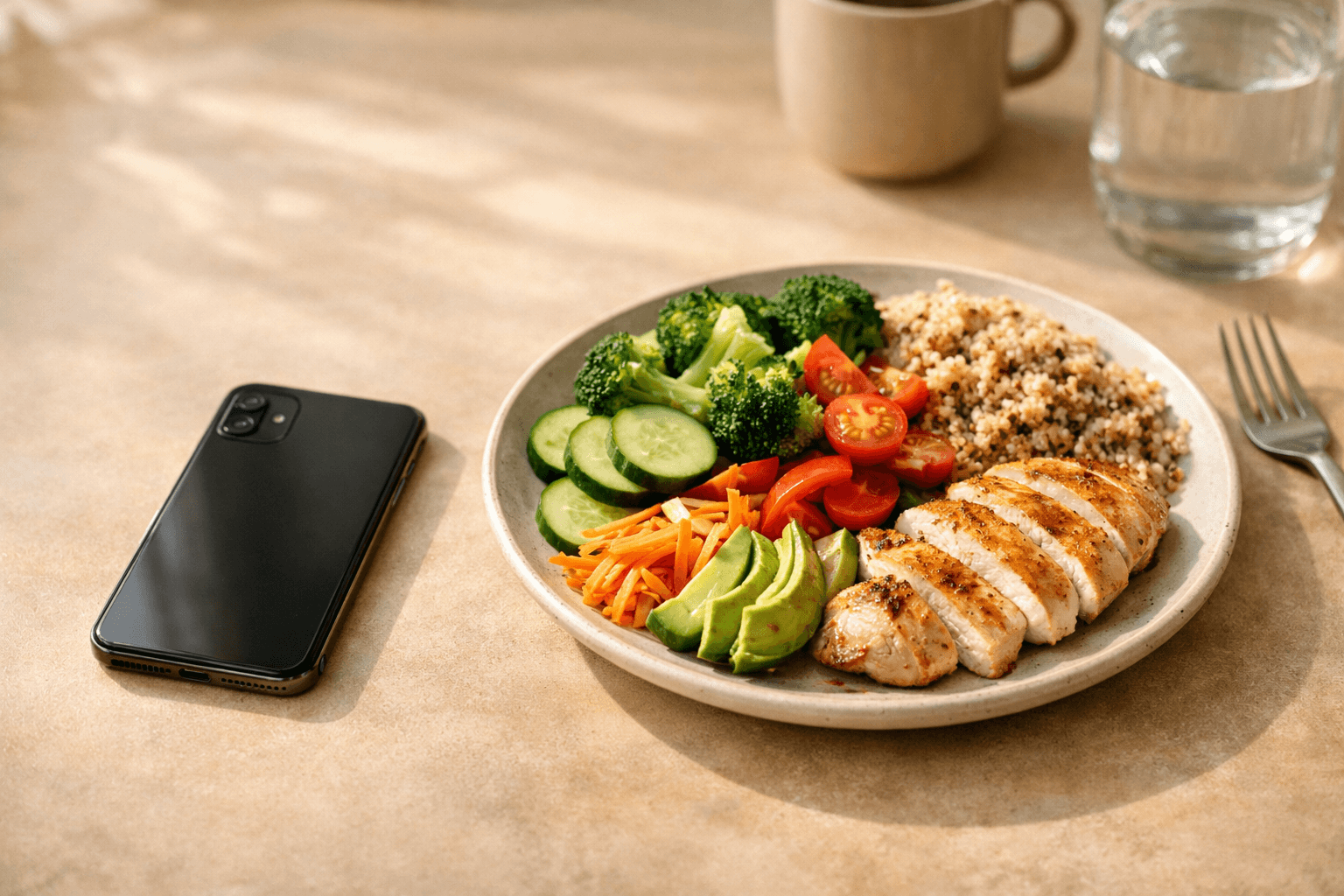
Step 2: Replace logging with visual plate assessment. Before eating a meal you've stopped tracking, take five seconds to look at the plate and assess: is there roughly half vegetables and fruits? A quarter protein? A quarter grain? This visual check — drawn from the Harvard Plate Method — replaces the numerical target with a compositional one. It takes no time and requires no database.
Step 3: Add hunger and fullness check-ins. Before eating, rate your hunger from 1 (not hungry at all) to 10 (extremely hungry). After eating, rate your fullness. Do this for the meals you've stopped logging. The goal isn't to eat only at specific numbers — it's to rebuild the habit of noticing your physical state before and after eating, which tracking had replaced.
Step 4: Stop logging the second meal. After one to two weeks, drop tracking from another meal. Continue the visual plate assessment and hunger check-ins. Repeat until you're no longer logging any meals.
Step 5: Uninstall the app (optional but recommended). For many people, having the app present — even unused — creates a pull to return to logging during moments of anxiety. Removing it removes the option as a stress response and completes the transition psychologically.
The full transition typically takes four to eight weeks done this way. It's slower than stopping immediately, but it's more durable — you build the alternative skills before fully removing the old safety net.
What Replaces Calorie Counting
Three tools cover the core functions that calorie tracking provided:
1. The Harvard Plate Method — For Structure and Composition
The Harvard Plate Method is an evidence-based visual framework for meal composition developed by Harvard T.H. Chan School of Public Health. Half the plate is vegetables and fruits. A quarter is whole grains. A quarter is healthy protein. Healthy fats on the side.
This replaces the numerical calorie target with a compositional structure that:
Ensures nutritional balance without requiring database knowledge
Works in any eating context — home, restaurant, social meals, travel
Requires no ongoing effort to maintain once internalized
Does not attach moral judgment to food
For more detail on how the method works and how to apply it, see our complete guide to the Harvard Plate Method.
2. The Palm Method — For Portion Awareness Without Weighing
The palm method uses your hand as a self-calibrating portion reference:
Palm = protein portion
Fist = vegetable or fruit portion
Cupped hand = grain portion
Thumb = fat portion
This replaces the gram-level precision of food weighing with a visual estimate that's accurate enough for everyday eating, requires no equipment, and works anywhere. Because hand size correlates with body size, it automatically adjusts for individual differences in the way that fixed gram targets do not.
3. Hunger and Fullness Awareness — For Quantity Regulation
Calorie counting provided an external quantity limit. The sustainable alternative is restoring internal quantity regulation — your body's own hunger and fullness signals.
This is the core skill of both intuitive eating and mindful eating: noticing when you're physically hungry before eating, and noticing when you're comfortably full during eating. These signals exist in everyone — they've often been suppressed or overridden by years of following external rules, but they rebuild with practice.
The simplest practice: before eating, pause and check in physically. Is there genuine hunger? During eating, pause halfway through and ask: how full am I? The signals become more reliable and more trustworthy over weeks of consistent attention.
What to Expect When You Stop
The first two to four weeks after stopping calorie tracking often feel uncertain. This is normal and temporary.
You may eat more than usual for a short period. People who have been in long-term caloric restriction often experience a period of increased appetite when restriction lifts. This is not a loss of control — it's the body's natural response to having been under-fueled, and it typically stabilizes within a few weeks as intake normalizes.
Food decisions will feel harder initially. Without a numerical reference, you're making decisions based on different information — hunger, composition, satisfaction — that take time to become fluent. This gets easier. After a few weeks of consistent visual assessment and hunger check-ins, the decisions become more automatic.
The scale may fluctuate. Water retention, glycogen stores, and digestive changes can all affect short-term weight. This is not fat gain. For most people who stop calorie tracking and adopt a composition-based approach, weight stabilizes within four to six weeks.
Anxiety around food tends to decrease over time. Research comparing calorie counting and intuitive eating in college students found that more frequent calorie counting predicted increased eating disorder symptom severity, while higher intuitive eating scores predicted lower severity. The psychological relief of not counting daily is a consistent finding across studies — but it takes time to feel it, because the anxiety often spikes initially before it falls.
When Calorie Counting Might Still Make Sense
This guide is honest: stopping calorie tracking is not the right move for everyone.
Performance athletes with specific body composition goals. Athletes who need to hit precise macronutrient targets — particularly protein timing around training — benefit from the data precision that tracking provides. For this population, the accuracy matters enough to justify the effort.
Short-term dietary awareness. Tracking for two to four weeks when changing eating habits can be genuinely useful for identifying patterns — where calories are concentrated, what meals are nutritionally incomplete, how food choices vary between weekdays and weekends. As a temporary audit, it has value.
Medical nutrition therapy. People managing conditions that require specific nutrient monitoring — kidney disease requiring careful potassium tracking, for example — may need to track specific nutrients under clinical guidance. This is different from general calorie counting for weight management.
If stopping immediately increases anxiety significantly. For some people, particularly those with a history of disordered eating, moving too quickly away from tracking can be destabilizing. A gradual transition with professional support — from a registered dietitian familiar with eating behavior — is the appropriate path.
If you're in any of these categories, the goal isn't to stop counting — it's to eventually reach a place where the tracking serves specific purposes rather than being an indefinite requirement for eating normally.
Frequently Asked Questions
How do I stop counting calories without gaining weight?
Replace calorie tracking with composition-based eating — the Harvard Plate Method provides the structure, and the palm method provides the portion reference. Both prevent the unstructured eating that people fear when they stop tracking. Research consistently shows that people who shift to composition-based and intuitive approaches do not experience significant weight gain on average, and often achieve more stable weight outcomes than chronic calorie counters.
What should I track instead of calories?
Track composition rather than calories. Before eating, take five seconds to assess: is there protein? Vegetables? Grains in appropriate proportions? This visual check is the most sustainable form of "tracking" — it takes no time, requires no app, and works in any eating context. Optionally, track hunger before meals and fullness after as a way to rebuild internal quantity regulation.
Is it OK to stop counting calories?
For most people with general healthy eating goals, yes. The evidence supports composition-based and intuitive approaches as producing equivalent or better long-term outcomes than calorie restriction, with significantly less psychological burden. The exception is specific clinical or performance contexts where precision tracking has a clear purpose.
How long does it take to feel comfortable not tracking?
Most people feel significantly more comfortable within four to six weeks of a gradual transition. The first two weeks are typically the most uncertain. By weeks four through eight, the alternative frameworks — visual plate assessment, hunger check-ins — become more habitual and the absence of tracking feels less like a gap and more like a normal state.
What do I eat when I stop counting calories?
The same food you ate before — but organized around composition rather than calorie targets. Half the plate is vegetables and fruits. A quarter is whole grains. A quarter is healthy protein. Healthy fats on the side. If you were eating reasonably balanced meals while tracking, you'll continue eating similarly — just without the numerical accounting. If your tracked diet was heavily restricted or nutritionally imbalanced, moving to a composition framework may involve some adjustment.
The Bottom Line
Calorie counting works as a temporary awareness tool. As a permanent strategy for eating well, it has a poor track record — most people who rely on it long-term eventually abandon it, and the abandonment often results in more disordered eating than if they'd never started.
The alternative is a composition-based approach: the Harvard Plate for structure, the palm method for portions, hunger and fullness awareness for quantity. These tools work in the real world — at restaurants, social meals, and difficult days — in a way that calorie counting never reliably does.
If you're ready to make the transition, the free Habit Wheel helps identify which eating habit to build first as you shift away from tracking. Or download Eated on the App Store — it's built specifically for people moving from calorie counting to habit-based eating, with plate scanning instead of logging and daily insights instead of calorie targets.