
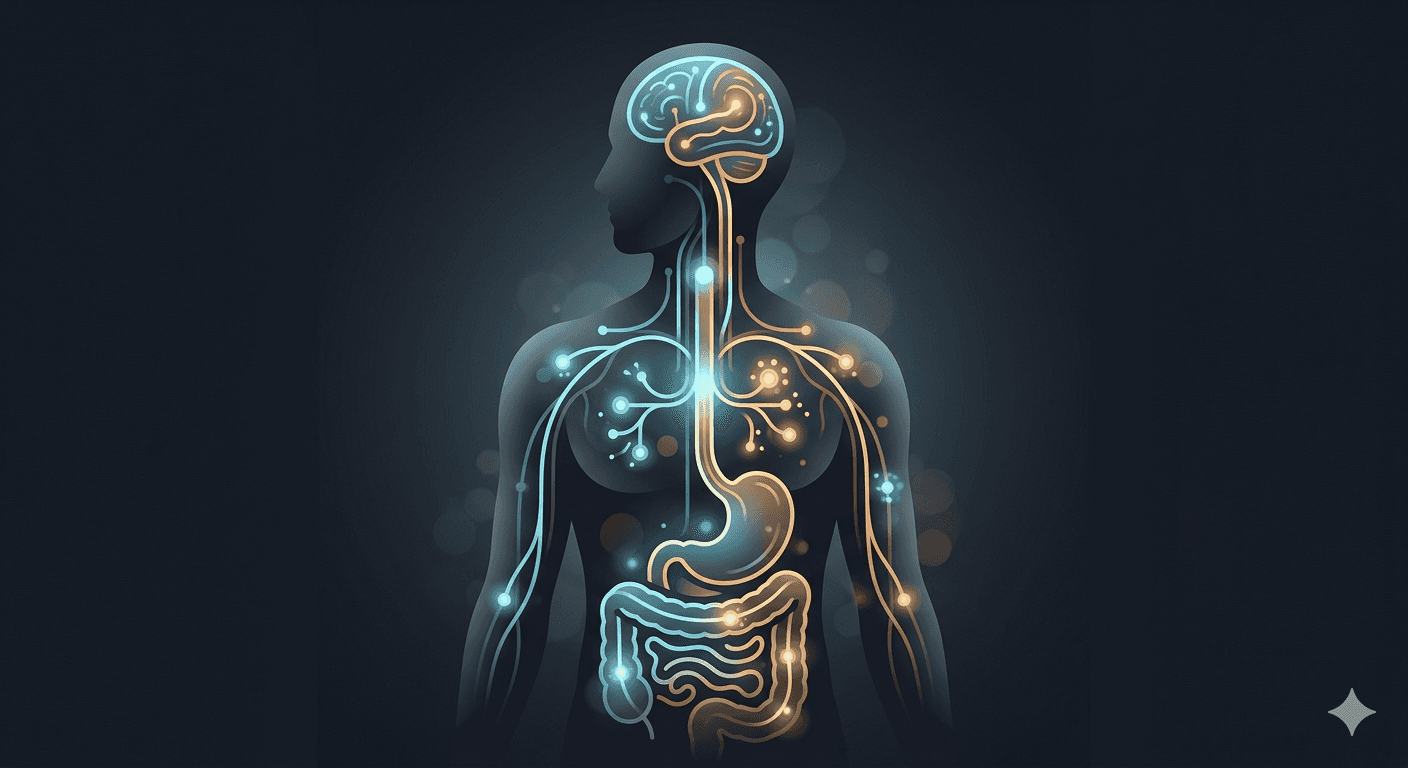
When a diet stops working — when hunger becomes unmanageable, willpower runs out, and weight comes back — most people blame themselves. The research tells a different story. Caloric restriction produces predictable hormonal changes that make hunger worse the longer you diet: ghrelin rises, leptin falls, and the brain receives increasingly urgent signals to eat more. This isn't weakness. It's biology responding exactly as designed — and understanding it changes what a sustainable approach to eating actually looks like.
The Two Hormones That Run the Show
Your hunger and fullness are regulated primarily by two opposing hormones: ghrelin, which signals hunger, and leptin, which signals satiety and long-term energy sufficiency. They operate through the hypothalamus — the brain region that controls appetite, energy balance, and metabolism.
Ghrelin is produced mainly in the stomach. Its levels rise before meals and fall after eating. It's a short-acting signal — meal to meal — telling the brain it's time to eat. When you're in a caloric deficit, ghrelin doesn't just signal hunger at mealtimes: it elevates consistently across the day, increasing baseline hunger regardless of when you last ate.
Leptin is produced by fat cells, in proportion to how much fat you're carrying. Its role is long-term: it tells the brain that energy stores are adequate and that appetite can be suppressed. When you lose body fat — through dieting — leptin levels fall, and the satiety signal weakens. The brain interprets falling leptin as a threat to survival and responds by increasing appetite, reducing metabolic rate, and making the body more efficient at storing energy from whatever food is consumed.
Together, these two hormones create what researchers call adaptive thermogenesis — the body's counter-response to caloric restriction that makes sustained weight loss progressively harder the longer a diet continues.
What Actually Happens When You Diet
The hormonal response to caloric restriction has been studied directly, and the findings explain a lot.
A landmark study published in the New England Journal of Medicine measured 24-hour ghrelin profiles in subjects before and after a six-month dietary weight loss program. After losing 17% of their initial body weight, participants showed a 24% increase in 24-hour ghrelin levels. The hunger hormone didn't just stay elevated after meals — it elevated across the entire day.
A more recent clinical study from the DiRECT trial found that the rise in ghrelin during diet-induced weight loss was a significant predictor of subsequent weight regain — and that ghrelin levels remained elevated over follow-up, suggesting a persistent compensatory drive. Of all the hormones measured, ghrelin alone predicted who regained.
A 2025 meta-analysis across 127 studies confirmed the pattern: weight loss through caloric restriction consistently increases total ghrelin, with greater weight loss associated with greater ghrelin elevation.
The mechanism is not subtle. Caloric restriction triggers a hormonal response specifically designed to reverse the deficit. The body doesn't distinguish between intentional dieting and famine — it responds to both the same way.
Why Leptin Resistance Makes This Worse
Leptin resistance is a condition where fat cells are producing adequate leptin, but the brain stops responding to the signal properly. It's common in people with overweight or obesity, and it creates a paradox: leptin levels are high — indicating significant fat stores — but the brain behaves as if it's receiving no satiety signal and continues driving hunger.
Research on leptin and ghrelin in obesity shows that obese individuals typically have elevated circulating leptin but impaired leptin signaling — the brain is resistant to what should be a powerful satiety signal. Meanwhile, ghrelin levels are lower than expected in obesity (another paradox) but become highly responsive after any weight loss attempt, rising sharply and staying elevated.
The practical implication: for many people, hunger during dieting isn't a character issue. The hormonal system is actively working against the deficit, and the brain is receiving genuine, biological hunger signals regardless of what the plan says to eat.
What This Means for Approach
The hormonal response to restriction is the core reason most diets fail long-term. The question isn't whether the biology is real — it clearly is — but what to do about it.
Three approaches have research support for working with hunger hormones rather than against them:
1. Composition over restriction
The ghrelin response is triggered by caloric restriction, not by food composition. A dietary approach that improves food quality — more protein, more fiber, more vegetables — without aggressively cutting total intake produces a much smaller ghrelin response than the same caloric deficit achieved through restriction of portions across the board.
Protein specifically has a robust effect on satiety hormones: it produces the strongest release of GLP-1, PYY, and CCK (the gut hormones that signal fullness), and it suppresses ghrelin more effectively than equivalent calories from carbohydrates or fat. Making protein the anchor of every meal — a palm-sized portion at breakfast, lunch, and dinner — is the single most impactful dietary change for managing hunger without aggressive restriction.
2. Consistent meal timing
Ghrelin follows a conditioned pattern: it rises in anticipation of habitual meal times and falls after eating. Irregular eating — skipping meals, eating at inconsistent times — disrupts this pattern and produces higher baseline ghrelin and more unpredictable hunger. Eating at consistent times conditions ghrelin to rise when food is coming, rather than at random.
3. Habit-based change rather than restriction-based change
The fundamental problem with restriction as a primary strategy is that it triggers the compensation mechanism directly. Approaches that improve eating quality without creating a large acute deficit — adding vegetables and protein to meals, eating more slowly, building variety — produce meaningful improvements in dietary patterns without the full ghrelin compensation response.
"Understanding the hormonal side of hunger is, in my experience, the most important shift I can help clients make. When someone understands that the hunger they feel on a restrictive diet is a biological response — not a character flaw — it changes the whole conversation. We stop trying to fight the biology and start designing an approach that doesn't trigger the same response." — Irene Astaficheva, PN1, GGS-1, co-founder of Eated
How Eated's Approach Relates to This
The Harvard Plate framework that underlies Eated works through composition change rather than restriction — filling half the plate with vegetables and fruits, a quarter with protein, a quarter with whole grains. This produces a natural reduction in calorie-dense foods without triggering the acute caloric restriction that elevates ghrelin. The Eat Enough Protein and Eat More Veggies habits in Eated are designed to build exactly this kind of compositional change — as automatic eating patterns rather than daily decisions.
The result isn't dramatic fast weight loss. It's a gradual shift in what feels like a normal plate — which changes the baseline without triggering the hormonal compensation that undoes restriction-based approaches.
If restriction-based dieting has repeatedly left you more hungry and back where you started — the biology above explains why, and a different approach is worth trying.
Download Eated free on the App Store → · 7-day free trial · $9.99/month or $59.99/year after trial
Honest Limitations
Ghrelin and leptin are the two best-studied hunger hormones, but appetite regulation involves many more signals — including GLP-1, PYY, CCK, insulin, cortisol, and others. This guide focuses on ghrelin and leptin because they have the strongest research base and the most direct relevance to why dieting produces hunger compensation.
The research on hormonal adaptation to caloric restriction is robust at the population level. Individual variation is significant — not everyone's ghrelin rises identically with restriction, and other factors (sleep, stress, exercise) affect hunger hormone levels substantially. The general pattern is well-established; the specific magnitude varies.
GLP-1 receptor agonists (like Ozempic/semaglutide) work partly by suppressing ghrelin and amplifying satiety hormone signaling — which is why they're effective for weight loss but also why they don't address the underlying eating patterns that determine what happens when the medication stops.
FAQ
What is ghrelin and why does it matter for weight loss? Ghrelin is the primary hunger-stimulating hormone, produced mainly in the stomach. Its levels rise before meals and in response to caloric restriction. During dieting, ghrelin doesn't just rise at mealtimes — it elevates consistently across the day, making hunger harder to manage the longer a diet continues. The DiRECT trial found that ghrelin elevation during weight loss was the single best predictor of who would regain weight afterward.
Why does dieting make you hungrier? Caloric restriction triggers a predictable hormonal response: ghrelin rises (more hunger) and leptin falls (weaker satiety signal). This is an evolutionary adaptation — the body responds to a caloric deficit as it would to famine, increasing the drive to eat and improving energy storage efficiency. The response doesn't distinguish between intentional dieting and actual food scarcity.
What is leptin resistance? Leptin resistance occurs when fat cells are producing adequate leptin but the brain stops responding to the signal correctly. It's common in people with overweight or obesity. The result is that the brain behaves as if it's receiving no satiety signal despite elevated leptin levels — driving continued hunger and appetite even when energy stores are sufficient.
Does eating more protein help with hunger hormones? Yes. Protein produces a stronger and longer-lasting satiety hormone response (GLP-1, PYY, CCK) than equivalent calories from carbohydrates or fat, and suppresses ghrelin more effectively post-meal. Making protein the anchor of every meal is the most evidence-based dietary strategy for managing hunger without aggressive caloric restriction.
Can you change your hunger hormones without medication? Yes, to a meaningful degree. Consistent meal timing conditions ghrelin patterns. Adequate protein at every meal reduces ghrelin response and improves satiety signaling. Building consistent eating habits around food quality rather than restriction avoids triggering the full ghrelin compensation response. Sleep significantly affects ghrelin — poor sleep raises ghrelin and lowers leptin, which is why sleep deprivation reliably increases appetite and caloric intake the following day.
Bottom Line
Hunger during dieting isn't a willpower problem. It's a predictable biological response to caloric restriction — ghrelin rises, leptin falls, and the brain receives increasingly urgent signals to eat. Understanding this mechanism explains both why restriction-based diets fail at the rates they do, and what a more durable approach looks like: improving food composition without triggering the hormonal compensation that undoes the deficit.
Want a structured approach that works with your biology instead of against it?
Download Eated free on the App Store · Free to download · 7-day free trial · $9.99/month or $59.99/year after trial