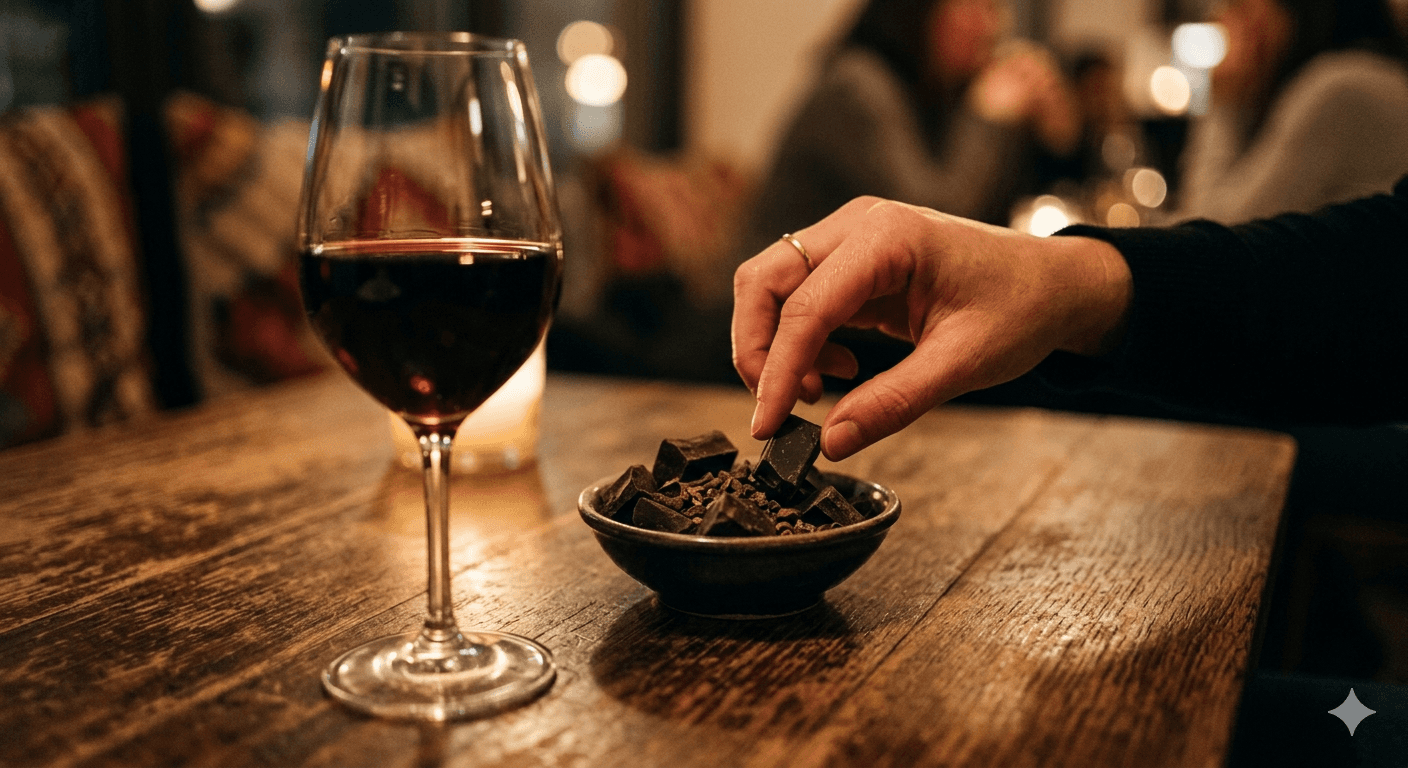
If you've cut back on alcohol and found yourself reaching for chocolate, sweets, or carb-heavy food more than usual, you're not imagining it and you're not failing. The craving is neurobiological. Alcohol and sugar activate the same dopamine reward pathways in the brain — which means when one source of dopamine drops, the brain seeks the other. Understanding the mechanism is the first step to working with it rather than against it.
The Shared Reward Pathway
Alcohol produces its pleasurable effects primarily through dopamine release in the nucleus accumbens — the brain's reward center. Dopamine is the neurochemical that signals reward, motivation, and pleasure. Regular alcohol consumption trains the brain to expect dopamine from this source.
Research on alcohol and dopamine confirms that even low doses of alcohol can increase dopamine release in the nucleus accumbens — and that alcohol-related stimuli maintain their motivational significance even after repeated exposure, which is part of what makes alcohol habits persistent.
Sugar activates the same pathway. A ScienceDirect study on daily associations between alcohol and sweets craving found that overconsumption of sweet foods potentiates dopamine release in the nucleus accumbens in the same way alcohol does — and that "sugar and alcohol may be competing for overlapping dopaminergic reward pathways." The practical consequence: abstinence from one tends to increase intake of the other. This cross-substitution has been observed in both animal studies and human clinical populations.
When you reduce alcohol — even moderately, as part of a sober curious approach rather than full abstinence — the dopamine input your brain was receiving from alcohol decreases. The brain doesn't simply accept this reduction. It looks for the next available dopamine source. And sugar, which is immediately available, immediately rewarding, and activates the same pathway, is the obvious candidate.
Why This Happens Even with Moderate Reduction
This mechanism is not limited to people with alcohol use disorder. It operates at lower levels of consumption change as well.
When habitual alcohol intake drops — even from moderate to low — the brain's reward calibration shifts. If alcohol was reliably providing a dopamine signal at the end of the day (the glass of wine after work, the beer with dinner), removing that signal creates a neurochemical gap. The body registers the absence as a deficit, not as a neutral state.
Research on ghrelin signaling and alcohol-sugar relationships identified that alcohol-dependent individuals have higher cravings for sweets than healthy controls — and that the hedonic response to sweet taste is linked to the same reward circuitry that drives alcohol consumption. The genetic factors underlying sweet preference and alcohol preference overlap meaningfully.
For people reducing alcohol as a lifestyle choice — not from dependency — the mechanism is milder but the same in direction. The habit of an evening drink also carries a behavioral component: a specific time, a specific context, a specific ritual. When the drink is removed, both the dopamine signal and the behavioral cue are disrupted. The brain seeks both a substitute reward and a substitute ritual. Sweet foods fill both roles quickly.
The Blood Sugar Layer
There is a second mechanism operating alongside the dopamine pathway: blood sugar regulation.
Regular alcohol consumption affects insulin sensitivity and blood glucose metabolism. Alcohol causes an initial blood sugar spike followed by a drop — particularly when consumed without food. Over time, the body adapts to this pattern. When alcohol intake decreases, the habitual blood sugar fluctuation changes, and the body may signal for quick sugar to compensate for what it expects.
Additionally, alcohol contains calories — often significant ones — that the body was using as fuel. Reducing alcohol reduces this caloric input, which can produce genuine physiological hunger or low-energy states that the body interprets as a need for quick energy. Sugar is the fastest available response to that signal.
This blood sugar dynamic is distinct from the dopamine mechanism but compounds it: reduced alcohol → reduced caloric input + altered blood sugar patterns → physiological craving for quick energy → sugar.
What This Means Practically
The sugar craving when reducing alcohol is real, physiologically driven, and not a sign that you're doing something wrong. It's a predictable neurochemical response to a change in reward input.
What it is not: a permanent state. The dopamine system recalibrates. As the brain adjusts to lower or no alcohol input, the compensatory sugar-seeking typically diminishes — usually within 2-4 weeks of consistent change. The challenge is navigating that window without building a new problematic habit to replace the old one.
The substitution problem: The risk is not the temporary craving — it's automatic substitution. If the evening drink is replaced automatically with evening chocolate or sweets, a new habit loop forms in the same cue-reward structure: same time, same context, same ritual, different substance. The habit loop — cue, routine, reward — doesn't care what the routine is. It will establish whatever behavior consistently follows the cue.
The practical response: Building an intentional substitute rather than defaulting to an automatic one. The substitute needs to deliver something genuinely rewarding to the brain — not just a distraction. Options that work neurochemically: exercise (direct dopamine release), social connection (social reward circuitry), engaging activity (novelty-driven dopamine). Options that are lower risk than sugar but still rewarding: sparkling water with flavor, herbal tea with ritual, dark chocolate in a controlled amount (not the whole bar by default).
The Emotional Eating Overlap
The evening drink often also serves as emotional regulation — decompression, stress relief, the signal that the workday is over. When it's removed without an equivalent emotional regulation tool in place, the underlying emotional need remains. Sugar addresses that need quickly and reliably in the short term.
This is where the sugar craving after reducing alcohol stops being purely neurobiological and starts being emotional eating — food used to manage emotional states rather than physical hunger. The distinction matters because the intervention differs: the dopamine mechanism responds to time and neurobiological recalibration; the emotional mechanism responds to building alternative emotional regulation tools.
If the sugar craving happens primarily in a specific emotional context — at a particular time of day, after a stressful event, when alone — the emotional layer is significant. If it's more general and time-independent, the physiological mechanism is more likely primary.
What to Eat During the Adjustment Period
During the 2-4 week recalibration window, specific nutritional choices help stabilize the blood sugar and dopamine dynamics:
Protein at every meal. Protein supports dopamine synthesis — it provides tyrosine and phenylalanine, the amino acid precursors to dopamine. It also stabilizes blood sugar, reducing the physiological sugar-seeking driven by glucose fluctuation. A palm-sized portion of protein at each eating occasion provides both benefits.
Complex carbohydrates over refined ones. If carbohydrate craving is strong — and it often is — whole grains, legumes, and starchy vegetables provide the glucose the body is seeking without the sharp spike and crash that refined sugar produces. The serotonin-raising effect of carbohydrates (which drives some sugar craving, particularly in the evening) is achievable with complex carbohydrates.
Don't restrict aggressively during this period. Calorie restriction adds stress, which elevates cortisol, which drives dopamine-seeking and sugar craving. The goal is stability, not simultaneous calorie cutting. Removing alcohol already creates a caloric reduction for most people.
Consistent meal timing. Eating at regular intervals prevents the blood sugar dips that the body interprets as urgency for sugar. The skip-then-crave pattern — common during alcohol reduction when appetite is disrupted — compounds the sugar craving significantly. Addressing boredom eating patterns that often emerge in the evening slot previously occupied by alcohol is also worth doing deliberately in this period.
"The sugar craving after cutting back on alcohol is one of the most common things people don't expect. They think they're replacing one vice with another. The reality is their brain is looking for the dopamine source that disappeared, and sugar is the fastest available option. Understanding that it's chemistry, not character, changes how people respond to it — and makes it much easier to work through."
— Irene Astaficheva, PN1, PN-SSR, GGS-1
Honest Limitations
This post covers the neurobiological and behavioral mechanisms behind sugar cravings when reducing alcohol. It is written for people making lifestyle changes around alcohol consumption — not for people in recovery from alcohol use disorder, where the mechanisms are more pronounced and clinical support is appropriate.
If sugar cravings after reducing alcohol are severe, persistent beyond 4-6 weeks, or accompanied by significant mood disturbance, it's worth discussing with a GP. This can indicate underlying blood sugar regulation issues, nutrient deficiencies from prior alcohol consumption, or other factors that warrant medical assessment.
The research on the alcohol-sugar dopamine overlap is primarily from clinical and addiction populations. The magnitude of the effect in moderate drinkers making voluntary reductions is less studied — direction is consistent, magnitude may vary.
FAQ
Is it normal to crave sugar more after cutting back on alcohol? Yes — and it's well-documented neurobiologically. Alcohol and sugar activate the same dopamine reward pathways. When alcohol input decreases, the brain seeks dopamine from the next available source. Sugar is fast, available, and activates the same circuitry. The craving is predictable and temporary — it typically diminishes as the brain recalibrates over 2-4 weeks.
Why do I specifically want sweets in the evening after stopping drinking? Because that's when the alcohol cue was active. The evening context — specific time, often specific location, often post-work routine — is a conditioned cue that previously triggered drinking. When the drink is removed, the cue still fires. The brain looks for a reward in that context. Sugar fills the slot. This is a habit loop problem as much as a neurochemical one — the cue-reward structure needs a deliberate substitute, not just an absence.
Will the sugar craving go away on its own? Largely yes, if you don't build a habitual substitute. The dopamine system recalibrates within weeks when a reward source is consistently removed. If every evening the alcohol is replaced with sweets, the craving doesn't go away — it transfers. If the replacement is something less automatically rewarding, the craving diminishes as the original cue loses its potency.
Should I just let myself eat sugar during this period? Moderate amounts of complex carbohydrates and dark chocolate are unlikely to cause harm during a 2-4 week adjustment. Unrestricted high-sugar intake during this period risks building a new habitual pattern in the same behavioral slot. The goal is a deliberate substitute rather than automatic substitution.
Does this happen with everyone who reduces alcohol? The mechanism operates in everyone neurobiologically, but the behavioral expression varies considerably. People who drank primarily socially, occasionally, or without strong routine attachment will notice less effect than people whose drinking was habitual, regular, and associated with a specific daily cue. The stronger the original habit loop, the more pronounced the substitution-seeking.
Bottom Line
Sugar cravings when reducing alcohol are neurobiological, not moral. The brain's reward system lost a dopamine source and is looking for the nearest substitute. That substitute is sugar — fast, available, and activating the same pathway.
The craving is temporary. The risk is automatic substitution creating a new habitual pattern. The practical response is building a deliberate substitute — one that delivers genuine reward through a different mechanism — and supporting the neurochemical recalibration with protein-rich, blood-sugar-stable eating during the adjustment window.
Download Eated
If you want to build consistent eating habits during a period of change — one behavior at a time, with daily structure — the Eated app is free to download on iOS. 7-day free trial · $9.99/month or $59.99/year after.