Calorie counting apps dominate the weight loss app market. They're well-designed, well-marketed, and they work — in the short term, for the right person. The problem is that "the right person" is a smaller group than the marketing implies. For people who find calorie tracking anxiety-inducing, obsessive, or simply unsustainable past eight weeks, the app market offers alternatives that have become meaningfully more sophisticated in 2025 and 2026. This guide covers who those apps are for, how they work, and which one is most likely to produce results for your specific situation.
First: Does Weight Loss Without Calorie Counting Actually Work?
This is the question that matters before comparing apps. If the approach doesn't work, the app selection is irrelevant.
The evidence is clear: non-calorie-counting approaches can produce comparable weight loss to calorie restriction over 12 months. A 2019 Obesity Reviews meta-analysis — covering 21 randomized controlled trials — found that mindfulness-based eating programs produced weight loss outcomes comparable to conventional diet programs. A 2022 DIETFITS trial compared low-fat versus low-carbohydrate diets — neither group counted calories — and both produced significant weight loss with similar outcomes. The quality and structure of what you eat produces a deficit without arithmetic.
A 2022 systematic review and meta-analysis covering 23 randomized controlled trials on smartphone weight loss apps found apps produced sustained weight loss at 3 months (2.18 kg) and 12 months (1.63 kg) — and critically, the most effective apps included components beyond food logging: behavioral coaching, habit formation, personalized feedback, and real-time monitoring. The apps that produced durable results weren't just trackers. They were behavior change systems — exactly what building sustainable eating habits actually requires.
For non-counters, this is the key distinction: a weight loss app that removes calorie counting but doesn't replace it with a behavioral mechanism is just an app with missing features. The ones that work replace counting with something equally systematic.
Who Should NOT Count Calories
Before listing alternatives, it's worth being direct about who calorie counting is genuinely contraindicated for — not just suboptimal, but likely harmful.
History of disordered eating. Research linking calorie tracking and eating disorder severity found significant associations between calorie tracking behaviors and disordered eating patterns — specifically restriction, guilt, and elevated eating disorder symptom scores. For people with any history of restrictive eating, orthorexia, binge-restrict cycling, or clinical eating disorders, calorie tracking apps are not a neutral tool — understanding what emotional eating actually is is more relevant than finding a better tracker. They're a risk.
Anxiety-driven eating patterns. For people whose eating difficulties center on food anxiety rather than overconsumption, adding a numerical monitoring system increases food preoccupation rather than reducing it. The monitoring mechanism that calorie counting provides is the same mechanism that makes food anxiety worse.
Repeat dieters who lose and regain. The research on why diets fail long-term consistently identifies the restriction-compensation cycle — aggressive restriction followed by compensatory overeating — as the primary driver of weight regain. If you've successfully tracked calories before and regained the weight afterward, the tracking produced a temporary state, not a behavioral change. A different mechanism is more likely to produce a different outcome.
People who find tracking unsustainable. If you've stopped logging more than once because the friction became intolerable — regardless of whether you had an eating disorder history — the behavioral evidence is there. Consistency is what produces weight loss; an approach you don't maintain produces nothing.
The Six Approaches to Weight Loss Without Counting
Not all non-tracking apps use the same mechanism. Understanding what each one actually does explains who it works for.
Approach 1: Habit Formation (Eated)
Mechanism: Identifies the single highest-leverage eating behavior to change, builds it through daily micro-tasks until automatic, then adds the next one. Based on BJ Fogg's Tiny Habits framework — behavior change through small consistent actions rather than comprehensive dietary overhaul.
What it actually changes: The default eating behavior. Over 24 days per habit (8 days × 3 rings), a specific eating pattern becomes automatic. The first habit might be protein at breakfast. The second, a glass of water before snacks. The third, half the plate filled with vegetables. Each one compounds on the last — not through willpower, but through repetition until habitual.
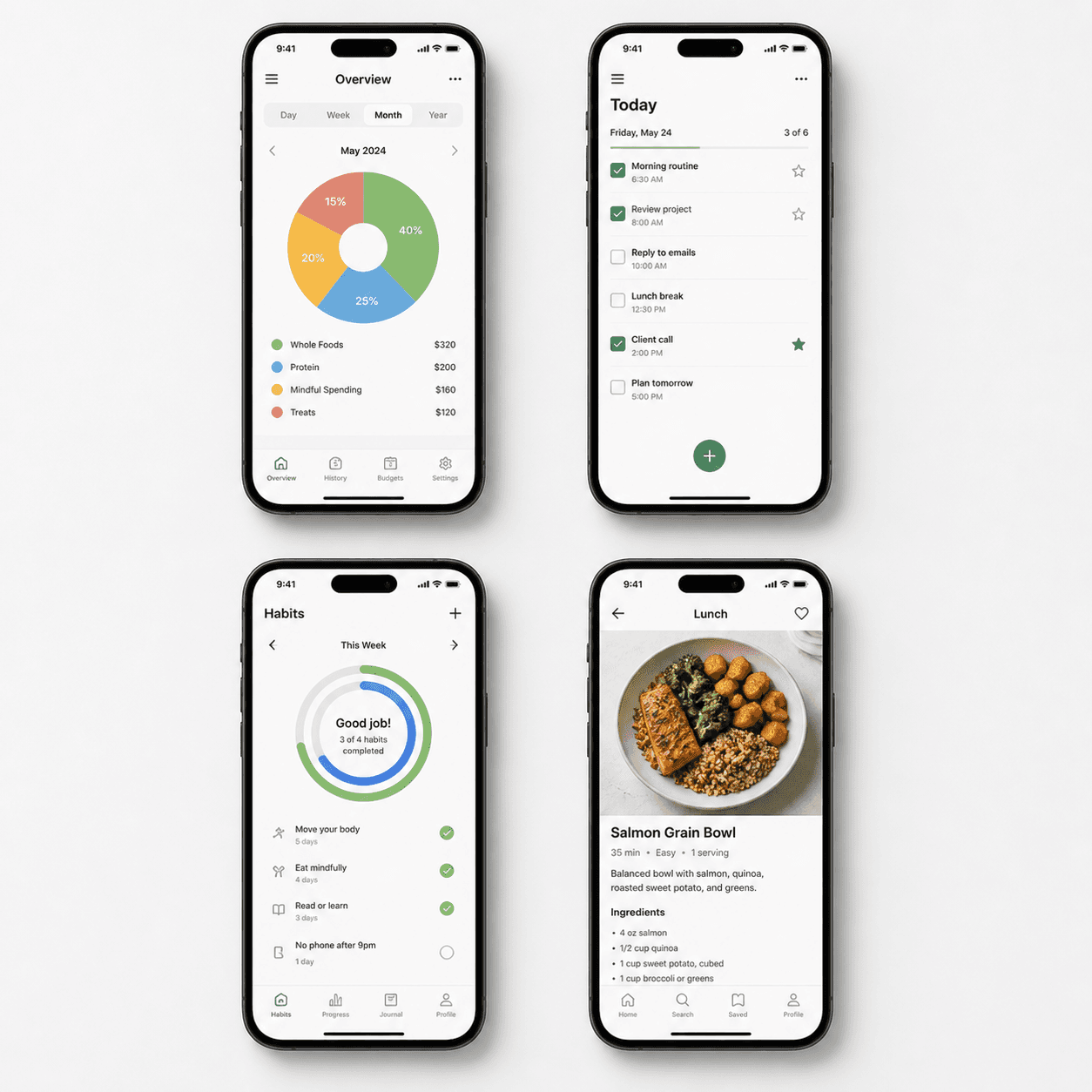
The Eated daily experience: Each morning, you open the app to a specific micro-task for your active habit. Not "eat more vegetables" — something exact: "Tonight, roast whatever vegetables are in your fridge and eat them before the main part of your meal." The task comes with a 1-minute explanation of why this specific action works. You complete it, close the ring, build the streak. After 8 days, the first circle closes. After 24 days across three circles, the habit is considered formed — and you move to the next one.
Food logging works through the Harvard Plate wheel: a visual circle divided into food groups (vegetables, fruits, protein, grains and starches, dairy, fats). You log by selecting what you ate in each category — no calories, no grams, just an honest visual of how your plate balanced. The wheel shows you what's there and what's missing. The AI Scan feature (available on trial and paid tiers) lets you photograph a meal and have the portions calculated automatically.
Food Coach delivers a personalized nutrition insight every morning after you've logged the previous day — one thing you did well, one small thing to adjust. After 7 consecutive days of logging, you receive a Weekly Nutrition Report: a detailed analysis of your eating patterns across the week.
Price: Free to download · 7-day free trial · $9.99/month or $59.99/year Platform: iOS only Best for: People who've tried tracking and found it unsustainable; people with any disordered eating history for whom tracking is contraindicated; people who want to genuinely change their relationship with food rather than just monitor it. Limitation: Results are gradual, not rapid. iOS only. Not suitable for people who need dramatic short-term scale movement to stay motivated.
Approach 2: Portion Guidance (Noom, Weight Watchers)
Mechanism: Replaces calorie counting with a points or color-code system that simplifies food decisions without eliminating the monitoring framework entirely.
Noom uses a color system (green, yellow, orange) based on calorie density. You're not counting calories — but you're categorizing food against a daily color budget, which is psychologically similar to counting and produces similar results for similar reasons. Noom's distinctive element is its CBT-based curriculum: daily 5–10 minute lessons on behavioral and psychological drivers of eating. For people whose main barrier is understanding their eating psychology, this is genuinely useful.
Weight Watchers (WW) uses Points — a numerical simplification of calorie content that adds health-related adjustments. It reduces decision fatigue compared to full calorie counting and has decades of clinical validation. The 2024–2025 product update added GLP-1 medication support tracks, which is meaningfully differentiated.
What it actually changes: Makes food decisions simpler without eliminating monitoring. Works for people who find raw calorie numbers overwhelming but still benefit from some numerical structure.
Best for: People who want lighter-touch monitoring with community support. Not suitable for people for whom any numerical food monitoring triggers anxiety or restriction behavior.
Approach 3: Mindful and Intuitive Eating Apps (Way, Peace With Food)
Mechanism: Rebuilds connection to internal hunger and fullness signals, reducing the reliance on external targets (calories, points, macros) to guide eating decisions.
Way — three consecutive years as Healthline's Best Non-Diet App — combines intuitive eating principles with CBT and mindfulness, delivered through 2–8 minute daily sessions. Three pathways: Mindful Shifts (body image), Emotional Eats (emotional eating), Body Feels (hunger awareness). Developed with input from Columbia, Duke, and UC behavior scientists.
Peace With Food — built by a Registered Dietitian and rated highly by Intuitive Eating practitioners — centers on a Rhythm Tracker: a hunger-fullness check-in system throughout the day.
What it actually changes: The psychological relationship with food and the ability to eat in response to internal signals rather than external rules.
Best for: People with significant diet culture history, body image concerns, or emotional eating as the primary barrier. Produces slower weight outcomes than habit formation approaches — IE is weight-neutral by design, with weight change as a secondary outcome.
Approach 4: Meal Structure Apps (Simple, Zero)
Mechanism: Adds structure through time-based eating patterns (intermittent fasting) rather than food-based counting. Defines when you eat rather than what or how much.
Simple — Fortune's pick for best IF app 2026 — focuses on fasting windows, education, and gentle habit formation around meal timing. It doesn't tell you what to eat during eating windows but reduces overall intake through the time constraint.
Best for: People whose eating difficulty is primarily grazing, late-night eating, or lack of structure rather than food quality. If the pattern problem is a window of eating (evenings, weekends) rather than the content of meals, time-restriction may be more relevant than food monitoring.
Approach 5: Plate Method Apps (Eated, Ate)
Mechanism: Replaces calorie arithmetic with visual plate composition — half vegetables and fruits, quarter protein, quarter whole grains — derived from the Harvard Healthy Eating Plate structure.
The Harvard Plate approach produces a calorie reduction through composition change: a plate that's half vegetables and quarter protein contains fewer calories and more satiety compounds than a plate that's half starch and quarter vegetables. The calorie difference is significant without any counting — typically 300–500 kcal per meal compared to the standard Western plate distribution.
Research comparing composition-based eating to calorie restriction consistently shows comparable weight loss outcomes over 12 months — with significantly better behavioral sustainability. The plate approach produces durable change because it changes the default composition rather than monitoring intake against a target.
Best for: People who understand why they overeat (food quality and portion imbalance) and want a visual rather than numerical framework.
The Honest Comparison Table
Eated | Noom | Way | WW | Simple | |
|---|---|---|---|---|---|
Core mechanism | Habit formation | Psychology + color code | Mindful/IE | Points system | Time-restricted eating |
Calorie counting | ❌ | ❌ (color code) | ❌ | ❌ (Points) | ❌ |
Behavior change framework | ✅✅ BJ Fogg | ✅ CBT | ✅✅ IE + CBT | Partial | Partial |
Food logging required | ✅ Daily | ✅ Daily | ❌ | ✅ Daily | Minimal |
Emotional eating support | ✅ | ✅✅ | ✅✅ | Partial | ❌ |
Suitable for ED history | ✅ | Caution | ✅ | Caution | ✅ |
iOS/Android | iOS only | Both | Both | Both | Both |
Speed of results | Gradual | Moderate | Slowest | Moderate | Variable |
Price/month | $9.99 | ~$70 | Subscription | ~$23 | ~$13 |
Free trial | 7 days | 14 days | Trial | Trial | Trial |
What the Research Says About App-Based Behavioral Weight Loss
A habit-based weight loss app pilot study — the Top Tips habit formation app — found that participants using a habit-based approach lost an average of 4.5 kg over 3 months. The participants who reported the largest improvements viewed the app content 2–3 times more and logged their weight more consistently — confirming that behavioral engagement (not feature count) is what produces results.
The broader research on smartphone weight loss apps shows an important pattern: apps that included habit formation and behavioral coaching components alongside monitoring produced better long-term outcomes than those focused purely on tracking. Apps that changed behavior — not just measured it — produced durable results.
The most predictive variable across studies is adherence. Not which app, not which features — whether the person is still using it at month three. This is the strongest argument for choosing an approach you can genuinely sustain rather than one with impressive short-term numbers.
How to Choose: A Decision Framework
Answer these three questions honestly.
Question 1: Why has my previous approach to weight loss not held?
If the answer involves: tracking becoming obsessive or anxiety-inducing → choose Eated or Way. Restriction followed by compensatory eating → choose Eated or Way. Logging friction and abandonment → choose Eated. Social support missing → choose WW. Lack of understanding of the psychological drivers → choose Noom. Late-night or grazing eating pattern → try Simple alongside Eated.
Question 2: How important is speed of results to you?
If you need to see the scale move significantly in the first month to stay motivated → the honest answer is that habit-based and mindful eating approaches will frustrate you. They produce real, durable results — but gradually. If you can commit to a 3–6 month horizon and measure progress by behavioral change rather than scale movement, habit-based approaches are more likely to produce outcomes you keep.
Question 3: Do you have any history of disordered eating, restriction, or food anxiety?
If yes → Eated or Way. Both are designed for a weight-neutral psychological framework. Noom and WW still involve food categorization that can trigger restriction behaviors in susceptible people.
"The apps I recommend depend entirely on what's been getting in the way. If someone has tried tracking multiple times and it hasn't held — the problem isn't that they haven't found the right tracker. The mechanism isn't working for them. Switching to a habit-based approach is a fundamentally different bet: instead of monitoring what you eat, you change what you automatically do. For most people who've failed at tracking, that's the right bet."
— Irene Astaficheva, PN1, PN-SSR, GGS-1
Honest Limitations
This review is written by the co-founder of Eated. I've tried to be fair in describing where competitors have genuine advantages — Noom's psychological curriculum is meaningfully differentiated for people who need behavioral coaching, Way has a stronger evidence-base for body image and emotional eating work, and WW has more long-term clinical validation than any other app in this category. Readers should weigh the authorship context.
No app produces weight loss on its own. What apps provide is structure, guidance, and accountability that reduce the friction of eating better. The behavioral changes the app supports do the actual work — which is why approach alignment (choosing an app whose mechanism matches your specific barrier) matters more than feature comparison.
Weight loss results also depend on many factors beyond the app: sleep, stress, underlying medical conditions, medications, and starting point all affect outcomes significantly.
FAQ
Do weight loss apps without calorie counting actually work? Yes — multiple randomized controlled trials show that composition-based, mindful eating, and habit-based approaches produce comparable weight loss to calorie restriction over 12 months. The evidence is particularly strong for approaches that combine a dietary framework with behavioral coaching and habit formation. The key is that the app replaces counting with an equally systematic behavioral mechanism — not just removes counting.
Which app is best for someone who's tried calorie counting and failed? Eated is the most direct alternative for people whose specific failure point was tracking fatigue, logging friction, or the restriction-compensation cycle. Way is the better choice if body image concerns or emotional eating are the primary barrier. The pattern of failure is diagnostic: if you stopped because tracking felt obsessive, the answer is a different mechanism, not a better tracker.
Can I lose significant weight without ever counting a calorie? Yes — research documents this consistently. The DIETFITS trial, the Stanford diet comparison, and multiple mindful eating RCTs all show significant weight loss in populations that never counted calories. What's required instead: a consistent structural approach to what and how much you eat, built into habitual behavior rather than monitored daily.
How long does it take to see results from a habit-based app? The behavioral changes become noticeable in 3–4 weeks. Weight changes typically begin appearing at weeks 6–10 as multiple habits compound. Significant body composition changes require 3–6 months of consistent habit execution. This timeline is slower than calorie restriction — which is the honest answer. The advantage is durability: habits that form through repetition don't require ongoing effort to maintain, unlike tracking.
Is Eated free? Eated is free to download. The free version includes the Guide (palm portion reference) and core habit tracking. The 7-day free trial unlocks all features including AI Scan, Food Coach insights, and Weekly Nutrition Report. After the trial: $9.99/month or $59.99/year — significantly less than Noom (~$70/month) or WW (~$23/month).
Bottom Line
The best weight loss app without calorie counting in 2026 is the one whose mechanism matches your specific barrier:
Habit formation and behavioral change: Eated
Psychology of eating and CBT: Noom
Intuitive eating and body image: Way
Points-based simplification with community: Weight Watchers
Meal timing and structure: Simple
The worst outcome is choosing an app whose mechanism is just a lower-friction version of the approach that already didn't work for you. If tracking failed, a simpler tracker probably won't solve it. If restriction triggered overeating, a lighter restriction system probably won't either.
Match the mechanism to the barrier. Then give it 12 weeks.
Try Eated Free
If the habit-based approach sounds right for you — one behavior at a time, no tracking, one daily action that actually explains the why — the Eated app is free to download on iOS.
7-day free trial · No credit card required to start · $9.99/month or $59.99/year after