"Habit-based eating app" isn't a category most people search for — because most people don't yet know it exists. What they search for is what they're tired of: calorie counters, macro trackers, point systems. What they actually need is something that changes what they automatically put on their plate, rather than something that measures what they already did.
That's the distinction this guide is built around. Most nutrition apps are tracking tools. Habit-based eating apps are behavior change tools. They're solving a different problem — and knowing the difference is what makes choosing between them straightforward.
Why Tracking Isn't the Same as Habit Change
Calorie tracking apps produce data. They tell you what you ate, how much, and whether it fits a target. What they don't do is change what you reach for next Tuesday when you're tired and hungry and not thinking about the app at all. Understanding how the habit loop actually works is what makes the difference between tracking behavior and changing it.
Research on long-term weight maintenance consistently finds that the strongest predictor of sustained results isn't how carefully someone tracked — it's how automatic their eating patterns became. Habit automaticity: behavior that runs without deliberate decision-making, in the same context, repeatedly. Tracking doesn't build automaticity. Repeated specific behavior does.
This is why the most common failure pattern with tracking apps isn't lack of effort — it's that nothing about the actual eating behavior changes. The same foods go on the same plate in the same situations, accurately logged. The app produces a perfect record of a pattern that never shifted.
"I've worked with clients who tracked calories meticulously for years. They knew exactly what they were eating. The problem wasn't awareness — it was that the knowledge never translated into automatic behavior. Knowing you should eat more vegetables and automatically eating more vegetables are completely different cognitive states. One requires constant effort. The other doesn't." — Irene Astaficheva, PN1, GGS-1, co-founder of Eated
A habit-based eating app works differently. Instead of measuring what you ate, it gives you a specific behavior to practice — repeatedly, in the same context, until it becomes automatic. The goal isn't a log. It's a new default.
What Makes an App Genuinely Habit-Based
Not every app that uses the word "habits" is actually building them. Here's what separates real habit-formation design from tracking apps with a habit-themed rebrand:
1. One behavior at a time
Habit research is unambiguous on this: trying to change multiple behaviors simultaneously dramatically reduces success rates for all of them. An app that gives you a checklist of eight daily eating habits to complete isn't using habit science — it's using a to-do list. A genuinely habit-based app focuses on one specific behavior per cycle and builds that single behavior to automaticity before introducing the next.
2. Specific daily tasks, not vague intentions
"Eat more vegetables" is a goal, not a habit. A habit is a specific behavior in a specific context: "put vegetables on your plate before anything else at dinner." Implementation intentions — the specific when, where, and how of a behavior — are what research shows produces follow-through, not goals alone. The daily task structure matters as much as what the task is.
3. A cycle long enough for automaticity to develop
The often-cited "21 days to form a habit" is not what the research shows. The actual study — Lally et al., 2010 at University College London — found a range of 18 to 254 days, with an average of 66. Simple behaviors (drinking water with breakfast) automated in weeks. Complex ones (changing what goes on your plate at dinner) take longer. An app built around 3-week streaks and calling it done isn't aligned with how habits actually form.
4. A nutritional framework underneath the habits
This is the element that separates eating-specific habit apps from generic habit trackers. Streaks, Habitify, and similar apps can track anything — running, meditation, journaling. They're general habit tracking infrastructure. An eating-specific habit app needs a nutritional framework that defines what "better" looks like: which foods, in what proportions, for what reasons. Without that, you're building habits toward an undefined target.
The Apps Worth Considering
Eated — The Only App Built Specifically Around This Model
Eated is the only app in 2026 built explicitly around habit-based eating as its primary design principle. It combines the Harvard Plate Method as a nutritional framework with BJ Fogg's Tiny Habits model as a behavior-change framework.
How it applies each criterion:
One behavior at a time: You pick one habit from eight options and work on it exclusively until the cycle completes. The eight habits are: eating more vegetables, adequate protein, eating slower, reducing sugar dependence, improving food variety, hunger awareness, hydration, and more fruit. One. Not all eight simultaneously.
Specific daily tasks: Each day of the habit cycle has a concrete task — not "eat more vegetables" but a specific action for that specific day with a clear explanation of how to do it. The task is designed to be completable in under five minutes. Small enough to remove the "I'll do it tomorrow" friction that kills most habit attempts.
Cycle length: 24 days across three 8-day cycles. The first cycle includes eight short educational videos explaining the mechanism behind the habit — why it works, what the research shows, common mistakes. Cycles two and three reinforce the behavior without re-explaining it. Three cycles builds the foundation; research suggests continued repetition over months is what produces full automaticity, but the 24-day structure establishes the pattern.
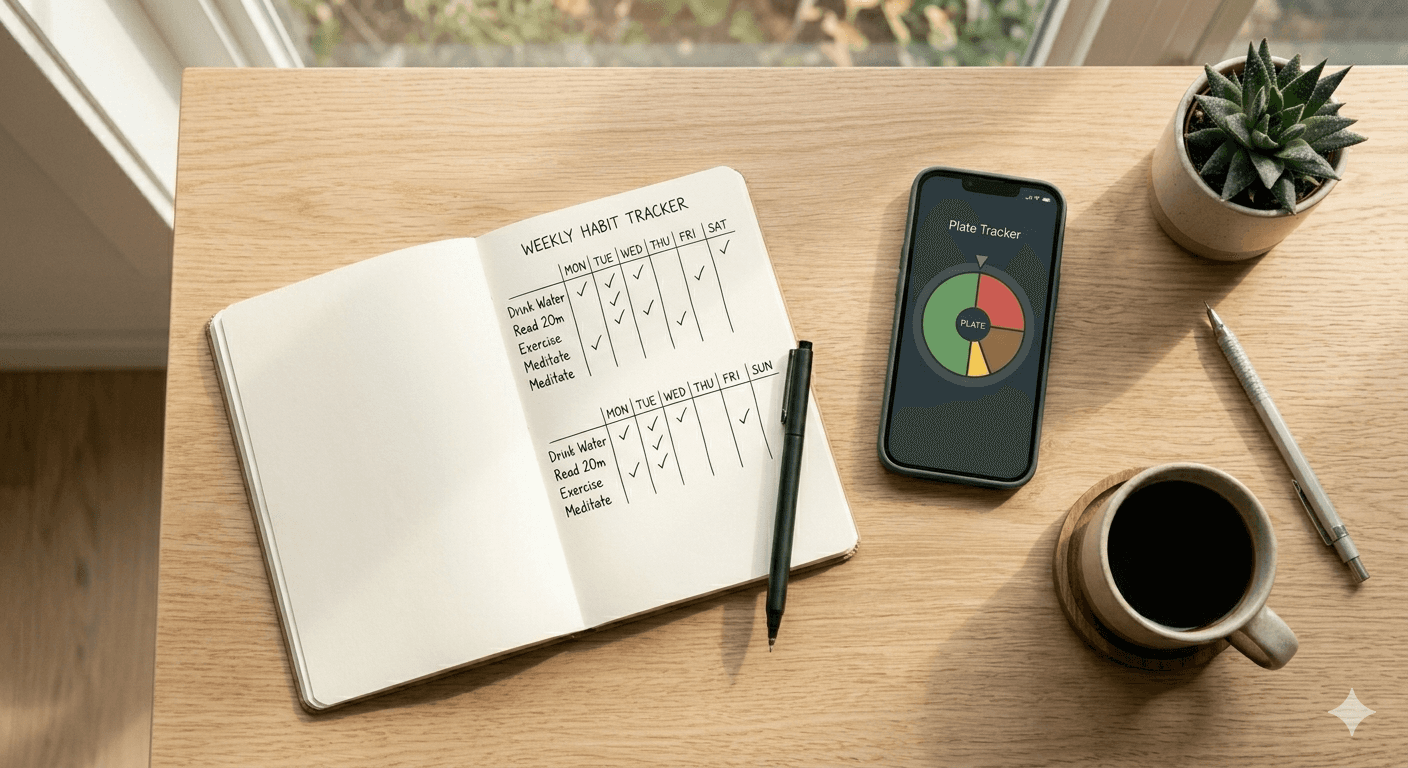
Nutritional framework: The Harvard Plate provides the target. Half vegetables and fruits, a quarter protein, a quarter whole grains, healthy fats alongside. Plate composition is logged visually — by food group, not calorie count. The Food Coach feature delivers a daily personalized insight based on what you actually logged: one thing you did well yesterday, one small shift for today.
What it doesn't do: No calorie counting, macro tracking, meal planning, or workout tracking. iOS only. Results are gradual — this is not a rapid-loss intervention. People who need dramatic short-term numbers to stay motivated will find the pace frustrating initially.
Pricing: Free to download · 7-day free trial · $9.99/month or $59.99/year
If you've been cycling through calorie trackers without changing what you actually eat — the mechanism, not the effort, is likely the problem.
Download Eated free on the App Store →
Noom — Habit Change Through Psychology
Noom addresses behavior change from a different angle: the psychological drivers of eating rather than the compositional patterns. Its daily CBT-based curriculum teaches why specific eating behaviors happen — what triggers them, how they run automatically, and how to interrupt the loop.
It includes food logging with a color-coded system (green, yellow, red by calorie density), daily psychology lessons, and optional coaching. It's meaningfully different from pure calorie tracking because the educational layer addresses behavior, not just data.
Where Noom diverges from a habit-formation model: it still involves daily food categorization, which is a form of tracking. The psychology curriculum is strong. The structural habit cycle — one behavior at a time, specific daily tasks, defined completion point — isn't how Noom is organized. It's a program with a curriculum, not a habit cycle system.
Best for: People whose eating problems are primarily psychological — eating in response to stress, emotion, or habit loops tied to specific emotional states — rather than people whose problem is simply not having the right behavioral defaults in place.
Pricing: Annual plan ~$17/month. 14-day trial available.
General Habit Trackers (Streaks, Habitify, Productive)
These apps track habits across any domain — exercise, sleep, meditation, eating, hydration, reading. They're well-designed infrastructure for habit tracking. What they don't provide is nutritional content: no framework for what eating habits to build, no daily tasks with explanations, no food coaching, no compositional logging.
If you already know exactly which eating habit you want to build and exactly how to do it, a general habit tracker gives you the accountability layer. If you need guidance on what to change and how — which is most people — a general tracker leaves that gap entirely open.
Best for: People who have already worked with a nutritionist and have specific behaviors to reinforce, who want a simple streak-based accountability tool without additional educational content.
How to Choose
You need... | Best fit |
|---|---|
A complete habit-formation system for eating, including what to change and how | Eated |
Help understanding the psychological triggers behind eating patterns | Noom |
A simple streak tracker for a habit you've already defined | Streaks / Habitify |
Pattern awareness before you decide what to change | AteMate |
What to Avoid
Apps that call everything "habits": Many tracking apps have added habit-themed language without changing the underlying mechanism. If the app's primary interaction is logging food into a database and checking against a calorie target, it's a tracker with habit branding — not a habit-formation tool.
Apps that give you too many habits at once: Eight daily eating habits to track simultaneously is a to-do list, not habit formation. One behavior, practiced repeatedly until automatic, then the next.
Apps without a nutritional framework: A generic habit tracker can tell you whether you completed a vague "eat healthy" task. It can't tell you what that means, whether your plates are compositionally sound, or what specifically to change tomorrow based on what you logged today.
Honest Limitations of This Whole Category
Research on mindfulness-based and habit-based eating interventions shows meaningful effects on eating patterns and weight-related behaviors — but effect sizes are modest, and app-based interventions consistently produce smaller effects than in-person behavioral support. Apps are accessible and low-friction; they're not a substitute for working with a registered dietitian or behavioral health professional for complex needs.
Habit formation also takes longer than most apps suggest. The 24-day cycle in Eated establishes a behavioral foundation — it doesn't complete habit formation in the neuroscientific sense. Continued repetition over months is what produces full automaticity. The app structure gets you started; daily repetition over time is what finishes the job.
FAQ
What is a habit-based eating app? A habit-based eating app uses behavior change science — specifically habit formation frameworks — to help users build automatic eating patterns, rather than tracking food intake against a daily target. The distinction matters: tracking measures what you did; habit formation changes what you automatically do. Eated is the primary example in this category in 2026.
Is Eated a habit tracker? Eated is an eating-specific habit formation app — not a general habit tracker. It includes a nutritional framework (Harvard Plate Method), specific daily tasks for each habit, educational content on the mechanism behind each behavior, food coaching, and plate composition logging. General habit trackers like Streaks or Habitify track completion of any habit without providing the nutritional content layer.
How long does it take to build an eating habit with an app? The honest answer: longer than most apps suggest. The 2010 Lally study found habit automaticity developed over 18–254 days depending on complexity. Simple eating behaviors (drinking water at breakfast) can automate in 3–4 weeks. Complex ones (consistently balancing plate composition at every meal) take longer. Eated's 24-day cycle establishes a foundation; sustained repetition builds full automaticity over months.
Do habit-based eating apps work for weight loss? Yes — through a different mechanism than restriction. Mindfulness and behavior-based eating interventions produce weight loss outcomes comparable to calorie restriction over 12 months in controlled studies, without the tracking burden. The mechanism is composition change — consistently eating more vegetables and adequate protein displaces higher-calorie foods and reduces later-day hunger, without counting anything.
Can I use a general habit tracker for eating habits? You can, with limitations. A general habit tracker provides accountability for completing a behavior you've already defined. It doesn't provide a nutritional framework, daily task specificity, food coaching, or compositional logging. If you already know exactly what eating habit to build and how to do it, a general tracker works. If you need guidance on what to change — which most people do — you need an eating-specific app.
Bottom Line
Most nutrition apps are tracking tools that measure what you eat. Habit-based eating apps are behavior change tools that change what you automatically eat. The difference is whether the app is producing a log or producing a new default.
In 2026, Eated is the only app built specifically around this model for eating — with a nutritional framework, one-habit-at-a-time structure, specific daily tasks, and food coaching all designed around habit formation rather than tracking. Building sustainable eating habits doesn't require tracking every meal. It requires changing what feels normal at the plate.
Ready to build eating habits that run on autopilot?
Download Eated free on the App Store · Free to download · 7-day free trial · $9.99/month or $59.99/year after trial