
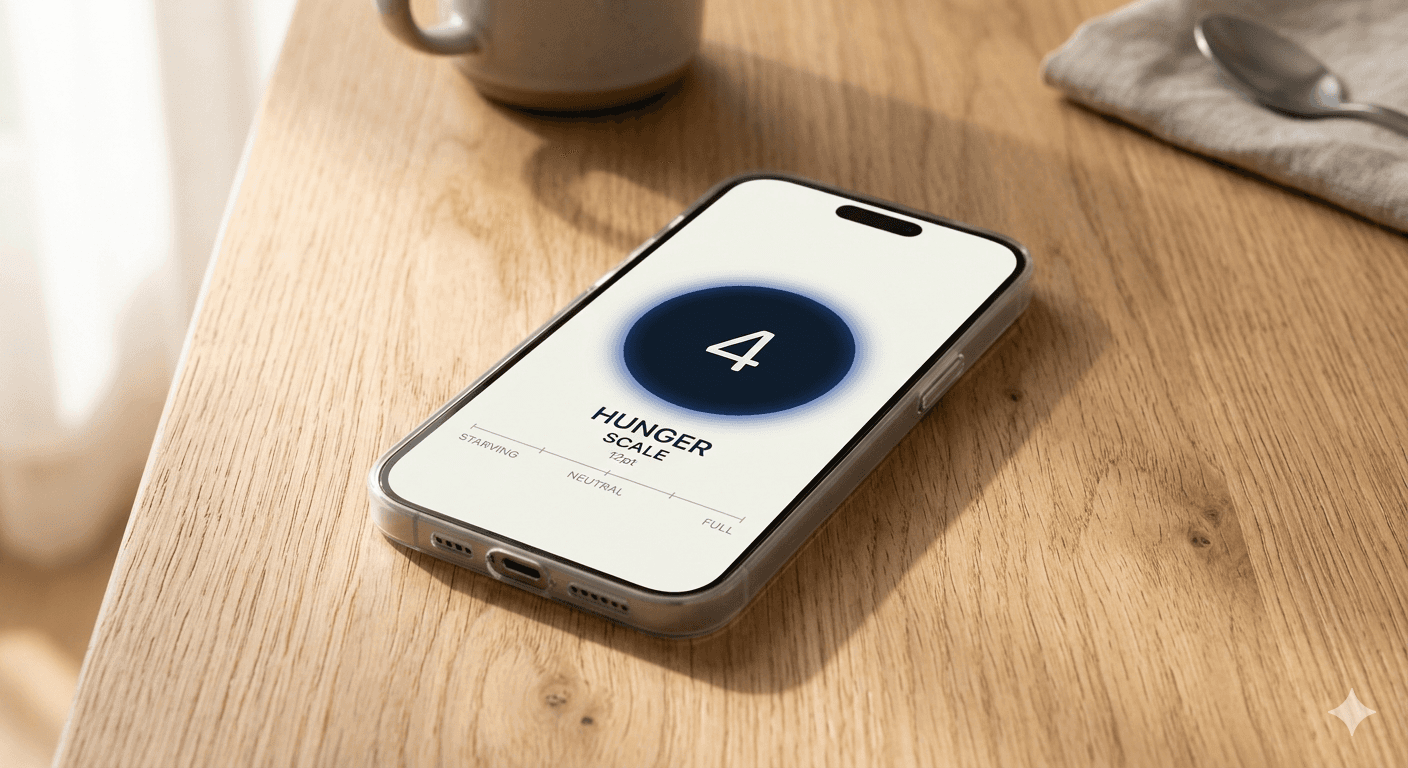
Most "mindful eating apps" aren't actually mindful eating apps. They're either calorie trackers with a wellness aesthetic, meditation apps that happen to mention food, or food diaries without any behavioral framework. Genuine mindful eating apps — ones built around hunger awareness, eating behavior change, and habit formation rather than calorie logging — are rare on the App Store. This review covers what's actually available for iPhone in 2026, what each option does well, and what to look for before downloading.
What a Mindful Eating App Should Actually Do
Before comparing options, it helps to be clear on what mindful eating actually involves — because the App Store definition is loose.
A genuine mindful eating app should, at minimum:
Help you recognize hunger and fullness signals before and during meals
Build awareness of what's driving eating decisions (hunger, habit, emotion, boredom)
Support slowing down eating pace
Help identify eating patterns over time
Not require calorie counting — which actively undermines the internal attunement mindful eating is building
A 2023 academic review of mindful eating apps found that most commercial apps in the category fail on several of these criteria: many are eating timers or simple diaries without genuine behavioral framework, and few teach hunger-satiety recognition in any depth.
With that as the benchmark — here's what's actually available.
The Options: What's on the iPhone App Store in 2026
Eated — Best Overall for Behavior Change
iOS: Yes (iOS only) Price: Free to download · 7-day free trial · $9.99/month or $59.99/year
Eated is built around BJ Fogg's Tiny Habits framework — one eating habit at a time, starting small, building toward automatic behavior change. The core mechanic: identify the single eating behavior with the most leverage for your specific patterns, then build it into a daily routine until it's automatic. No calorie counting, no food logging, no macro tracking.
What makes it different: the behavioral architecture. Most mindful eating apps give you tools (a hunger journal, a timer) but no framework for how to use them. Eated's Tiny Habits structure provides the framework — a systematic process for changing eating behavior that doesn't depend on willpower or sustained motivation.
The free trial version gives you access to the Habit section, ability to select the habit you want to develop, and track it.. The trial unlocks everything for 7 days — enough time to complete the initial habit assessment and start the first behavior. At $9.99/month or $59.99/year (effectively $5/month), it's priced considerably below Noom and comparable to most calorie trackers.
If you want to understand how this approach differs from traditional calorie tracking, the Eated vs MyFitnessPal comparison covers the philosophy in detail.
Best for: people who've tried calorie tracking and found it unsustainable, people who want to address specific behavioral patterns (emotional eating, overeating at night, eating too fast), anyone who wants lasting change rather than short-term restriction.
Not ideal for: people who want rapid weight loss through calorie restriction, Android users.
Peace With Food — Best for Hunger Signal Reconnection
iOS: Yes Price: ~$10/month
Built by a Registered Dietitian and rated highly by Intuitive Eating professionals. The core feature is a Rhythm Tracker — a hunger-fullness check-in system that prompts you throughout the day. App Store reviews consistently praise it specifically for helping people reconnect with hunger signals after years of dieting.
Best for: people specifically focused on rebuilding hunger and fullness awareness, chronic dieters whose internal signals have been disrupted.
Limitation: limited habit-change framework beyond the hunger tracking itself.
MEAL — Best for Emotional Eating Support
iOS: Yes Price: Subscription
Combines guided sessions with psychologists and nutritionists, meditation, and content on emotional eating, binge eating, and stress eating. More educational than behavioral in structure.
Best for: people wanting to understand the psychological roots of their eating patterns.
Limitation: technical reliability issues flagged in user reviews. Content-heavy format suits some people and frustrates others.
MyTummy — Best Free Starting Point
iOS: Yes Price: Free
Self-paced app for logging meals without calorie counting — users tag meals by how they feel rather than macros. Low-friction, non-judgmental, no expertise required.
Best for: beginners to non-calorie-based eating tracking, people who want a low-pressure starting point.
Limitation: no behavioral change framework, no habit guidance.
AteMate — Best for Visual Pattern Recognition
iOS: Yes Price: Free trial
Photo-based food diary — you photograph each meal rather than logging numbers. Useful for identifying visual patterns across the week.
Best for: people who want food awareness without any logging.
Limitation: no hunger tracking, no behavioral framework, no emotional eating support.
The Honest Comparison
Eated | Peace With Food | MEAL | MyTummy | AteMate | |
|---|---|---|---|---|---|
Hunger tracking | Partial | ✅✅ | ✅ | Partial | ❌ |
Habit framework | ✅✅ | ❌ | Partial | ❌ | ❌ |
Emotional eating | ✅ | Partial | ✅✅ | Partial | ❌ |
No calorie counting | ✅ | ✅ | ✅ | ✅ | ✅ |
Evidence-based framework | ✅ BJ Fogg | ✅ IE | ✅ Psychology | ❌ | ❌ |
iOS | ✅ | ✅ | ✅ | ✅ | ✅ |
Price | Free + $9.99/mo | ~$10/mo | Subscription | Free | Free trial |
What the Research Says
A PMC review of mindful eating apps on the Apple App Store found that most commercial apps scored moderately on quality but fell short in comprehensiveness, depth of behavioral guidance, and engagement. The review concluded that apps need to provide guided behavioral frameworks — not just tracking tools — to genuinely support mindful eating.
A 2024 meta-analysis on mindfulness-based interventions and obesogenic behaviors confirmed that structured behavioral components — not just awareness features — are what produce measurable outcomes in eating behavior change. An app that logs your hunger level but doesn't help you change behavior based on it is measuring, not intervening.
The distinction between a tool and a framework is the most important thing to evaluate when choosing an app.
What to Look for Before Downloading
A behavioral framework, not just tracking features. A hunger journal without guidance on what to do with the data is a diary. Look for apps with a structured approach to habit formation or behavior change.
No calorie counting as the core mechanic. If the primary feature involves logging numbers, it's not a mindful eating app regardless of the branding. Calorie counting works against internal attunement.
A meaningful free trial. Behavioral apps require 2–4 weeks of consistent use before producing measurable change. Seven days is the minimum; enough time to run the initial assessment and start one habit. Apps without trials are harder to evaluate honestly.
iOS optimization. Some apps are cross-platform but Android-first. If you're on iPhone, check iOS-specific reviews.
"The clients I see who get results from mindful eating apps are the ones using apps with a process, not just a feature. 'Here's a hunger scale' isn't enough — you need to understand what you're looking for and what to do when you find it. The app should scaffold behavior change, not just observe it."
— Irene Astaficheva, PN1, PN-SSR, GGS-1
Honest Limitations
This review reflects the App Store landscape as of early 2026. Apps update frequently and pricing changes. The 4 Best Mindful Eating Apps for Sustainable Weight Loss post covers a broader comparison updated separately.
I'm the co-founder of Eated. I've tried to be honest about where other apps have strengths Eated doesn't match — particularly Peace With Food's hunger tracking depth and MEAL's psychological content. Readers should weigh that context when reading this review.
FAQ
Do mindful eating apps actually work? Research on mindfulness-based eating interventions shows consistent improvements in eating behavior — reduced emotional eating, improved hunger awareness, better satiety recognition. Whether a specific app works depends on whether it implements these principles in depth rather than superficially. Well-designed apps with behavioral frameworks produce better outcomes than simple tracking tools.
Can a mindful eating app help with weight loss? Indirectly, yes. Mindful eating reduces the behavioral patterns that drive overeating — eating past fullness, distracted eating, emotional eating, eating too fast. When these patterns change, caloric intake typically decreases without deliberate restriction.
What's the difference between a mindful eating app and a calorie tracker? A calorie tracker externalizes food decisions — everything is measured against a number. A mindful eating app builds internal awareness — you learn to recognize hunger, fullness, and behavioral patterns. The mechanisms are opposite in direction. Using both simultaneously long-term tends to create conflicting feedback: an external number vs. an internal signal.
Is Eated worth the price? At $9.99/month or $59.99/year, it sits mid-market — below Noom and comparable to most calorie trackers. The free version is functional for basic habit tracking. The 7-day trial gives you enough time to assess whether the approach fits how you want to work. If you've previously paid for calorie tracking apps that you stopped using, the behavioral approach is worth trying — it's a different mechanism, not a worse version of the same one.
What if I want to track calories and eat mindfully? Partially compatible short-term, increasingly incompatible long-term. Many people use calorie tracking to understand their eating patterns and then transition to a mindful eating approach. Running both permanently creates competing feedback loops that most people eventually resolve in favor of one or the other.
Bottom Line
The best mindful eating app for iPhone in 2026 depends on what you specifically need:
For hunger signal reconnection: Peace With Food
For emotional eating support: MEAL
For structured habit change without calorie counting: Eated
For a free starting point: MyTummy
What to avoid: apps that call themselves mindful eating but are primarily calorie trackers with a softer aesthetic. They work against the internal attunement mindful eating is designed to build.
Try Eated Free
The Eated app is free to download on iOS. The 7-day free trial gives you full access — no credit card required to start. After the trial: $9.99/month or $59.99/year (cancel anytime).
If you've tried tracking and it didn't hold, this is a different mechanism — built on habits, not numbers.