
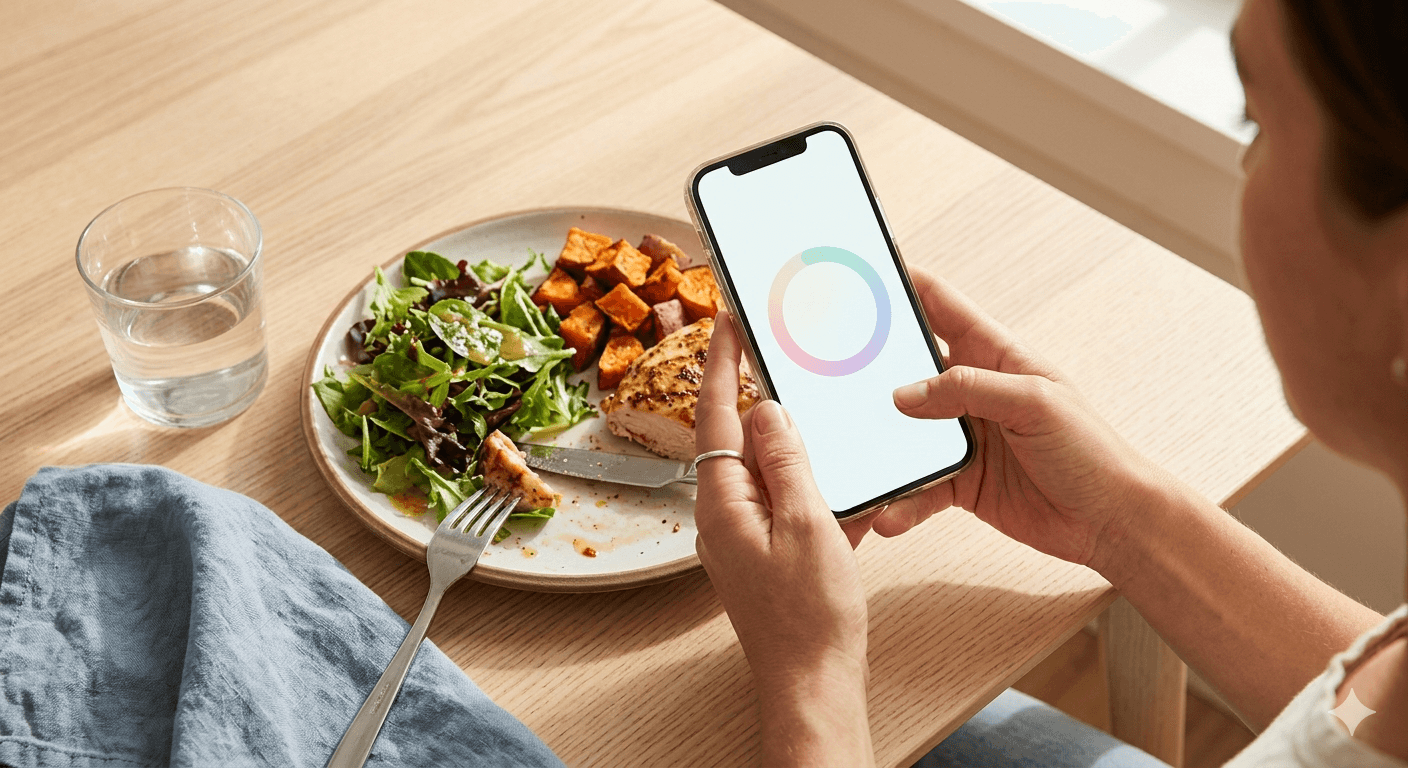
Searching "intuitive eating app" in the App Store returns dozens of results. Most of them are calorie trackers with softer branding, or meditation apps with a food section bolted on. Genuine intuitive eating apps — ones that implement the actual principles of intuitive eating, not just the aesthetic — are a small subset. This guide covers what a real intuitive eating app should do, which options exist in 2026, and how to decide which one is right for where you are.
What Intuitive Eating Actually Requires From an App
Intuitive eating is a framework developed by dietitians Evelyn Tribole and Elyse Resch built around 10 principles — from rejecting the diet mentality and honoring hunger, to making peace with food and discovering the satisfaction factor. It's not a diet and it's not "eat whatever you want." It's a structured practice of rebuilding internal attunement with your body's signals.
An app that genuinely supports intuitive eating should:
Support hunger and fullness recognition. The hunger-fullness scale is the primary practical tool in IE. An app should help you check in before and during meals, track your scores over time, and help you see patterns — not just log the number without context.
Not require calorie counting. This is non-negotiable. Calorie tracking is the mechanism IE specifically rejects — it externalizes food decisions and undermines the internal attunement the practice is building. Any app calling itself an IE app while centering calorie logs is misrepresenting what it does.
Address the behavioral and emotional layer. IE includes principles about emotional eating, the satisfaction factor, and body respect. An app that only tracks hunger scores without addressing why you eat outside of hunger is covering one principle out of ten.
Provide a framework, not just features. A hunger journal is a tool. An app with a structured approach to working through the IE principles — sequenced, with guidance on how to apply each one — is a framework. The difference matters for outcomes.
Not promise weight loss as the primary outcome. IE is not a weight loss protocol. Apps that use IE language but lead with weight loss claims are reframing the approach through a diet-culture lens that's directly contrary to what IE is designed to do.
What's Actually Available in 2026
Intue (formerly Savvy)
The official IE app — launched 2026, co-created with Elyse Resch iOS/Android: iOS Price: Subscription
The most significant new entrant: Intue is the first app built in direct collaboration with the original IE framework co-creator, Elyse Resch. It's specifically designed to implement the 10 IE principles with guidance from the source. This is the closest thing to an "official" intuitive eating app.
What it offers: structured work through the 10 IE principles, evidence-based content, direct lineage to the framework. Still new — user base and long-term outcomes data are limited.
Best for: people who want the most direct implementation of the original IE framework, particularly those already familiar with IE principles and wanting structured support.
Way — Intuitive Eating App
Named Best Non-Diet App by Healthline 2023, 2024, 2025 iOS/Android: Both Price: Subscription
Way combines IE with CBT (cognitive behavioral therapy) and mindfulness, delivered through 2–8 minute sessions organized across three pathways: Mindful Shifts (body image), Emotional Eats (emotional eating), and Body Feels (hunger/fullness awareness). Developed with input from IE dietitians and behavior scientists from Columbia, Duke, and UC.
73.5% of users report thinking differently about eating within the first week — a meaningful early engagement signal. Three consecutive Healthline awards suggest consistent user satisfaction.
Best for: people who want a comprehensive approach covering body image, emotional eating, and hunger awareness together. Good fit for people with significant diet culture history.
Limitation: content-heavy; requires sustained engagement with sessions rather than quick daily check-ins.
Eated
Habit-based eating without calorie counting iOS: Yes (iOS only) Price: Free to download · 7-day free trial · $9.99/month or $59.99/year
Eated is not a pure IE app — it's a habit-based eating app built around BJ Fogg's Tiny Habits framework. Where IE focuses on rebuilding the relationship with food through the 10 principles, Eated focuses on identifying your highest-leverage eating behavior and building it into an automatic habit.
The overlap with IE is meaningful: Eated doesn't use calorie counting, centers hunger awareness, and addresses emotional eating. Where it differs: it's more behavioral than philosophical — less about working through IE principles, more about changing specific eating behaviors one at a time.
At $9.99/month or $59.99/year, it's priced below most competitors. The free version gives you access to core features; the 7-day trial unlocks everything.
Best for: people who've tried IE principles but struggle to build consistent daily practices; people who want behavioral change rather than conceptual framework work; people coming from a calorie tracking background. If you want to understand how Eated compares to a calorie tracker specifically, the Eated vs MyFitnessPal comparison covers the core differences.
Not ideal for: people who want to work through the full IE framework systematically (Intue is better for that).
Eat Right Now
CBT and mindfulness for craving and stress eating iOS/Android: Both Price: Subscription
Developed by Dr. Judson Brewer (Brown University) and based on his mindfulness and craving research. Structured 28-day program targeting habitual eating patterns and emotional eating through mindfulness practices.
Best for: people specifically focused on craving-driven eating and habit disruption.
Limitation: more focused on cravings/mindfulness than the full IE framework. Not primarily an IE app.
The Honest Comparison
Intue | Way | Eated | Eat Right Now | |
|---|---|---|---|---|
Follows IE 10 principles | ✅✅ | ✅ | Partial | ❌ |
No calorie counting | ✅ | ✅ | ✅ | ✅ |
Habit framework | Partial | Partial | ✅✅ | ✅ |
Emotional eating support | ✅ | ✅✅ | ✅ | ✅✅ |
Body image work | ✅ | ✅✅ | ❌ | ❌ |
iOS available | ✅ | ✅ | ✅ | ✅ |
Price | Subscription | Subscription | Free + $9.99/mo | Subscription |
Red Flags to Watch For
"Intuitive eating" in the name but calorie tracking as the core feature. This is the most common misrepresentation in the category. If the app's primary function is logging food intake and hitting a calorie target, it's a calorie tracker — not an IE app — regardless of the language used in marketing.
Weight loss as the primary promised outcome. IE doesn't promise weight loss. Apps that lead with "lose weight intuitively" are reframing a weight-neutral framework through a diet-culture lens. This isn't just a philosophical disagreement — it's likely to produce worse outcomes for people coming from a dieting background, who need the weight-loss framing removed, not rebranded.
No evidence of the framework in practice. "Inspired by intuitive eating" is meaningfully different from "implements the IE framework." Look for specific features: hunger-fullness tracking, principle-based content, emotional eating support. Vague wellness language without specific features is a flag.
No free trial. An IE app requires weeks of use to produce any change. Any app without a meaningful trial period is harder to evaluate honestly.
What the Research Shows About App-Based IE Support
A 2026 randomized trial testing a digital IE micro-intervention found that structured IE content delivered digitally significantly enhanced body appreciation and increased reliance on internal eating cues — confirming that digital delivery of IE principles can produce meaningful outcomes. The structured content component was key: passive exposure didn't produce the same results as guided, interactive engagement.
A 2024 JMIR study on AI-assisted eating behavior apps found that check-in prompts for eating triggers and behavioral self-monitoring were among the most valued features by users — reinforcing that the behavioral engagement layer, not just information delivery, drives outcomes.
"The most important question when choosing an IE app is whether it's actually built to remove the diet mentality — or whether it's just rebranded restriction. If the app is measuring, counting, or comparing your food intake to a target, it hasn't removed the diet mentality. It's just wrapped it in softer language."
— Irene Astaficheva, PN1, PN-SSR, GGS-1
Honest Limitations
This review is written by the co-founder of Eated. I've tried to present competitors fairly — including Intue, which is a stronger fit for strict IE framework work than Eated is. Readers should weigh that context.
The IE app market is developing quickly. Intue launched in 2026 and is still early-stage; Way has the most track record of the apps listed. Outcomes data on these specific apps is limited — most of what we know about IE outcomes comes from clinical research on the framework itself, not app-based delivery specifically. For more on how the broader category of non-calorie-counting apps compares, the 5 Best MyFitnessPal Alternatives post covers the wider landscape.
FAQ
Is there an official intuitive eating app? Yes, as of 2026: Intue, developed in collaboration with IE co-creator Elyse Resch. It's the most directly connected to the original framework.
Can an intuitive eating app help with weight loss? Potentially, as a secondary outcome. IE is associated with weight stability and improved eating patterns, which can produce weight reduction in people whose weight was elevated by restriction-compensation cycles. It's not a weight loss intervention by design. Apps that promise weight loss through IE are misrepresenting the approach.
What's the difference between a mindful eating app and an intuitive eating app? Meaningful overlap, but distinct. Mindful eating focuses on the quality of attention during eating — slowing down, reducing distraction. IE is a broader framework that includes rejecting diet culture, making peace with food, and body respect principles. Many apps blend both. Practically, the distinction matters most if you want to specifically work through the IE 10 principles (choose an IE-specific app) vs. building mindful eating habits (a broader mindful eating app works).
How long before I see results from an IE app? The psychological outcomes IE produces — reduced food preoccupation, improved body image, reduced disordered eating patterns — are measurable at 3–6 months of consistent practice. Early weeks involve building awareness; behavioral and psychological change follows. Weight outcomes, if they occur, typically appear later still.
Is Eated an intuitive eating app? Not strictly. Eated is a habit-based eating app that shares IE's core commitments — no calorie counting, hunger awareness, non-restrictive approach — but is organized around habit formation rather than the IE 10 principles specifically. It's the better choice for people who want behavioral change tools; Intue or Way are better for people who want to specifically work through the IE framework.
Bottom Line
The App Store is crowded with apps claiming to support intuitive eating. Most don't implement the framework — they use the language without the substance. Red flags: calorie counting as a core feature, weight loss as the primary promise, no free trial.
For strict IE framework work: Intue (the official option, new in 2026). For behavioral and emotional eating support with IE overlap: Way. For habit-based eating change without calorie counting: Eated. For mindfulness-specific craving work: Eat Right Now.
The right choice depends on whether you want to work through the IE principles systematically, or change specific eating behaviors — or some combination of both.
Try Eated Free
If habit-based eating change without calorie counting is the right fit, the Eated app is free to download on iOS. 7-day free trial, no credit card required. After the trial: $9.99/month or $59.99/year.