
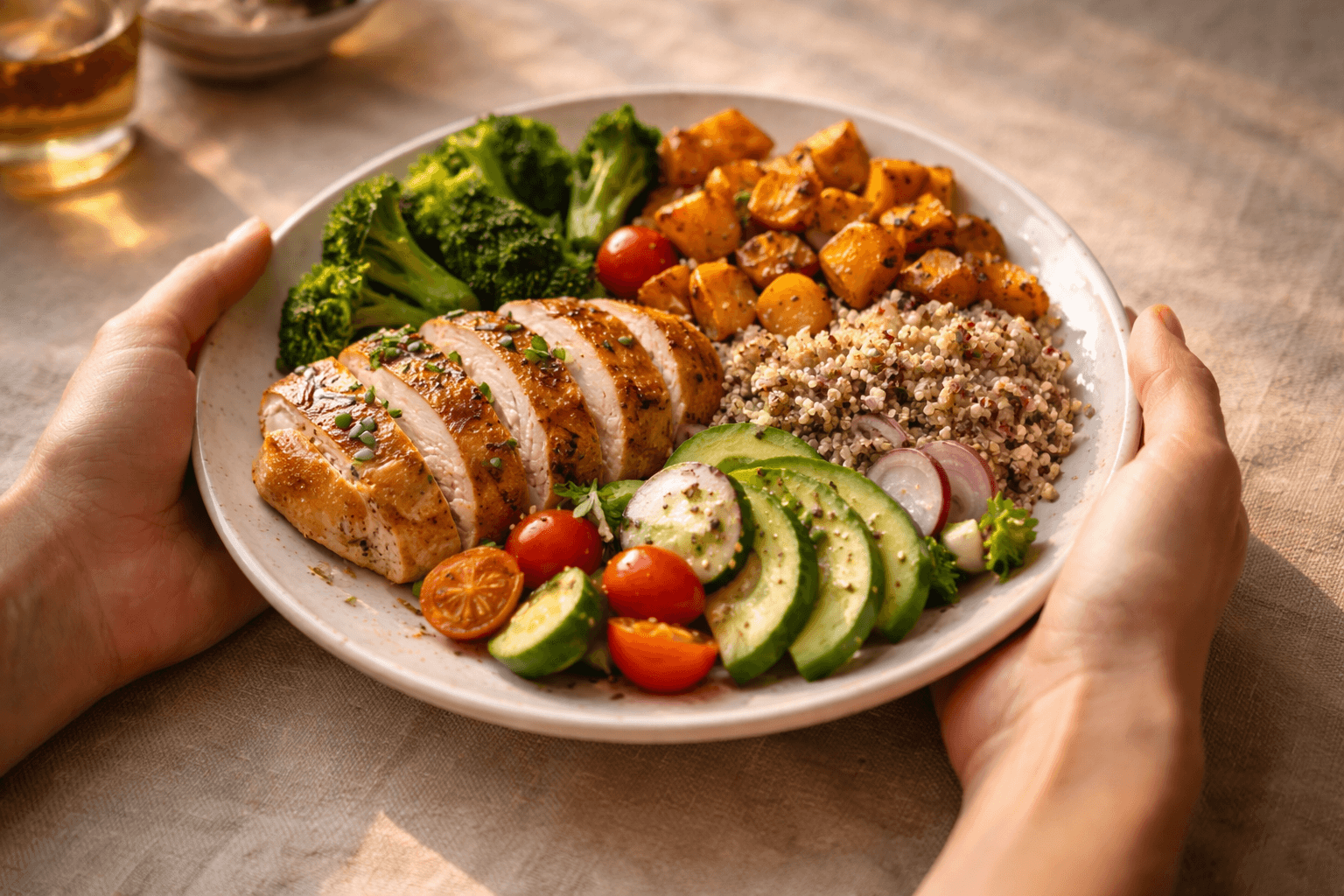
Most people who look for a MyFitnessPal alternative aren't looking for a better calorie tracker. They're looking for a way out of calorie tracking entirely. If that's you — you've tried logging, it worked for a while, then life got busy and it all fell apart — this list is built for that situation.
The apps below are not ranked by features or database size. They're organized by how far they move away from the calorie-counting model and toward something more sustainable. Some still track numbers. Some don't track numbers at all. What they have in common is that they offer a genuinely different approach than MyFitnessPal's core loop of log → hit target → repeat indefinitely.
Why People Leave MyFitnessPal
MyFitnessPal has over 200 million registered users. The vast majority are inactive. That gap between downloads and consistent use tells you everything about the fundamental problem with calorie tracking as a long-term behavior change strategy.
As we've covered in detail, calorie tracking fails most people for three interconnected reasons: it triggers metabolic adaptation that works against weight loss, it requires a level of sustained cognitive effort that eventually collapses under real-life conditions, and it creates a numerical relationship with food that damages rather than improves eating behavior over time.
The right alternative depends on what specifically wasn't working for you. Here are five options — each solving the problem differently.
1. Eated — Build Habits Instead of Tracking Numbers
Best for: People who want eating well to eventually become automatic
Eated is the furthest departure from MyFitnessPal's model on this list. There are no calories, no macros, no food database, and no daily target to hit. Instead, Eated is built on habit formation science and the Harvard Plate Method — a visual framework for meal composition developed by Harvard T.H. Chan School of Public Health.
How it works: You photograph meals to see plate balance rather than calorie counts. You pick one eating habit from eight evidence-based options and work through structured daily micro-tasks over 8 days, guided by certified nutritionist Irene Astaficheva's video coaching. You receive personalized daily and weekly insights based on your actual eating patterns over time.
What makes it different: Every other app on this list still tracks numbers in some form. Eated doesn't. The premise is that the problem was never a lack of data — it was a lack of automatic behavior. Habits get easier over time. Tracking stays effortful at the same level indefinitely.
The honest limitation: Eated is iOS only and currently doesn't support Android. It also has no intermittent fasting tools, no macro tracking, and no fitness device integration. If you need any of those things, another app on this list will serve you better.
Pricing: Free tier available. 7-day free trial of full features.
Full comparison: Eated vs. MyFitnessPal →
Download Eated on the App Store →
2. Noom — Psychology-Based Coaching With Calorie Awareness
Best for: People who want to understand the "why" behind their eating patterns
Noom occupies an interesting middle ground — it still tracks calories, but it wraps that tracking in a genuine behavioral psychology framework. Daily 5-10 minute lessons draw on Cognitive Behavioral Therapy to help users understand the emotional and cognitive patterns behind their eating. A color-coded food system (green, yellow, orange) makes the calorie dimension more intuitive than a raw number.
Human coaches are included in the subscription — real people available via in-app messaging, not chatbots. This is rare at Noom's price point and is the feature that most consistently drives long-term engagement for users who respond to accountability.
What makes it different from MFP: MyFitnessPal is a data tool. Noom is an education tool that happens to include data. The psychology lessons are genuinely well-produced and go deeper than anything MyFitnessPal offers.
The honest limitation: Noom still requires daily food logging to deliver value. The behavioral education is excellent — but it doesn't solve the fundamental sustainability problem of indefinite tracking. Users who stop engaging with the lessons and logging tend to see progress stall.
Pricing: Approximately $17-42/month depending on plan length. 14-day trial available.
Full comparison: Eated vs. Noom →
3. YAZIO — Clean Design With Best-in-Class Intermittent Fasting
Best for: People who practice intermittent fasting, and European users
YAZIO is the best-designed calorie tracking app that isn't MyFitnessPal. The interface is cleaner, the learning curve is lower, and the food database has genuinely superior coverage of European grocery brands and international foods that North American apps consistently miss.
Its standout feature is intermittent fasting integration — 16:8, 5:2, 6:1, and custom protocols are built directly into the core dashboard rather than bolted on as an afterthought. The fasting timer, eating window notifications, and ketosis tracking are available in the free tier.
What makes it different from MFP: YAZIO is more accessible for beginners, significantly better for non-US users, and uniquely strong for people who combine calorie tracking with intermittent fasting.
The honest limitation: YAZIO still counts calories — it's a more polished version of the same fundamental mechanism. It also requires an internet connection to function, which limits its use for travelers and users with inconsistent connectivity. The free tier is quite restricted compared to competitors like Cronometer.
Pricing: ~$47.90/year (frequent discounts to ~$23.90).
Full comparison: Eated vs. YAZIO →
4. Lose It! — Simple, Affordable Calorie Tracking Done Right
Best for: Budget-conscious users who want straightforward calorie tracking without complexity
Lose It! has been around since 2008 and remains one of the most honest calorie trackers available — it does exactly what it promises without unnecessary complexity or aggressive upsells. The interface is clean, onboarding takes minutes, and the free tier is genuinely functional for basic calorie counting.
At approximately $39.99/year for premium, it offers comparable tracking functionality to MyFitnessPal at roughly half the price. The database covers 47 million food items, barcode scanning is fast, and the app integrates with Apple Health, Fitbit, and Garmin.
What makes it different from MFP: Lose It! is simpler, cheaper, and more honest about what it is. It doesn't try to be a psychology platform or a health ecosystem — it's a calorie tracker, and a good one.
The honest limitation: Lose It! is the closest thing to MyFitnessPal on this list. If you're leaving MFP because calorie tracking isn't working for you, Lose It! is not a fundamentally different solution — it's a more affordable version of the same approach.
Pricing: Free tier available. ~$39.99/year for premium. Lifetime option at $189.99.
Full comparison: Eated vs. Lose It! →
5. Cronometer — Clinical-Grade Micronutrient Tracking
Best for: People with specific clinical nutrition needs, vegans, and serious health optimizers
Cronometer is in a different category from everything else on this list. It's not trying to help you lose weight through a more appealing interface — it's the most scientifically rigorous nutrition tracker available to consumers, built for people who need to monitor specific micronutrients rather than just calories and macros.
The database draws from verified scientific sources (USDA SR Legacy, NCCDB) rather than user-submitted data, tracking up to 84 micronutrients across 300,000+ foods. Registered dietitians recommend it more often than any other consumer app for clinical use.
What makes it different from MFP: Cronometer's data is significantly more accurate and far more detailed. If you're managing a condition that requires monitoring specific nutrients — iron, B12, potassium, vitamin D — it's the only consumer app that does this reliably.
The honest limitation: Cronometer is not a MyFitnessPal alternative for general healthy eating. It's a clinical tool for users with specific nutritional monitoring needs. The interface is dense, the learning curve is steep, and for most people who just want to eat better, the data depth is far more than needed.
Pricing: Generous free tier. ~$4.99-10.99/month or ~$49.99-59.88/year for Gold.
Full comparison: Eated vs. Cronometer →
How to Choose
The right app depends on one question: why wasn't MyFitnessPal working for you?
If calorie tracking felt unsustainable and you want to stop tracking entirely → Eated. It's the only app on this list that removes numerical tracking from the equation completely.
If you want to understand your eating patterns better before changing them → Noom. The psychology education is genuine and the human coaching provides accountability that MFP never offered.
If you practice intermittent fasting or you're outside the US → YAZIO. Its IF integration and international database coverage are genuinely best in class.
If you just want cheaper, simpler calorie tracking → Lose It!. Same mechanism as MFP, lower price, less friction.
If you have a specific clinical nutrition need → Cronometer. Nothing else comes close for micronutrient monitoring accuracy.
Frequently Asked Questions
What is the best free MyFitnessPal alternative?
For habit-based eating without calorie counting, Eated offers a free tier with a 7-day trial of full features. For calorie tracking specifically, Cronometer has the most generous free tier — full micronutrient tracking with no time limit, only ads and a 7-day data history cap.
Is there a MyFitnessPal alternative without calorie counting?
Yes — Eated is built specifically for people who want to improve their eating without calorie tracking. It uses the Harvard Plate Method to assess meal composition visually rather than numerically. No calorie budget, no food database, no daily target.
Why do people stop using MyFitnessPal?
The most consistent reasons are logging fatigue (the daily effort of entering every meal becomes unsustainable), accuracy frustration (calorie estimates are often imprecise), and the return of old habits when tracking stops. Most people who quit MFP find that the tracking was doing the behavioral work rather than an internalized habit — so when the app goes, the progress goes with it.
Is Noom better than MyFitnessPal?
Noom is more expensive than MyFitnessPal and still tracks calories — but it adds behavioral psychology education and human coaching that MyFitnessPal doesn't offer. For users who respond to structured learning and accountability, Noom delivers more value. For users who just want data, MyFitnessPal is more comprehensive at a lower price.
Which MyFitnessPal alternative is best for weight loss?
All five apps on this list support weight loss through different mechanisms. Research consistently shows that long-term weight management depends more on behavioral sustainability than on tracking precision — which is why habit-based approaches like Eated tend to produce more durable results than calorie tracking alone, even if the initial progress is slower.
The Bottom Line
The best MyFitnessPal alternative is the one that changes the mechanism, not just the interface. If calorie tracking wasn't working, a cleaner calorie tracker is unlikely to solve the problem. The apps that address the root issue — habit formation, behavioral sustainability, the ability to eat well without active effort — are the ones worth trying next.
If you're ready to try an approach that doesn't involve counting anything, download Eated on the App Store and start with a 7-day free trial. Or begin with the free Habit Wheel — a five-minute tool to identify which eating habit to build first.