
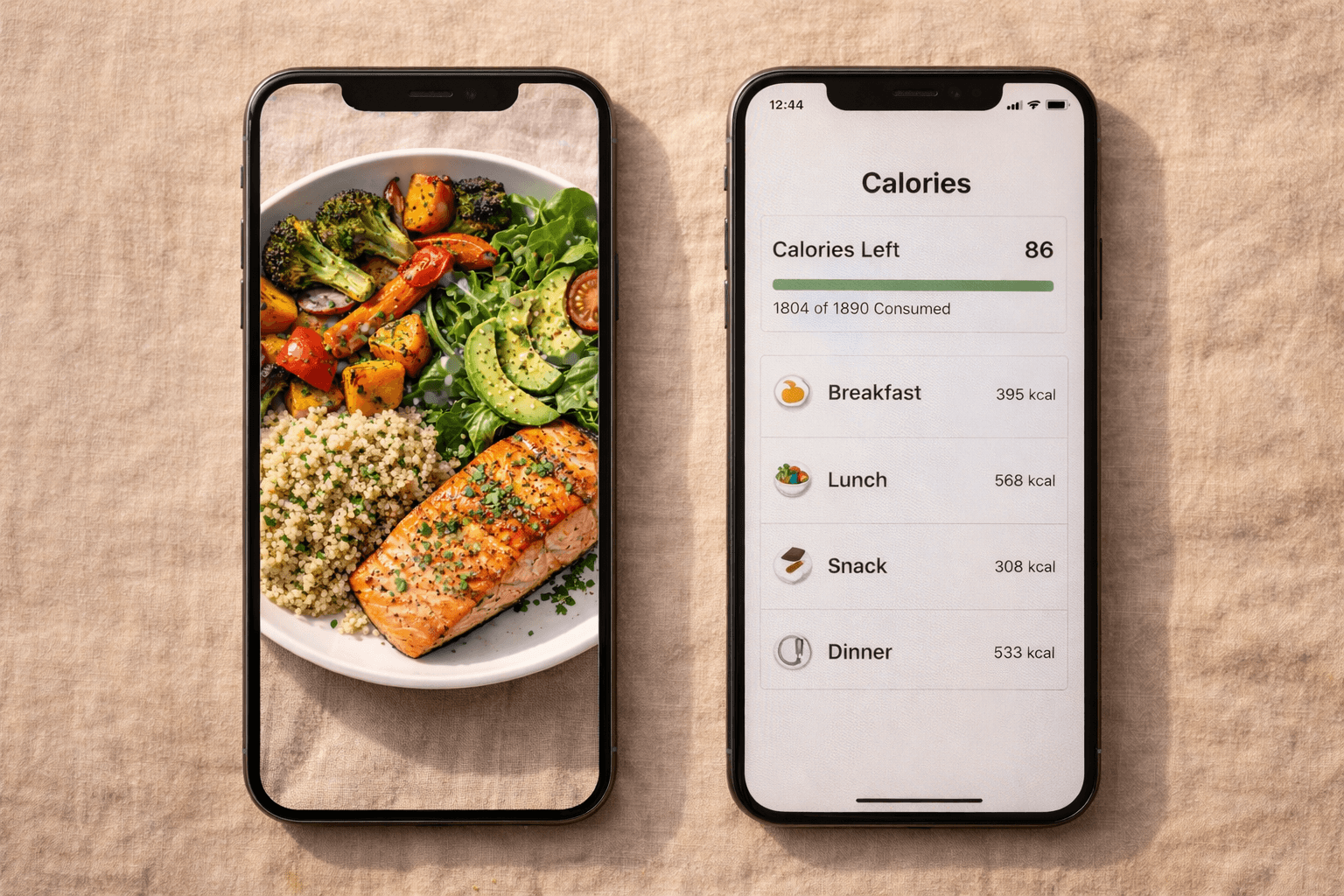
MyFitnessPal and Eated are both nutrition apps — but they are built on fundamentally different premises about how people actually change their eating behavior. MyFitnessPal is built on the idea that tracking calories creates awareness, and awareness produces change. Eated is built on the idea that habits produce change, and that calorie tracking is the wrong mechanism for most people trying to eat better long-term. That single difference in premise drives every product decision, every feature, and every user experience both apps deliver.
This is not a features comparison. It is a comparison of two different theories of behavior change — and an honest look at which one works for whom.
What MyFitnessPal Is Built On
MyFitnessPal launched in 2005 and is now the most downloaded nutrition app in the world, with over 200 million registered users. Its core model is straightforward: log everything you eat, hit a daily calorie target, create a deficit, lose weight.
The product executes this model well. MyFitnessPal has one of the largest food databases available — over 14 million foods — with barcode scanning, recipe logging, macro tracking, and deep integrations with wearables like Fitbit, Apple Watch, and Garmin. For people who want granular nutritional data, it delivers more than almost anything else on the market.
The underlying logic is energy balance: calories in minus calories out equals weight change. This is physiologically true at a basic level, and MyFitnessPal is genuinely useful for people who need precise data — athletes managing performance nutrition, people working with a clinical dietitian on a specific medical protocol, or anyone who benefits from short-term dietary awareness.
The problem is not what MyFitnessPal tracks. The problem is what happens when most people try to maintain that tracking indefinitely.
What Eated Is Built On
Eated was built from a different starting question: if people already know roughly what healthy eating looks like, why don't they do it consistently?
The answer, backed by behavioral research on habit formation, is that knowledge and intention are not the limiting factors. Automaticity is. People eat well when eating well becomes a default behavior — something that happens without sustained deliberate effort. Calorie tracking requires deliberate effort at every meal, indefinitely. That's why adherence collapses.
Eated is built on the Harvard Plate Method — an evidence-based visual framework for meal composition that replaces calculation with pattern recognition. Instead of logging calories, users photograph meals to see plate balance. Instead of hitting daily targets, they build one eating habit at a time through structured micro-tasks and guided learning. Instead of tracking numbers, they receive next-day insights based on their actual eating patterns.
"I spent years coaching clients who had tried MyFitnessPal and quit — sometimes multiple times. The pattern was always the same: they did well for a few weeks, then life happened, the streak broke, and the guilt made it hard to restart. What they needed wasn't better tracking. They needed a different relationship with food entirely. That's what we built Eated around." — Irene Astaficheva, certified nutritionist, co-founder of Eated
How They Compare — A Side-by-Side Look
Category | Eated | MyFitnessPal |
|---|---|---|
Core approach | Habit formation via visual plate balance | Calorie and macro tracking |
What you log | Meal photos — plate composition | Every food item with weight/portion |
Framework | Harvard Plate Method | Calorie deficit / CICO model |
How success is measured | Habit streaks, plate balance, weekly insights | Daily calorie targets, macro percentages |
Daily effort required | Low — one photo per meal | High — manual logging of every item |
Learning curve | Minimal | Moderate to high |
Long-term sustainability | Designed to get easier over time | Requires sustained effort to maintain |
Best for | Building lasting eating habits | Precise nutritional data tracking |
Calorie tracking | No | Yes |
Habit building | Yes — structured 8-day habit programs | No |
Personalized insights | Daily and weekly, AI-generated | Basic progress charts |
Platform | iOS | iOS and Android |
Free tier | Yes, with 7-day trial of full features | Yes, with premium upsell |
Where MyFitnessPal Works Well
MyFitnessPal is the right tool in specific contexts, and saying otherwise would be dishonest.
Performance athletes who need to hit precise macro targets — a certain amount of protein per kilogram of bodyweight, a specific carbohydrate window around training — benefit from the granular data MyFitnessPal provides. The database depth and wearable integrations make it genuinely useful for this use case.
Short-term dietary awareness is another legitimate use. Logging meals for two to four weeks can reveal patterns people genuinely didn't know existed — where the majority of calories come from, which meals are nutritionally complete, how much added sugar is in seemingly healthy foods. As a temporary audit tool, it has value.
Clinical contexts — working with a dietitian on a specific medical protocol, managing a condition that requires precise nutrient monitoring — are situations where detailed tracking is medically appropriate and where a professional is interpreting the data.
The issue is that MyFitnessPal is marketed and used primarily as a long-term weight management tool, and for that application, the evidence for sustained calorie tracking is weak. Most people who rely on it quit within weeks, and those who lose weight through calorie restriction alone have high rates of regain when tracking stops.
Looking for a MyFitnessPal Alternative?
Where the Habit-Based Approach Works Better
Eated is built for a specific person: someone who has tried calorie tracking — possibly multiple times — and found it unsustainable. Someone who understands roughly what healthy eating looks like but can't maintain it consistently when life gets busy. Someone who wants to change their relationship with food, not just their daily calorie number.
This is a large group. MyFitnessPal's 200 million registered users are mostly inactive — the majority quit early. The people who need a different approach outnumber the people for whom calorie tracking is working.
The habit-based approach works better in several specific situations:
Busy, variable schedules. Calorie tracking requires consistent logging to be accurate. Travel, social meals, and unpredictable days break the chain. Visual plate balance requires no database, no measurement, and no app open — it travels with you.
People with a history of disordered eating patterns. Attaching numbers to food is known to exacerbate anxiety around eating for people prone to restrictive patterns. A composition-based approach removes the numerical judgment entirely.
Long-term sustainers. People who want to build eating patterns that last decades, not weeks. Habits compound. Tracking doesn't — it stays effortful at the same level indefinitely.
Families and communal eating. Logging a shared meal or a home-cooked dish with multiple ingredients in MyFitnessPal is genuinely difficult. The Harvard Plate method applies to any meal in any context without calculation.
The Fundamental Question: What Are You Actually Trying to Change?
This is the question worth sitting with before choosing any nutrition tool.
Calorie tracking changes what you are aware of. It does not change what you automatically reach for when you are tired, stressed, or eating at someone else's house. Awareness requires your conscious attention to function — and conscious attention is a finite resource that runs out by the end of a long day.
Habit building changes what you automatically do. A well-formed eating habit operates without deliberate effort — the same way you don't think about how to drive a familiar route. Building that automaticity takes longer than downloading an app and hitting a calorie target. But once it exists, it doesn't require maintenance the way tracking does. It gets easier over time, not harder.
If you want precise data for a specific short-term goal, MyFitnessPal is a reasonable tool. If you want to change how you eat for the rest of your life, the mechanism needs to be habit formation — not tracking.
Frequently Asked Questions
Is Eated better than MyFitnessPal?
It depends entirely on what you are trying to do. MyFitnessPal is better for precise calorie and macro tracking, performance nutrition, and short-term dietary audits. Eated is better for building sustainable eating habits, reducing the cognitive load of healthy eating, and developing a long-term relationship with food that doesn't require ongoing tracking. For most people who have tried and quit calorie tracking, Eated addresses the actual problem — which is habit formation, not data collection.
Can you use Eated and MyFitnessPal together?
You can, but the approaches work from different premises and can create conflicting feedback. Using both simultaneously tends to pull attention back toward calorie numbers, which undermines the habit-formation process Eated is designed to support. Most users find it more effective to commit to one approach for a defined period rather than combining them.
Does Eated track calories?
No. Eated tracks meal composition — how balanced your plate is relative to the Harvard Plate Method — not calorie totals. The app generates insights based on food patterns rather than numerical targets. This is a deliberate product decision, not a missing feature.
What is the main difference between Eated and MyFitnessPal?
The core difference is the mechanism of change. MyFitnessPal uses calorie awareness as the driver of behavior change. Eated uses habit formation. Everything else — what you log, how you measure progress, what the app shows you — follows from that fundamental difference in approach.
Who is Eated designed for?
Eated is designed for people who want to build lasting healthy eating habits without calorie counting. Specifically, it works well for people who have tried tracking apps before and found them unsustainable, people with busy or variable schedules, people who want to improve their relationship with food rather than just manage a number, and anyone looking for a lower-effort approach to consistent healthy eating.
The Bottom Line
MyFitnessPal and Eated are solving different problems. MyFitnessPal helps you track what you eat. Eated helps you change how you eat — automatically, sustainably, without the daily effort that tracking requires.
If you've been around the block with calorie counting and you're looking for something built on a different premise, download Eated on the App Store and start with a 7-day free trial. Or begin with the free Habit Wheel — a five-minute framework to identify which eating habit to build first.