Cycle syncing — the practice of adapting your diet and exercise to the four phases of the menstrual cycle — has become one of the most discussed nutrition trends of the past few years. TikTok and Instagram are full of detailed phase-by-phase food guides, often presented as though the science is settled. It isn't. Some parts of cycle syncing are genuinely supported by research. Others are extrapolated far beyond what the evidence shows. This post covers the distinction clearly — what's real, what's plausible but unproven, and what to actually do with the information.
What Cycle Syncing Claims
The cycle syncing framework — popularized by Alisa Vitti in her book WomanCode — proposes that the four menstrual cycle phases (menstrual, follicular, ovulatory, luteal) each create distinct hormonal environments that respond differently to food. The claim is that eating phase-specific foods optimizes hormonal balance, energy, metabolism, and symptom management.
The recommendations vary by source but generally follow a pattern: iron-rich foods during menstruation, lighter foods and antioxidants during the follicular phase, fiber and cruciferous vegetables during ovulation, and complex carbohydrates and magnesium-rich foods during the luteal phase.
The idea is intuitively appealing — the cycle is real, hormones fluctuate significantly, and food does affect hormones. The problem is that the evidence for specific dietary prescriptions mapped to specific cycle phases is much weaker than the social media presentation implies.
What the Research Actually Supports
1. Hunger and appetite do change across the cycle — but less consistently than cycle syncing suggests
A 2023 Nutritional Reviews meta-analysis — the first comprehensive review of dietary energy intake across the menstrual cycle — found that food intake and energy expenditure do vary between phases on average, with the luteal phase associated with higher intake. Progesterone elevates resting metabolic rate and appetite, which is real and well-documented.
However, a 2025 preprint from the University of British Columbia measuring hunger, food intake, and resting metabolic rate across cycle phases in healthy premenopausal women using precise hormonal verification found that — contrary to expectations — appetite and energy intake were largely consistent across phases under controlled conditions. Individual variation was high enough that population-level averages obscured rather than described individual experience.
This is covered in more depth in how the menstrual cycle affects hunger — the short version is: the mechanism is real, but the magnitude varies significantly by individual.
2. Diet affects menstrual symptoms — the evidence for specific foods is limited
A 2024 review of 28 studies on diet and menstrual symptoms found that anti-inflammatory dietary patterns were associated with reduced PMS and dysmenorrhea. Higher fiber, more omega-3s, adequate vitamin D and magnesium, and less ultra-processed food are all consistently associated with better menstrual symptom profiles.
What the research does not support: specific phase-by-phase food prescriptions. "Eat flaxseeds in the follicular phase" or "avoid dairy in the luteal phase" — these are plausible hypotheses extrapolated from hormone physiology, but they haven't been tested in controlled trials. The broad anti-inflammatory dietary pattern has evidence. The granular phase-specific prescriptions don't.
3. Cycle syncing content on social media significantly overstates the evidence
A 2025 content analysis of TikTok cycle syncing videos found that only about one-third of creators provided any credentials, and very few mentioned scientific evidence for their recommendations. The researchers concluded that "cycle syncing content on TikTok oversimplifies a complex literature" and noted potential for misinformation.
A separate 2025 study examining cycle syncing messaging and health behaviors found that clinical research on the effects of cycle syncing remains "inconclusive" — and raised concerns that the trend could perpetuate gender stereotypes about female bodies as hormonally unstable and in need of constant management.
What's Worth Taking From Cycle Syncing (Even Without Strong Evidence)
Being honest about the evidence gaps doesn't mean cycle syncing has no value. Several elements are genuinely useful regardless of whether the specific phase-food pairings are proven.
Increased body awareness. The practice of paying attention to how you feel, eat, and perform across the cycle builds interoceptive awareness — which has independent value for hunger recognition, emotional eating patterns, and general wellbeing. Tracking your cycle alongside your energy, hunger, and mood for two to three months reveals your personal pattern, which matters more than population averages.
Addressing real nutritional gaps. Iron needs attention during and after menstruation — particularly for people with heavy periods, where iron-deficiency risk is meaningful. Magnesium has reasonable evidence for reducing PMS cramping and mood symptoms. Omega-3s have anti-inflammatory properties relevant to dysmenorrhea. These aren't phase-specific prescriptions so much as nutrients worth ensuring are adequate throughout the month.
Making sense of luteal phase hunger. Understanding that the increased appetite before your period has a physiological basis — not a willpower failure — is genuinely useful. It changes how you interpret the experience and whether you respond with restriction (which tends to worsen the pattern) or with adequacy.
Permission to eat differently at different times. For people coming from restrictive eating backgrounds, the cycle syncing framework can provide permission to eat more in the luteal phase without guilt. That psychological shift has value, even if the specific food recommendations aren't evidence-based.
What the Evidence Supports: A Practical Framework
Rather than phase-specific prescriptions, the research points to principles that apply across the whole cycle with some luteal phase adjustments:
Consistently throughout the cycle:
Prioritize anti-inflammatory foods: fatty fish, leafy greens, berries, olive oil, whole grains
Ensure adequate iron (especially important if periods are heavy): red meat, legumes, dark leafy greens with vitamin C for absorption
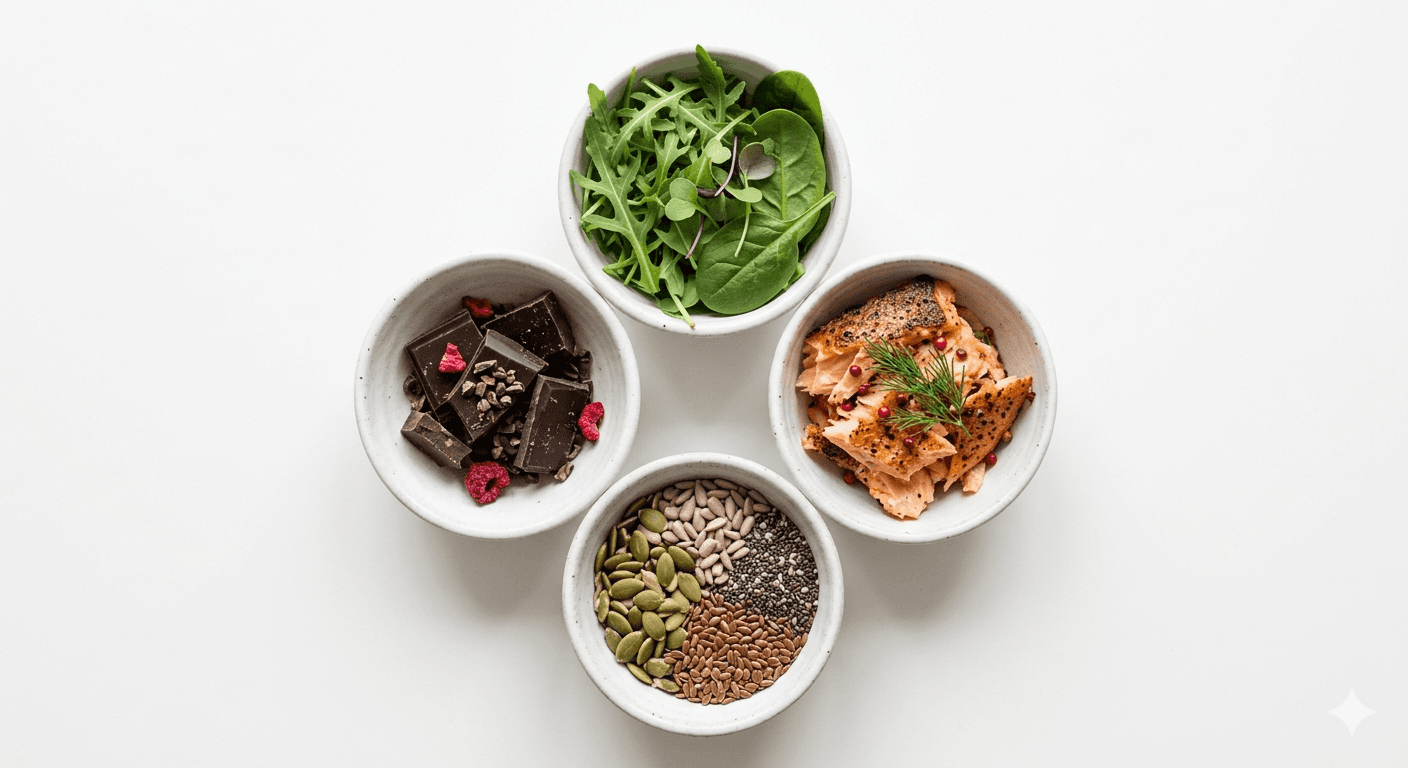
Maintain adequate magnesium: dark chocolate, nuts, seeds, legumes
Reduce ultra-processed food — consistently associated with worse PMS outcomes
In the luteal phase specifically:
Allow for slightly higher food intake — the increased appetite reflects real metabolic need
Complex carbohydrates (oats, sweet potato, whole grains) over refined ones — these raise serotonin similarly but with better satiety and less blood sugar volatility
Don't restrict harder — luteal phase restriction intensifies cravings and worsens the restriction-compensation pattern
What's overhyped and worth ignoring:
Specific phase-by-phase food lists without evidence base
Claims that the wrong food in the wrong phase will "disrupt your hormones"
Seed cycling (flaxseeds in follicular, pumpkin in luteal, etc.) — a popular practice with essentially no clinical evidence
"I'm careful about how I present cycle syncing to clients because the framework can be genuinely useful for building body awareness — but the specific prescriptions are mostly extrapolation, not evidence. What I tell people is: track how you feel across your cycle, notice your patterns, eat anti-inflammatory foods consistently, and give yourself permission to eat more in the two weeks before your period. That's the part that has evidence. The rest is interesting hypothesis."
— Irene Astaficheva, PN1, PN-SSR, GGS-1
How This Connects to Hormonal Health More Broadly
Cycle syncing is one piece of a larger picture of how food and hormones interact in women. What the research shows about eating for hormonal health covers the broader evidence — including the estrobolome, gut-estrogen connection, and dietary patterns that consistently improve hormonal balance markers.
The consistent finding across that literature: overall dietary pattern matters more than specific food timing. A Mediterranean-adjacent eating pattern — high vegetables, quality protein, healthy fats, low ultra-processed food — improves hormonal health markers regardless of cycle phase.
Honest Limitations
The cycle syncing research gap is real and acknowledged by researchers in the field. Most nutrition research has historically excluded cycling women or failed to control for cycle phase — which means many nutritional recommendations that exist weren't developed with female physiology in mind. This is a legitimate criticism of the field, not just cycle syncing advocates.
The practice of paying attention to your cycle and your body is genuinely valuable, and the lack of clinical evidence for specific food prescriptions doesn't mean they're wrong — it means they're untested. Some of them may well be validated by future research. The honest position is "plausible but unproven," not "disproven."
Cycle syncing is not appropriate as a framework for managing clinical conditions like PCOS, endometriosis, or hypothalamic amenorrhea without clinical guidance. These conditions have specific nutritional considerations that go beyond what a general cycle syncing approach addresses. The research on eating and PCOS covers the PCOS-specific evidence separately.
FAQ
Does cycle syncing actually work? "Work" needs a definition. For building body awareness, noticing personal patterns, and understanding that luteal phase hunger is physiological — yes, the framework is useful. For the specific phase-by-phase food prescriptions — the evidence is insufficient to confirm or deny. The overall practice of eating anti-inflammatorily and giving yourself permission to eat more in the luteal phase has reasonable support. The detailed food lists circulating on social media don't.
Should I eat more before my period? Yes — slightly. The luteal phase increases resting metabolic rate and appetite, and the increased hunger reflects real physiological need. Restricting harder in the luteal phase tends to intensify cravings and worsen the restriction-compensation cycle. A modest increase in complex carbohydrates and overall food intake is appropriate.
Is seed cycling evidence-based? No. Seed cycling — the practice of eating flaxseeds and pumpkin seeds in the follicular phase and sunflower seeds and sesame seeds in the luteal phase to influence estrogen and progesterone — has no clinical trial evidence to support it. Seeds are nutritious foods. The specific cycling protocol has no evidence base.
Does cycle syncing help with PMS? An anti-inflammatory dietary pattern is associated with reduced PMS symptoms — and that's what most cycle syncing recommendations broadly point toward. If following a cycle syncing framework leads you to eat more vegetables, fish, and whole grains and less ultra-processed food, it's likely to improve PMS symptoms. Whether the specific phase-food pairings add anything beyond the overall dietary quality improvement is unknown.
Can I do cycle syncing with hormonal contraceptives? The hormonal fluctuations that cycle syncing is designed around don't occur on combined hormonal contraceptives — estrogen and progesterone are kept at relatively stable levels. The framework applies most directly to naturally cycling women. That said, the general anti-inflammatory dietary principles still apply regardless of contraceptive use.
Bottom Line
Cycle syncing contains genuine insights — hunger does increase in the luteal phase, diet does affect menstrual symptoms, and body awareness is valuable. The error is the certainty with which social media presents phase-specific food prescriptions that the research doesn't actually support.
The evidence-based version of eating for your cycle is simpler: eat anti-inflammatorily throughout the month, ensure iron and magnesium are adequate, allow for more food in the luteal phase without guilt, and track your personal patterns rather than following a generic prescription. The elaborate food lists are interesting hypotheses. Treat them as inspiration, not protocol.
Download Eated
If you want to build eating habits that work with your body's natural rhythms — without following a rigid food protocol — the Eated app is free to download on iOS. 7-day free trial, $9.99/month or $59.99/year after.