
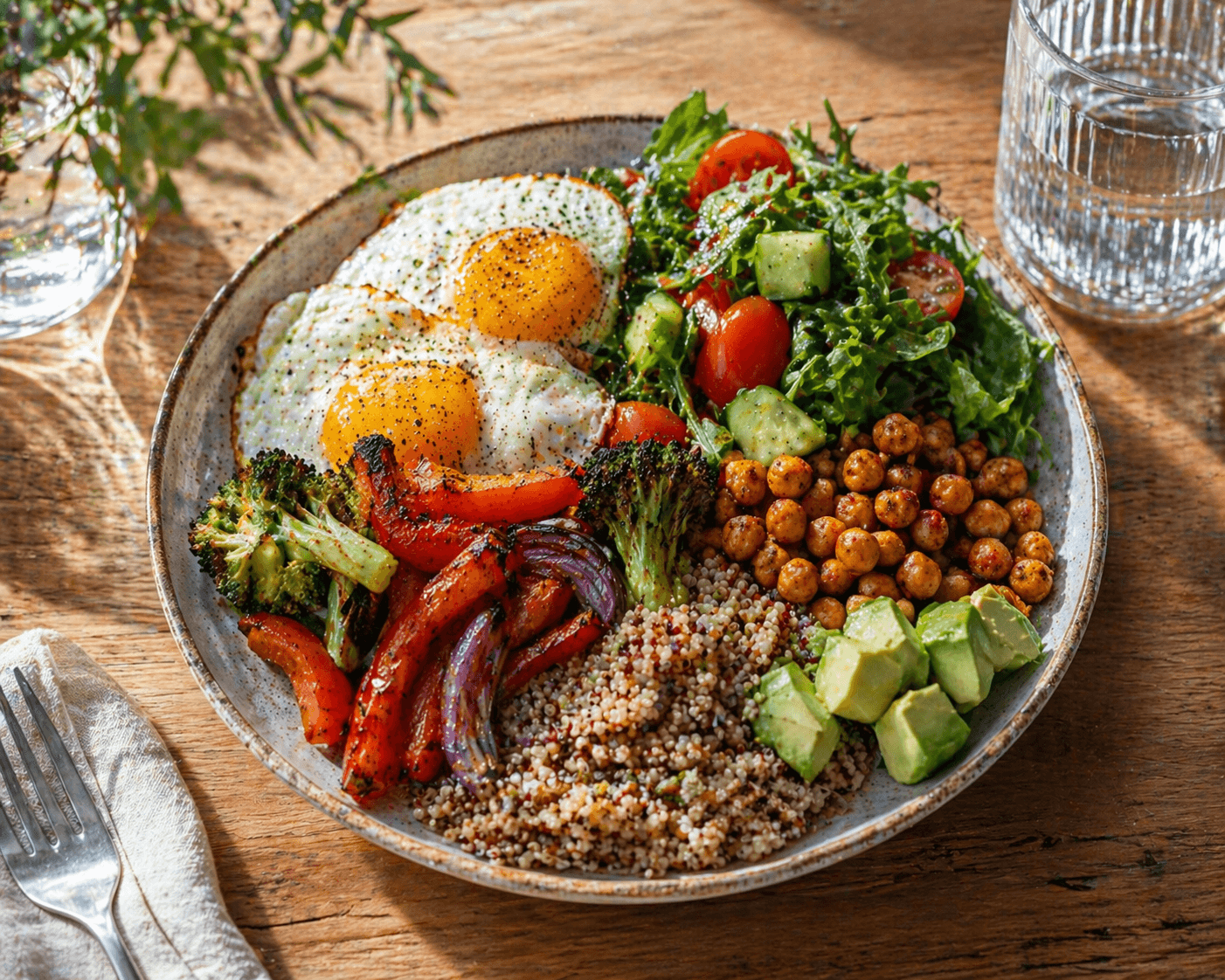
Some foods keep you full for three to four hours. Others leave you looking for something else within 45 minutes. The difference isn't random — it's driven by three measurable properties: protein content, fibre content, and energy density. Understanding those three levers tells you what to eat to stay satisfied longer, without tracking calories or restricting portions.
Why Satiety Is Not About Eating Less
The standard weight loss advice frames fullness as something to override — eat smaller portions, use smaller plates, stop before you want to. That framing is backwards.
The goal isn't to feel full on less food through discipline. It's to eat food that genuinely produces satiety at a lower caloric intake — so the stopping point arrives naturally, not through willpower.
These are different strategies with different sustainability profiles. Restriction relies on ongoing effort. Satiety engineering changes what the effort feels like. A plate built around high-satiety foods keeps you satisfied until the next meal without any deliberate restraint — the biology does the work.
This connects directly to how a calorie deficit can happen without counting: when your food produces genuine satiety, you eat less as a consequence, not as an intention.
The Three Satiety Mechanisms
Mechanism 1: Protein
Protein is the most satiating macronutrient, and the evidence for this is consistent across decades of research. A 2020 systematic review and meta-analysis in Nutrition, Metabolism & Cardiovascular Diseases covering 49 studies found that acute protein ingestion significantly reduced hunger, increased fullness, decreased desire to eat, and suppressed ghrelin — the primary hunger hormone — while increasing cholecystokinin and GLP-1, the gut hormones that signal satisfaction.
The mechanism operates through several pathways simultaneously: protein stimulates more gut hormone release than carbohydrate or fat per calorie, it requires more energy to digest (the thermic effect of food is highest for protein), and it provides slower gastric emptying — meaning the stomach takes longer to clear, extending the fullness window.
Practically, a palm-sized portion of protein at each meal — eggs, chicken, fish, legumes, Greek yogurt, cottage cheese — is the single highest-leverage change for most people trying to eat less without feeling deprived. How to portion it without a scale is the practical application.
Mechanism 2: Fibre
Fibre extends satiety through two distinct pathways. Insoluble fibre (found in vegetables, wholegrains, pulses) adds physical bulk and increases chewing time, which slows eating rate and activates mechanical stretch receptors in the stomach earlier. Soluble fibre (found in oats, lentils, apples, flaxseed) forms a gel in the digestive tract that slows gastric emptying and glucose absorption, producing a longer, more gradual satiety curve.
A review of soluble dietary fibre and satiety in the PMC literature found consistent evidence that soluble fibre reduces energy intake and prolongs perceived fullness, particularly when consumed as part of a solid food matrix rather than as a supplement. The food form matters — fibre in whole foods works better than fibre powders added to processed foods, because the food structure itself contributes to the mechanical signals.
Average fibre intake in Western diets sits at roughly 15–17g per day. Recommended intake is 25–30g. That gap is significant for satiety — it represents the difference between a diet that keeps you hungry and one that doesn't.
Mechanism 3: Energy Density
Energy density is calories per gram of food. It's the lever most people don't think about explicitly but that determines more about satiety than almost anything else.
A 2023 review in Philosophical Transactions of the Royal Society B confirmed what the energy density literature has shown for decades: people tend to eat a consistent weight of food, regardless of caloric content. When the energy density of available food goes down — more water, more fibre, less fat — total caloric intake decreases, without any reduction in the physical volume of food eaten.
Water content is the primary driver of energy density. Vegetables are 80–95% water. Cooked oats are roughly 85% water. Crisps and crackers are under 5%. This is why a large bowl of soup keeps you fuller than a small bag of crisps despite potentially containing fewer calories — the stomach registers volume, not calories.
A 2017 review in Nutrition Bulletin summarized the practical application: when people incorporate more low-energy-density foods — particularly vegetables, fruit, and broth-based dishes — into meals, they spontaneously reduce ad libitum energy intake without any deliberate restriction. The structure does the work.
The Foods That Actually Deliver on All Three Mechanisms
Not every food is high on all three satiety axes. Here's where the evidence points:
Eggs — High protein, moderate fat, low energy density relative to their volume cooked. Consistently one of the highest-scoring breakfast foods in satiety research. Specifically, starting the day with eggs rather than a carbohydrate-dominant breakfast (cereal, toast, pastry) produces lower hunger ratings and lower calorie intake at subsequent meals.
Legumes — lentils, chickpeas, black beans — High protein for a plant-based food, very high in both soluble and insoluble fibre, high water content when cooked, low energy density. One of the most underused satiety foods. A 2016 systematic review in Obesity found legume consumption significantly increased fullness compared to control meals matched for calories.
Greek yogurt and cottage cheese — High protein, moderate volume, low to moderate energy density. Particularly useful as snacks because the protein content prevents the hunger return that follows most carbohydrate-dominant snacks within 60–90 minutes.
Oats — High in beta-glucan, a soluble fibre with strong satiety evidence. Slower gastric emptying than most breakfast cereals. The satiety effect of oats relative to other breakfast foods is one of the better-replicated findings in the nutrition literature.
Vegetables — particularly leafy greens, broccoli, courgette, cucumber, tomatoes — Extremely low energy density (largely water and fibre), high volume. Not a primary protein or fibre source in meaningful amounts, but the volume contribution to satiety is real. Filling half a plate with vegetables before eating the rest of the meal consistently reduces total meal calorie intake without reducing satisfaction ratings.
Whole fruit — Higher fibre and water content than juice, lower energy density. The chewing time and volume contribute to satiety in a way that fruit juice categorically does not — liquid calories bypass the satiety mechanisms that solid food activates.
Fish and lean poultry — High protein, moderate energy density, low fat relative to caloric contribution. Among the highest satiety-per-calorie foods in the protein category.
What Low-Satiety Foods Have in Common
It's easier to understand what makes food satiating by looking at what makes food specifically unsatiating:
High energy density + low protein + low fibre + low water content. That's the profile of most ultra-processed snacks — crisps, biscuits, processed crackers, most breakfast cereals. They deliver a high caloric load in a small physical volume, with minimal protein or fibre to slow digestion or trigger satiety hormones.
The NIH ultra-processed food RCT found participants consumed 500 more calories per day on ultra-processed diets despite reporting similar hunger levels — which means the satiety system wasn't failing, it just wasn't being given the inputs it needs to work properly.
Liquid calories deserve special mention. Drinks — including fruit juice, smoothies, and most coffee drinks — largely bypass the gastric stretch receptor signaling that solid food triggers. You can consume 400 calories of orange juice and register almost none of the fullness you'd feel from eating the same caloric equivalent in solid food. This is one of the least appreciated contributors to caloric surplus for people who think they eat well but drink their calories casually.
How to Build a High-Satiety Meal Without a Formula
The Harvard Plate structure captures the satiety principles without requiring you to calculate anything:
Half the plate is vegetables — this is the energy density lever. High volume, low calories, significant fibre.
A quarter is protein — this is the satiety hormone lever. Activates ghrelin suppression and cholecystokinin release.
A quarter is whole grains or complex carbohydrate — this is the sustained energy lever. Fibre content slows glucose absorption and extends the fullness window.
That structure, applied consistently, produces the food environment where satiety happens by default rather than by effort.
"Clients come in convinced they need to eat less. What they usually actually need is to eat differently. A plate of grilled chicken, roasted vegetables, and lentils can be larger than what they were eating before — and they'll feel satisfied longer. The volume goes up, the hunger goes down. That's the satiety mechanism working."
— Irene Astaficheva, PN1, PN-SSR, GGS-1
Honest Limitations
Satiety is individual. The research above reflects population averages, and individual responses vary meaningfully based on gut microbiome composition, metabolic rate, insulin sensitivity, hormonal status, and eating history. What produces 4 hours of fullness for one person may produce 2 hours for another eating the same meal.
Satiety research is also largely conducted in controlled laboratory settings — real-world conditions (distraction, social eating, stress) can override the physiological signals even when the food inputs are right. Eating without distraction is the environmental condition that allows the satiety mechanisms to work as measured.
Finally, women's satiety signals are specifically affected by hormonal phase. Appetite and food intake naturally increase in the luteal phase (the two weeks before menstruation) due to progesterone-driven metabolic changes. Knowing this prevents the common misinterpretation of luteal phase hunger as a lack of willpower — it's a physiological shift that adjusts energy requirements by roughly 100–200 calories per day. Nutrition for women's hormonal health covers this in more detail.
FAQ
Why am I hungry an hour after eating if I ate a full meal? The most common reasons: the meal was carbohydrate-dominant with low protein (fast glucose spike, fast crash), it was eaten quickly (satiety signals hadn't caught up before you stopped), or it was high in energy density but low in volume (stomach didn't register as much food as the calories suggest). Auditing protein content is the fastest diagnostic — a genuinely protein-rich meal should hold hunger for 3–4 hours in most people.
Do I need to eat all three — protein, fibre, and low energy density — at every meal? Ideally yes, but prioritise protein if you have to choose. A meal with strong protein content will hold hunger longer than a high-fibre, low-protein meal. The combination amplifies the effect, but protein is the primary lever for most people.
Is fat satiating? Fat is more calorically dense than protein or carbohydrate and slows gastric emptying, which contributes to satiety — but less per calorie than protein, and without the hormone response that protein generates. The satiety-per-calorie ratio of fat is lower than protein, which is why high-fat foods alone (cheese, nuts, olive oil) don't prevent overeating as reliably as high-protein foods do. That said, adequate fat in a meal extends satisfaction and makes food more palatable — both of which matter for how much you eat and how satisfied you feel afterward.
Are protein shakes and supplements as satiating as whole food protein? Less so. Liquid protein sources trigger weaker satiety signals than solid food protein because the mechanical components of eating — chewing, gastric stretch, slower transit — don't apply to drinks. Whole food protein sources consistently outperform liquid protein in satiety research. Supplements have their place for hitting protein targets, but they're not a substitute for food-based satiety.
Does meal timing affect how satiating food feels? Yes — there's evidence that eating earlier in the day produces better satiety per calorie than eating the same food later. Morning meals appear to produce stronger appetite hormone responses than evening meals, which partly explains why skipping breakfast and eating heavily at night produces more overall intake than front-loading calories does. The night overeating pattern is partly a consequence of this circadian asymmetry in satiety regulation.
Bottom Line
Satiety isn't something you impose on your eating through portion control. It's something you engineer through food choice. Protein, fibre, and energy density are the three variables that determine how long food keeps you full — and the practical application is simpler than it sounds: anchor every meal with a protein source, fill half your plate with vegetables, and choose whole foods over processed ones where you can.
The hunger stops coming back so quickly. That's the outcome — and it doesn't require counting a thing.
Start Here
The Eated Habit Wheel identifies which eating habit will most shift your satiety and hunger patterns specifically. Free, 5 minutes.
The Eated app guides you through building these habits one at a time on iOS — free to download.