
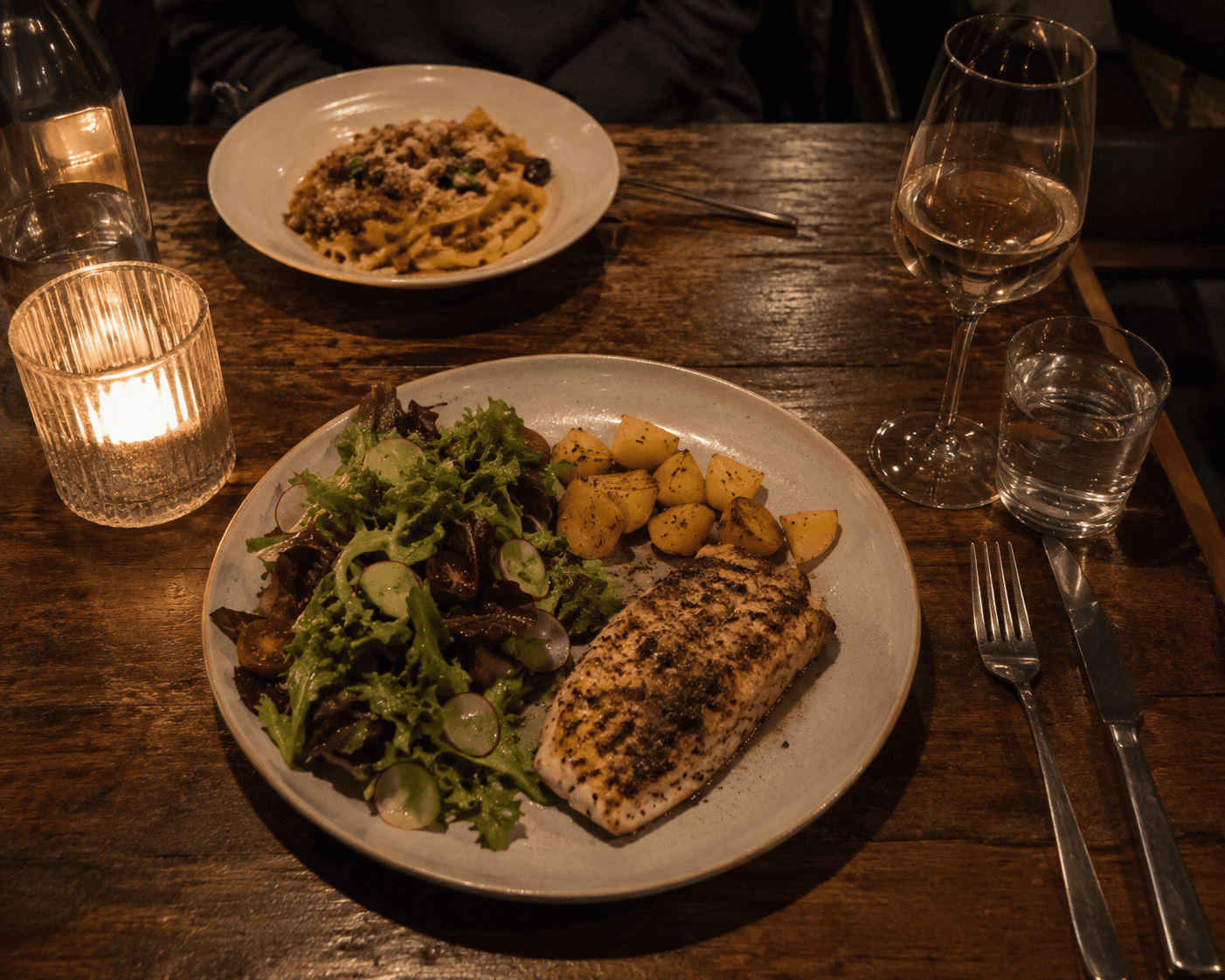
Restaurant meals are typically twice the calorie density of home-cooked meals, have portions significantly larger than physiological need, and are designed around palatability rather than nutritional balance. None of this makes eating out a problem to be avoided — but it does mean that eating out without any framework tends to undermine eating habits that work well at home. The Harvard Plate structure applies in restaurants — it just requires translation from a controlled kitchen environment to a menu-driven one.
Why Restaurants Make Eating Harder
The restaurant food environment is designed to produce consumption, not satiety. Understanding the specific mechanisms explains what you're navigating.
Portion size. Restaurant portions have grown consistently over decades — studies document portions 2–3 times larger than government recommendations across food categories. Research on portion size and consumption consistently finds that people eat more when portions are larger, largely unconsciously — the larger the portion, the more is consumed, regardless of physiological hunger. Restaurants serve more than you need; most people eat most of what's served.
Plate and bowl size. A 2024 study found that large plates make food appear smaller, which increases serving and consumption. Restaurant plates are almost universally larger than home plates — which amplifies the portion size effect by making already-large portions appear normal-sized.
Calorie density. Restaurant food is typically higher in fat, salt, and refined carbohydrates than home-cooked equivalents — ingredients that increase palatability and slow down satiety signaling. A 2024 Cochrane scoping review on restaurant food environment interventions identified calorie density as one of the most significant factors in restaurant overconsumption, noting that even when people intend to eat moderately, the energy content of restaurant food frequently exceeds what they'd estimate.
Social eating pace. Social meals are eaten faster when conversation isn't creating natural pauses — the group eating momentum produces faster consumption and less attention to satiety signals. The food is gone before the fullness signal has completed its 15–20 minute cascade.
The Harvard Plate in a Restaurant: The Translation
The Harvard Plate method divides the meal into half vegetables/fruit, quarter protein, quarter whole grain. In a home kitchen, this is straightforward to implement. In a restaurant, the structure looks different — but the principles apply.
Half the plate as vegetables: In most restaurants, the default plate composition is heavily protein and carbohydrate, with vegetables as a minor accompaniment. The translation: order a side salad or vegetable side dish to add to the main, eat the vegetable components first, or choose dishes where vegetables are central rather than decorative. The goal is that roughly half of what you eat during the meal is vegetable-based — not necessarily what arrives on one plate.
Quarter protein: Most restaurant main courses are protein-heavy — the protein target is usually already met or exceeded. The translation here is less about adding protein and more about recognizing that a full restaurant steak or large chicken portion is often twice the palm-sized reference. Half the protein, eaten slowly, with the vegetable components, is typically sufficient.
Quarter whole grain or starchy vegetable: This is where restaurants often default to refined carbohydrates — white bread, refined pasta, white rice. The translation: choose dishes built on whole grain options where available, or treat the bread basket as part of this quarter rather than as a separate unlimited category. Potatoes, sweet potato, and legume-based sides are also appropriate in this quarter.
Practical Strategies That Work
Before You Order
Review the menu before you're hungry. Decision-making under acute hunger defaults toward calorie-dense, immediately rewarding options. Reviewing the menu before arriving, or before hunger peaks at the table, allows deliberate rather than reactive ordering.
Identify the vegetable source first. Before deciding on the main, identify what will provide the vegetable half. This might be a side salad, a shared vegetable starter, or a main that's vegetable-forward. Deciding this first means it doesn't get dropped when the protein choice dominates.
Order the dressing and sauces on the side. Restaurant sauces and dressings often contain more calories than the food they accompany. This isn't about restriction — it's about control. Dressing on the side allows you to use an appropriate amount rather than whatever the kitchen applies.
At the Table
Start with vegetables, not bread. The bread basket is the most common restaurant eating pattern that works against the plate structure — it's immediately available, eaten before genuine hunger has been assessed, and adds refined carbohydrate before the meal's vegetables and protein have been chosen. Salad or a vegetable starter as the opening course establishes the vegetable-first pattern that the Harvard Plate is built around.
Eat slowly — particularly in the first half of the meal. The research on eating speed and satiety is directly relevant in the restaurant context: the satiety signal takes 15–20 minutes to arrive, and social eating pace is typically faster than solo eating. Deliberate pauses — putting utensils down between bites, engaging in conversation before eating again — allow the signal time to register before the plate is empty.
Assess at the halfway point. When roughly half the food has been eaten, pause and check the hunger level. Most restaurant portions are large enough that stopping at three-quarters full is nutritionally adequate. The cultural norm to finish the plate is the primary mechanism that produces consistent restaurant overconsumption.
Share or request a half portion. Most restaurants will split a dish onto two plates, provide a takeaway container, or offer smaller portions on request. Shared mains are one of the most effective structural strategies for restaurant eating — they remove the plate-completion pressure by changing what "finishing" means.
Choosing From the Menu
Choose cooking methods over specific dishes. Grilled, steamed, poached, and roasted preparations contain significantly less added fat than fried, battered, or cream-based. This is a consistent rule that applies across cuisine types without requiring detailed calorie knowledge.
Vegetable-forward cuisines. Asian cuisines (Japanese, Vietnamese, Thai, Chinese) generally offer better vegetable-protein ratios than Western cuisines by default. Mediterranean restaurants typically have better whole food options. Choosing cuisines with strong vegetable traditions reduces the structural barrier to the plate balance.
Starters as the meal. A protein-based starter (fish, lean meat, seafood) and a shared vegetable dish often provide more nutritional balance and appropriate portion sizes than a single large main course. This isn't about restriction — it's about the structure of the meal matching the plate composition rather than fighting against it.
What About Special Occasions and Social Context
Applying the Harvard Plate structure at every restaurant meal is an appropriate default. Applying it at every meal at every cost — when it creates social friction, when it's someone's birthday, when the only vegetable option is a wilted garnish — is not the goal.
The palm method for portion control is useful here as a reference rather than a rule: a palm of protein, a couple of fists of vegetables, a cupped hand of grains gives a body-referenced anchor that travels to any restaurant in any country without requiring a plate template. It's not precise — it's a calibration tool that keeps portions in a reasonable range when the plate structure can't be applied directly.
The realistic goal for restaurant eating is: apply the principles when practical, don't apply them rigidly when the social or contextual cost is high, and maintain the overall dietary pattern across the week rather than treating any single meal as determinative. One restaurant meal that doesn't follow the plate structure is nutritionally irrelevant. A consistent pattern of restaurant eating that defaults to vegetable-light, portion-unlimited, refined-carbohydrate-heavy meals does affect outcomes over time.
"Restaurant eating is where I see the biggest gap between what my clients do at home and what they do when they're out. At home, the plate structure is automatic. In a restaurant, everything resets. What I teach is pre-deciding — before the menu arrives, you know that you're ordering a vegetable component, you're not eating the whole bread basket, and you're checking in at the halfway point. You're not restricting. You're just not eating on autopilot."
— Irene Astaficheva, PN1, PN-SSR, GGS-1
Honest Limitations
The Harvard Plate structure was designed for home meal preparation and translates imperfectly to restaurant contexts where menu composition is fixed and plate balance isn't controllable. The strategies described here approximate the plate principles rather than implement them precisely — which is appropriate, and nutritionally equivalent to precise home implementation for most practical purposes.
Restaurant eating frequency matters significantly. People who eat out once a week face a different challenge than people who eat out daily — for the latter group, restaurant eating is effectively home eating with a different kitchen, and more deliberate structural approaches are warranted.
Individual restaurants vary enormously. The strategies here apply most cleanly to sit-down restaurants with menu choice. Fast food, set menus, and buffet settings present different structural challenges that require different approaches.
FAQ
Can I follow the Harvard Plate method at fast food restaurants? With adaptation. Most fast food menus offer: salad sides or apple slices as vegetable components, protein options in varying sizes (choose smaller), and whole grain bread options at some chains. The structure doesn't apply as cleanly as at a full-service restaurant, but the principles — vegetable component present, protein appropriate size, limit refined carbohydrate — can be approximated at most chains.
What do I do when the menu doesn't have good vegetable options? Order a side salad if available, request extra vegetables as a side, or accept that this meal will be protein and carbohydrate-heavy and compensate at the next meal. A single meal without adequate vegetables doesn't undermine anything — the weekly pattern is what matters. If you're eating at that restaurant regularly, it's worth finding which menu items come closest to the structure or choosing a different venue.
Does alcohol at a restaurant affect the plate method? Alcohol affects decision-making and reduces inhibition around food choices — people who drink during a meal consistently consume more food, particularly higher-calorie options. This is independent of the plate method but worth acknowledging: the strategies described here are easier to apply before alcohol has reduced decision quality than after. A simple practical rule: decide what you're eating before ordering drinks.
Is it appropriate to ask restaurants to modify dishes? Yes — requesting sauces on the side, asking for extra vegetables, requesting smaller portions, or asking for whole grain alternatives are reasonable requests at most full-service restaurants. Most kitchens accommodate these without difficulty. The request is about matching the meal to your preference, not imposing a nutritional framework on the restaurant.
How do I handle the bread basket? The bread basket is refined carbohydrate before you've decided what else to eat. Options: move it to the end of the table where it requires deliberate reaching rather than automatic consumption; decide in advance how much you'll have (one piece, before the meal); or treat it as your grain quarter and account for it when ordering the main. The basket itself isn't the problem — automatic, unaccounted consumption of it while waiting for the meal is.
Bottom Line
The Harvard Plate structure applies in restaurants — translated from a fixed plate template to a set of principles: identify and order the vegetable component first, eat the vegetable content early in the meal, assess at the halfway point, and eat slowly enough that the satiety signal has time to register. The portion size and calorie density of restaurant food make these principles more important in restaurants than at home, not less.
The goal is not perfect plate balance at every restaurant meal. It's consistent enough application that restaurant eating doesn't consistently undermine the eating patterns that work well everywhere else.
Download Eated
If you want to build the eating habits that make the Harvard Plate structure automatic — including in the situations where it's hardest — the Eated app is free to download on iOS. 7-day free trial · $9.99/month or $59.99/year after.