You can lose weight without counting calories. This is not a wellness platitude — it's the conclusion of multiple randomized controlled trials comparing calorie-tracking approaches to non-tracking alternatives. The evidence consistently shows that what you eat and how you structure your eating matters more than whether you're logging numbers into an app. The mechanisms are different. The sustainability is usually better. And the psychological cost is significantly lower.
This guide covers the evidence-based approaches that produce weight loss without calorie tracking, how they work, and what to realistically expect from each.
Why Calorie Counting Isn't the Only Path
The core argument for calorie counting is energy balance: consume fewer calories than you burn, and you lose weight. This is physiologically true. But the assumption embedded in this argument — that tracking calories is the most effective way to achieve a calorie deficit — is not well supported by long-term evidence.
Most people who count calories achieve short-term results and then either stop tracking (and regain weight) or continue tracking indefinitely (which is exhausting and unsustainable for most people). The mechanism is externally managed and stops working the moment the external management stops.
Non-tracking approaches work differently: they change eating patterns, food composition, or the timing of eating in ways that naturally reduce calorie intake without requiring active monitoring of every meal. The deficit happens as a consequence of better eating behavior, not as a target that requires ongoing calculation.
For more on why calorie counting specifically fails over time, see our post on why calorie counting doesn't work.
"The question I ask clients who want to lose weight isn't 'what's your calorie target' — it's 'what's your eating pattern, and where are the points where things go wrong?' The answer is almost never 'I don't know how many calories are in my food.' It's usually behavioral: eating when not hungry, eating past fullness, eating differently when stressed. Calorie counting doesn't address any of those things directly." — Irene Astaficheva, certified nutritionist, co-founder of Eated
Approach 1: The Harvard Plate Method
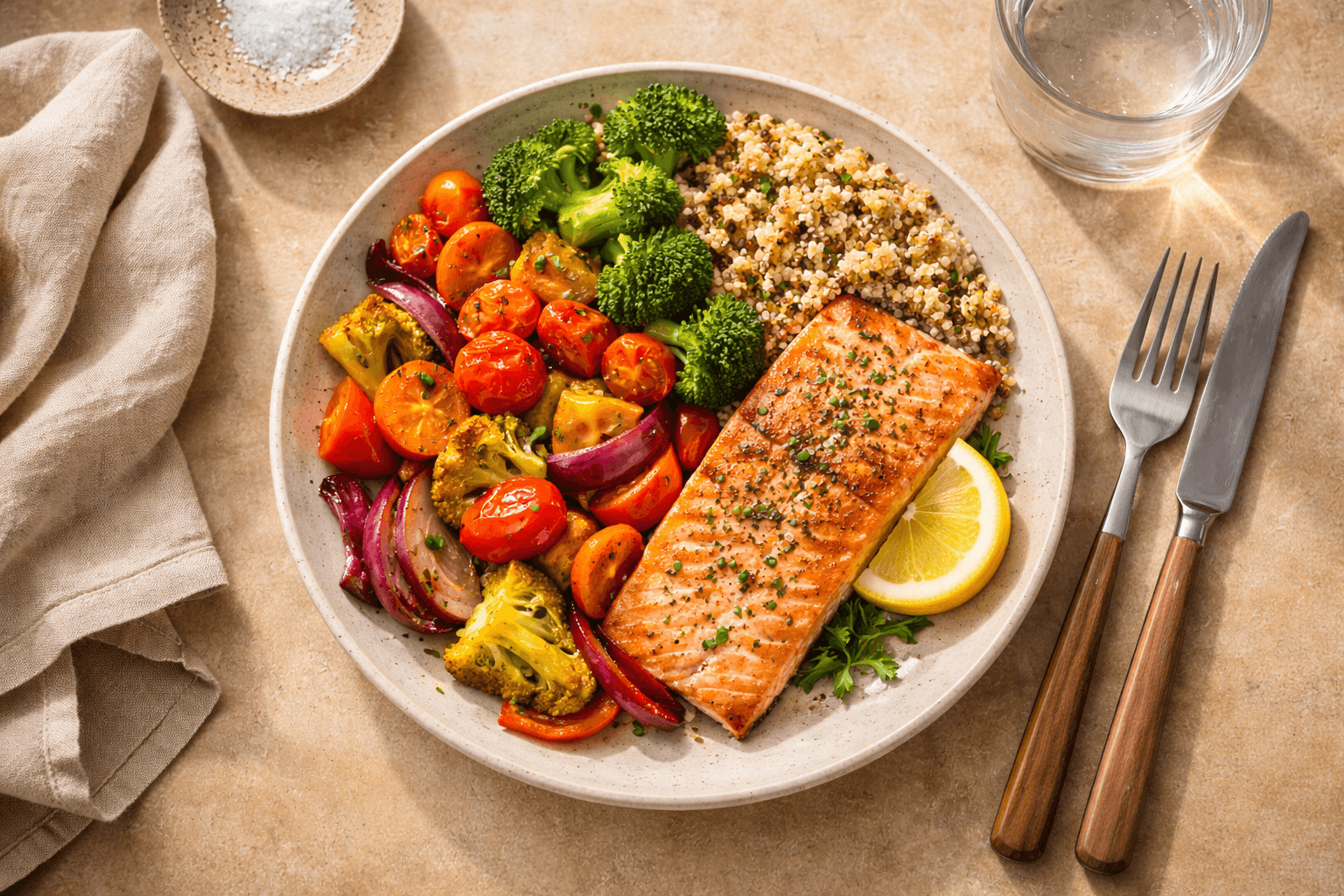
The Harvard Plate Method is a visual framework for meal composition developed by nutrition scientists at Harvard T.H. Chan School of Public Health. Half the plate is vegetables and fruits. A quarter is whole grains. A quarter is healthy protein. Healthy fats on the side.
How it supports weight loss without counting:
The Harvard Plate naturally reduces calorie density — filling half the plate with vegetables and fruits displaces higher-calorie foods while increasing fiber, which slows digestion and extends satiety. A meal built around the Harvard Plate proportions typically contains fewer calories than a typical Western meal not because you've counted anything, but because the composition itself shifts.
Research on intuitive and mindful eating programs — which share the composition-over-counting philosophy — has found that these approaches produce weight loss outcomes comparable to conventional calorie restriction programs, without the tracking burden.
What to expect:
Weight changes from switching to a composition-based approach are typically gradual — weeks to months rather than rapid. The pace is slower than aggressive calorie restriction, and less predictable. But the behavioral pattern it creates is more durable, because it doesn't require ongoing willpower or app management to maintain.
Who it works best for:
People whose current diet is largely unstructured or dominated by processed foods, large portions of refined grains, or limited vegetables. The compositional shift produces the largest benefit for people whose current eating pattern is furthest from the Harvard Plate structure.
Approach 2: Building Eating Habits — One at a Time
Weight loss from habit formation works through a different mechanism than restriction: instead of managing calories, you replace lower-quality eating behaviors with better ones, one behavior at a time, until the better behaviors become automatic.
How it supports weight loss without counting:
Each habit change creates a small, sustainable improvement in eating quality that adds up over time. Eating a protein-containing breakfast every day. Putting vegetables on the plate before adding anything else. Stopping eating when comfortably full rather than finishing everything on the plate. None of these require tracking — but each one consistently shifts eating patterns toward compositions that support weight management.
Research on habit formation shows that habits take approximately 66 days on average to become automatic — meaning a behavior you deliberately practice for two months can become a default action that requires no willpower to sustain. A collection of better eating habits, built over a year, creates a significantly different baseline eating pattern without any ongoing numerical management.
What to expect:
This approach is the slowest of the methods described here for initial weight change. But it's also the most durable — because the weight loss, when it comes, is supported by changed behavior rather than active restriction. It also has the lowest psychological cost of any approach.
Who it works best for:
People who want long-term behavioral change rather than rapid weight loss. People who have tried calorie tracking repeatedly and found it unsustainable. People for whom the relationship between eating and emotion needs to be addressed alongside the eating pattern itself.
Approach 3: Prioritizing Protein and Vegetables
Among the specific food composition changes that support weight loss without counting, protein and vegetable intake are the most consistently supported by research.
Protein: Protein is the most satiating macronutrient — it produces a stronger and longer-lasting fullness response than carbohydrate or fat. Higher protein intake is consistently associated with reduced overall calorie consumption, because people spontaneously eat less when protein is adequate. Aiming for a palm-sized portion of protein at every meal — using the palm method — provides a practical framework without requiring gram counting.
Vegetables: Non-starchy vegetables are high in fiber and water, low in calorie density. Filling half the plate with vegetables before adding other food creates an automatically lower-calorie meal — not because you've calculated anything, but because the volume and fiber of vegetables crowds out higher-density foods while still producing fullness.
These two changes together — adequate protein and a vegetable-dominant plate — address the two primary mechanisms of satiety: hormonal (protein triggers satiety hormones) and mechanical (fiber and volume create physical fullness). Neither requires counting.
What to expect:
People who make these two changes — more protein, more vegetables — typically experience gradual reduction in overall food intake without any deliberate restriction, because the satiety response improves. Weight loss tends to follow over weeks to months.
Approach 4: Reducing Ultra-Processed Foods
Ultra-processed foods — foods manufactured with industrial ingredients and additives, including most packaged snacks, fast food, sweetened drinks, and many convenience foods — are specifically engineered to override satiety signals. They tend to be calorie-dense, low in fiber, and designed to encourage continued eating past fullness.
A 2019 randomized controlled trial from the NIH — one of the most rigorous studies ever conducted on diet and food processing — found that people assigned to an ultra-processed diet consumed approximately 500 calories more per day than people assigned to an unprocessed diet, even when both groups had equal access to food and were told to eat as much as they wanted. The calorie difference wasn't tracked or restricted — it emerged from the composition of what was available.
Reducing ultra-processed food intake — without any calorie tracking — typically reduces overall calorie consumption as a natural consequence. Replacing packaged snacks with whole foods, sweetened drinks with water, and heavily processed meals with home-cooked or minimally processed alternatives produces a compositional shift that supports weight management without numerical monitoring.
What to expect:
The effect size depends on how much ultra-processed food currently dominates the diet. For people with high current ultra-processed food intake, this change can produce meaningful weight reduction relatively quickly. For people already eating largely whole foods, the effect is smaller.
Approach 5: The Palm Method for Portion Awareness
The palm method uses your hand as a self-calibrating portion reference. Palm for protein. Fist for vegetables. Cupped hand for grains. Thumb for fats.
It's not as precise as weighing food — but it's far more practical. It works at restaurants, social meals, and anywhere else a scale is unavailable. And because hand size correlates with body size, it naturally calibrates for individual differences in a way that fixed gram targets do not.
For weight loss specifically, the palm method's primary value is reducing portion distortion — the common pattern of significantly under-estimating how much is being eaten, particularly of high-calorie foods like oils, nuts, and refined carbohydrates. Applying the thumb measure to fats and the cupped hand measure to grains creates awareness of these portions without requiring a database or a scale.
What to expect:
The palm method works best as a complement to a composition framework like the Harvard Plate rather than as a standalone approach. Together, they provide both the compositional structure (what to eat) and the portion reference (roughly how much) that produce balanced, appropriately-sized meals without counting.
What the Research Shows About Non-Tracking Approaches
The strongest clinical evidence for weight loss without calorie counting comes from time-restricted eating research — a useful proxy because it demonstrates that eating pattern changes, rather than tracking, can drive weight loss.
A 2023 randomized controlled trial published in Annals of Internal Medicine compared time-restricted eating (eating within an 8-hour window, with no calorie counting) against traditional calorie restriction (25% energy reduction with tracking) in 90 adults with obesity over 12 months. The result: both groups lost weight, with no statistically significant difference between them. Time-restricted eating produced approximately 4.6kg of weight loss without any calorie counting, compared to 5.4kg with active calorie restriction — not significantly different.
The implication is important: eating pattern and composition can drive weight loss comparable to calorie tracking, without the tracking burden. The mechanism is different — changed behavior versus managed numbers — but the outcome is similar.
For composition-based approaches specifically (Harvard Plate, intuitive eating), a 2019 meta-analysis in Obesity Reviews found that mindful and intuitive eating programs produced weight loss outcomes comparable to conventional diet programs. Non-tracking approaches are not inferior to tracking for weight outcomes — they're equivalent, with better psychological outcomes and typically better long-term maintenance.
Realistic Expectations
Weight loss without calorie counting is real and evidence-supported. But it comes with honest caveats:
It's slower than aggressive calorie restriction. Non-tracking approaches typically produce weight loss of 0.2-0.5kg per week in the early months — slower than a calorie-deficit approach that targets 0.5-1kg per week. For people with a specific timeline (a medical procedure, an event), aggressive calorie restriction may be more appropriate.
It's less predictable. Calorie restriction produces weight loss that's roughly calculable from the deficit. Composition and habit-based approaches produce results that vary more between individuals and are harder to predict in advance.
It requires patience with behavioral change. The weight loss follows behavioral change, which takes time. If you change your eating patterns meaningfully today, you won't see the full weight effect for weeks to months. This is psychologically harder than seeing a daily number on a tracking app.
It works best for long-term goals. The sustainable nature of non-tracking approaches is their biggest advantage — but "sustainable" implies a long time horizon. People who want rapid weight loss in a short period typically achieve better short-term results with active calorie management, with the understanding that long-term maintenance will require transitioning to something more sustainable.
Combining Approaches: What Works Best Together
The most effective non-tracking approach for most people combines:
Composition structure (Harvard Plate) — for what to eat at each meal without counting.
Portion awareness (Palm Method) — for roughly how much of each food category.
Protein priority — a palm of protein at every meal to optimize satiety.
Vegetable dominance — filling at least half the plate before adding other food.
Ultra-processed food reduction — progressively replacing engineered foods with whole or minimally processed alternatives.
Habit building — turning these patterns into automatic behaviors through consistent practice rather than ongoing deliberate effort.
None of these require tracking. Together, they address composition, portion, food quality, and behavioral sustainability — the four variables that most reliably determine weight outcomes over time.
Frequently Asked Questions
Can you lose weight without counting calories?
Yes. Multiple randomized controlled trials have shown that composition-based and pattern-based approaches — including time-restricted eating and mindful/intuitive eating programs — produce weight loss outcomes comparable to calorie counting, without the tracking burden. The mechanisms are different, but the outcomes are similar.
How do I lose weight without dieting?
The key shift is from restriction (eating less of what you'd normally eat) to composition (eating differently). The Harvard Plate Method provides the compositional framework — half vegetables, quarter protein, quarter whole grains — that naturally reduces calorie density without requiring restriction or tracking. Combined with protein prioritization and reduced ultra-processed food intake, this approach supports gradual weight loss through changed eating patterns rather than active dieting.
How long does it take to lose weight without counting calories?
Non-tracking approaches typically produce slower initial weight loss than aggressive calorie restriction — often 0.2-0.5kg per week in the early months for people making meaningful composition changes. The pace accelerates as habits become more automatic and eating patterns more consistently improved. Realistic timelines for meaningful weight loss (5-10kg) are three to six months, though this varies significantly by individual.
What is the most effective way to lose weight without counting calories?
Combining composition-based eating (Harvard Plate), protein prioritization, reduced ultra-processed food intake, and consistent habit building produces the most reliable results. No single approach is universally most effective — the most effective approach is the one that changes your actual eating patterns most sustainably given your specific lifestyle and history.
Is it OK to eat intuitively and still lose weight?
Yes. Research on intuitive eating and weight shows that people who shift to intuitive eating tend to have more stable weight over time and lower rates of weight regain than chronic calorie counters. Intuitive eating is not designed as a rapid weight loss tool, but it consistently produces better long-term weight outcomes than repeated calorie restriction cycles.
The Bottom Line
Losing weight without counting calories is not only possible — for most people, it's more sustainable than tracking. The approaches that work do so by changing eating composition, food quality, and behavioral patterns rather than managing a numerical target.
The Harvard Plate for composition. The palm method for portions. Protein at every meal. Vegetables on half the plate. Less ultra-processed food. Better eating habits built one at a time.
None of these require an app. All of them, applied consistently, produce the behavioral foundation for lasting weight management.
If you want to start building these habits one at a time, the free Habit Wheel helps identify which eating habit makes the most difference for your specific situation. Or download Eated on the App Store and begin your 7-day free trial — built for people moving from calorie tracking to habit-based eating.