Eated and AteMate are the two most distinct alternatives to calorie tracking apps in 2026. Both reject the daily calorie target model. Both claim to build lasting habits rather than enforce short-term restriction. But they work through entirely different mechanisms — and choosing the wrong one for your specific problem means getting stuck again, just in a different app.
This is an honest comparison of how each works, where each falls short, and which one fits which type of person.
The Core Difference: Guided Structure vs. Reflective Awareness
The simplest way to frame it: Eated tells you what to do. AteMate helps you see what you're already doing.
Eated gives you a behavioral framework — the Harvard Plate Method as a visual template for what goes on your plate, and a structured 24-day habit cycle to build one eating behavior at a time. You have a daily task, a daily insight, a streak to close. The app is actively coaching you toward a specific outcome.
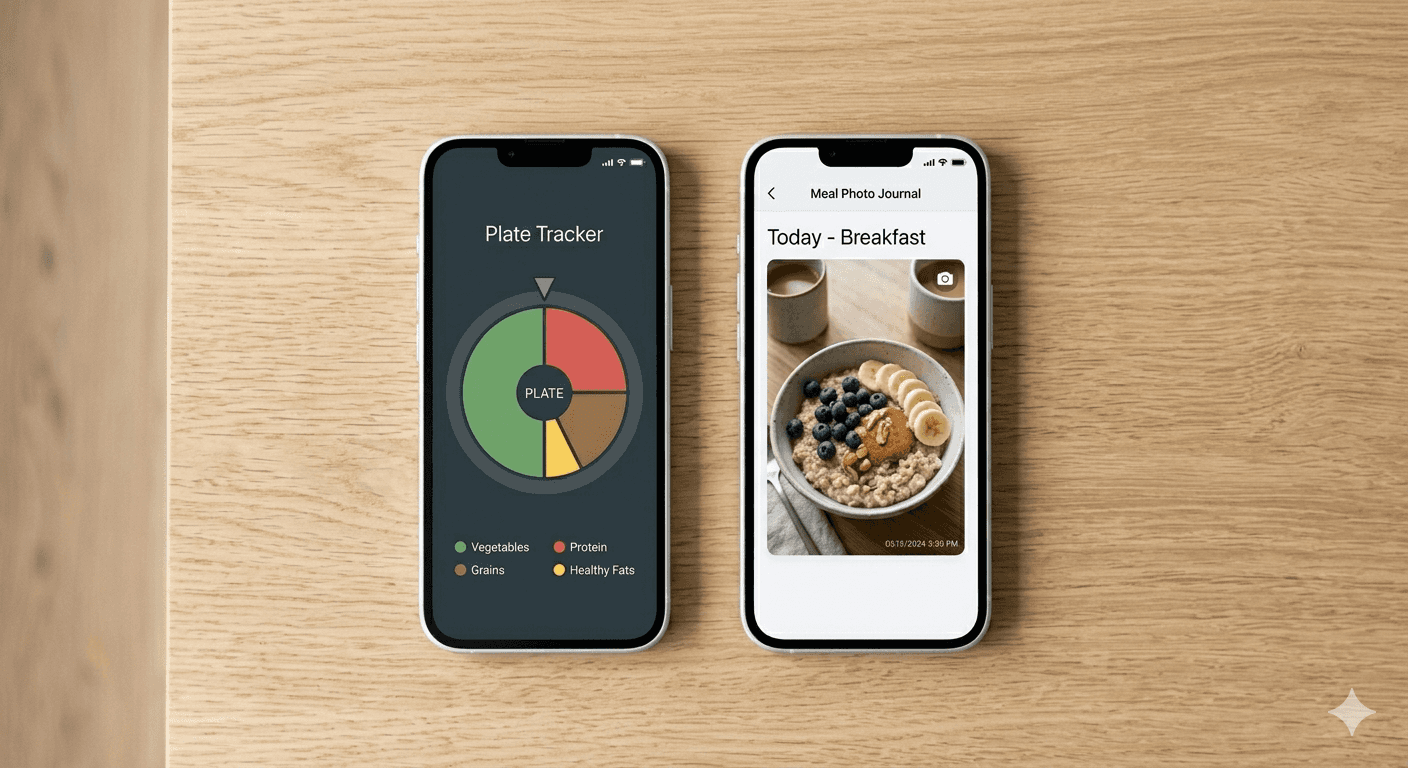
AteMate gives you a mirror. You photograph your meals, reflect on whether each felt "on path" or "off path," and over time patterns emerge — between stress and eating, between certain situations and specific food choices, between how you felt and what you ate. The app surfaces these patterns; it doesn't prescribe what to do with them.
Neither approach is inherently better. They solve different problems. The important question is which problem you actually have.
Eated: How It Works
Eated is built on two foundations — the Harvard Plate as a composition framework, and BJ Fogg's Tiny Habits model as a behavior-change framework.
The plate logging: Instead of calories, you track how your meals distribute across Harvard Plate categories — vegetables and fruits on half the plate, protein on a quarter, whole grains on a quarter, healthy fats alongside. No database searching, no gram weighing. On paid tier, you can scan a photo of your meal and let the AI assign portions automatically. On the free tier, you log manually by selecting food groups.
The habit layer: You choose one of eight habits to work on — eating more vegetables, getting enough protein, eating slower, reducing sugar dependence, improving food variety, managing hunger cues, staying hydrated, or eating more fruit. One at a time. Each habit runs for 24 days across three 8-day cycles — a structure grounded in research showing habit automaticity develops over roughly 66 days of consistent practice, with the first 24 days establishing the behavioral foundation. In the first cycle, you get eight short educational videos (Irene's AI avatar, covering the mechanism, common myths, and practical application). In cycles two and three, the videos drop off and you work with daily tasks only.
The daily task structure: This is where Eated is distinctly different from anything else in this category. Tasks aren't vague ("eat more vegetables today"). They're specific and behavioral: exactly what to do, why it works, and how to fit it into a normal day. Each task is designed to be completed in under five minutes. The point is to make the behavior feel small enough to actually do — which is the core of the Fogg model.
Food Coach: Every morning after you log the previous day, Eated's Food Coach delivers one personalized insight — one thing you did well, one small shift for today. After seven consecutive days of logging, you receive a full weekly nutrition report. This is the closest thing in an app to having a nutritionist briefly review your actual eating patterns each day, rather than just flagging whether you hit a calorie target.
What Eated doesn't do: No calorie counting, no macro tracking, no meal planning, no workout tracking, no shopping list. It doesn't track sleep or mood. It doesn't adjust for hormonal cycles or life events. It is a focused eating habits app — not a holistic wellness dashboard.
AteMate: How It Works
AteMate describes itself as a "reflective health journal" — and that framing is accurate. The core action is photographing meals and reflecting on them. The core output is pattern awareness.
The photo journal: You snap a photo before or after eating — or just type a description if you're in a hurry. The app's AI analyzes the photo and tags it with estimated nutritional information (calories and macros are available but optional — the app explicitly frames them as "awareness tools, not daily targets"). Visual food records have genuine research backing: a 2016 University of Sydney study found that hand- and photo-based food records produce meaningful accuracy in dietary assessment without precise weighing. You then mark the meal as on-path or off-path, based on whatever criteria you've set for yourself. You can also add notes on mood, hunger level, and why you ate.
What "on path / off path" means: This is AteMate's most distinctive design choice. There is no universal definition of on-path — you define it. Mindfully eating a piece of chocolate cake can be on-path; absent-mindedly eating a "healthy" salad at your desk can be off-path. The framework is genuinely adherence-neutral, which makes it compatible with any dietary philosophy or eating style. The flip side: if you don't have a clear sense of what you're working toward, the framework doesn't provide one.
The holistic timeline: AteMate also tracks movement, sleep, hydration, and mood alongside food — and its Health Intelligence Engine looks for correlations across all five. The weekly "Path Review" surfaces patterns: this is what high-stress days look like for your eating, this is what sleep-deprived mornings produce at breakfast. This cross-domain pattern recognition is something Eated doesn't offer at all.
What AteMate doesn't do: It doesn't teach you what to eat. It doesn't provide a nutritional framework, daily tasks, or structured behavior change curriculum. The personalized insights it delivers are observation-based — "here's what we noticed about your patterns" — not prescriptive. It doesn't have a habit cycle, a streak mechanic oriented toward building specific behaviors, or educational content on nutrition mechanisms. AteMate assumes you already broadly know what you should be eating; it helps you understand why you're not consistently doing it.
What Real Users Say
AteMate's strongest reviews consistently say the same thing: the format makes it easier to stay "on path" after a bad meal because there's no concept of having "ruined" a day. One user described years of cycling through trackers before finding that not having a numerical target to fail against was what finally made consistent journaling possible. The photo approach gets mentioned frequently — taking a picture before eating creates a brief moment of awareness that influences choices without requiring discipline.
The criticism that appears in less positive AteMate reviews: the app shows you patterns but doesn't tell you what to do about them. Users who came in wanting guidance on what to eat, not just insight into why they're eating the way they are, found it incomplete. Without a nutritional framework underneath the journaling, pattern awareness alone doesn't produce dietary change for everyone.
Eated users most often cite the daily task specificity as what makes the difference — the fact that "eat more vegetables" becomes a concrete action for that specific day, rather than an ongoing vague intention. The streak mechanic and 24-day cycle structure get mentioned as creating just enough accountability without the guilt spiral of broken calorie streaks. The Food Coach daily insights are described as practical and genuinely personalized, not generic.
The most common frustration with Eated: it's iOS only. Android users can't access it. And the results are gradual — people who expected to feel dramatically different within a week sometimes find the pace disappointing before the habit changes accumulate.
Head-to-Head Comparison
Eated | AteMate | |
|---|---|---|
Core mechanism | Structured habit formation | Reflective pattern awareness |
What you log | Plate composition by food group | Photos + mood + sleep + movement |
Nutritional framework | Harvard Plate Method | None — you define your own "path" |
Guidance provided | Daily tasks + educational content | Pattern observations + weekly review |
Habit structure | 8 habits, 24-day cycles, one at a time | No formal habit curriculum |
Nutritionist-backed | Yes — Irene Astaficheva, PN1, GGS-1 | No named nutritionist |
Calorie/macro tracking | ❌ Not available | ⚠️ Optional, framed as awareness |
AI features | AI Scan (meal photo → plate portions) | AI food analysis + pattern engine |
Platforms | iOS only | iOS + Android |
Pricing | Free / $9.99mo / $59.99yr | Subscription (7-day trial, pricing via App Store) |
Who Should Use Eated
You need to know what to eat differently and want a structured framework for doing it. Your plates are consistently unbalanced — light on vegetables, low on protein, heavy on the same foods repeatedly. You want something that tells you exactly what to do each day, not just what to observe about what you're already doing.
You've tried calorie trackers and found the restriction mechanism counterproductive, but you still want accountability and direction. You respond to streaks and progress cycles. You want a nutritionist-designed approach, not a self-defined one.
Eated is not right for you if: you need Android, you want holistic tracking across sleep and mood, or your eating problems are primarily psychological and emotional rather than behavioral and structural.
If you recognize your eating as habit-driven — automatic, repetitive, missing key food groups — Eated's habit cycle is exactly the right tool.
Download Eated free on the App Store → · 7-day free trial · $9.99/month or $59.99/year
Who Should Use AteMate
You don't need to be told what to eat — you broadly know. What you don't understand is why you consistently don't do it. Your eating breaks down in specific situations (stress, fatigue, social settings) in ways that pattern analysis could illuminate.
You've had a difficult relationship with tracking — numbers, streaks, and failure states have made previous apps counterproductive. The "on path / off path" framework appeals because you define success on your own terms. You want to track more than food — connecting eating to sleep, movement, and mood matters to you.
You're also potentially starting Eated in a month or two, once you understand your patterns well enough to know which habits to prioritize.
AteMate is not right for you if: you want to be told what to do, you need a nutritional framework rather than a personal one, or your main problem is not knowing what better eating looks like in practice.
Can You Use Both?
Surprisingly, yes — and the combination makes sense for a specific type of person. AteMate for the first 2–4 weeks to understand which situations and patterns are driving your current eating; Eated once you know which habits to start with. AteMate builds the self-knowledge. Eated builds the behavior.
For most people, though, one or the other fits. The choice comes down to a single question: do you need a framework for what to eat, or insight into why you're not eating the way you intend?
Honest Limitations of Both
Neither app replaces a registered dietitian for complex clinical needs. AteMate doesn't provide nutritional guidance — people with significant dietary gaps may plateau at awareness without knowing what to change. Eated doesn't address the psychological and emotional drivers of eating — people whose eating problems are stress- or emotion-driven will find the structural approach incomplete.
Both apps require consistent use to produce meaningful results. Apps that get used three days then ignored don't change eating patterns, regardless of how well-designed they are.
FAQ
Is Eated better than AteMate? For different people, each is better. Eated provides structure and guidance — it tells you what habits to build and how. AteMate provides awareness — it helps you understand your existing patterns. If you need direction on what to change, Eated. If you need insight into why you're not changing, AteMate.
Does AteMate count calories? Calories and macros are available in AteMate as optional data, but they're explicitly framed as awareness tools rather than daily targets. The app doesn't set calorie goals or frame eating as success or failure based on numbers.
Is Eated available on Android? No — Eated is currently iOS only. AteMate is available on both iOS and Android.
Which app is better for weight loss? Eated is more directly structured around producing dietary change — the Harvard Plate framework reduces calorie density without counting, and the habits target the behavioral patterns most associated with weight gain (under-eating vegetables and protein, eating on autopilot, eating past fullness). AteMate can support weight loss through awareness, but doesn't provide a framework for what to change.
How much does AteMate cost? AteMate is a subscription app with a 7-day free trial. Pricing is managed through the App Store and Play Store — check the current price at download. Eated is free to download with a 7-day free trial, then $9.99/month or $59.99/year.
Bottom Line
AteMate and Eated are genuinely different tools for genuinely different problems. AteMate is for understanding — surfacing the patterns that drive your current eating behavior. Eated is for changing — building specific eating habits through a nutritionist-designed framework, one behavior at a time.
Most people who've cycled through calorie trackers without lasting results have a behavioral problem: the same foods go on the same plate in the same situations regardless of what the app told them. For that problem, Eated's structured approach — the Harvard Plate framework, the daily tasks, the 24-day habit cycles — addresses the mechanism directly.
If self-knowledge is what's missing, AteMate gets there faster. If behavioral structure is what's missing, Eated does.
Ready to build habits instead of tracking numbers?
Download Eated free on the App Store · Free to download · 7-day free trial · $9.99/month or $59.99/year after trial