
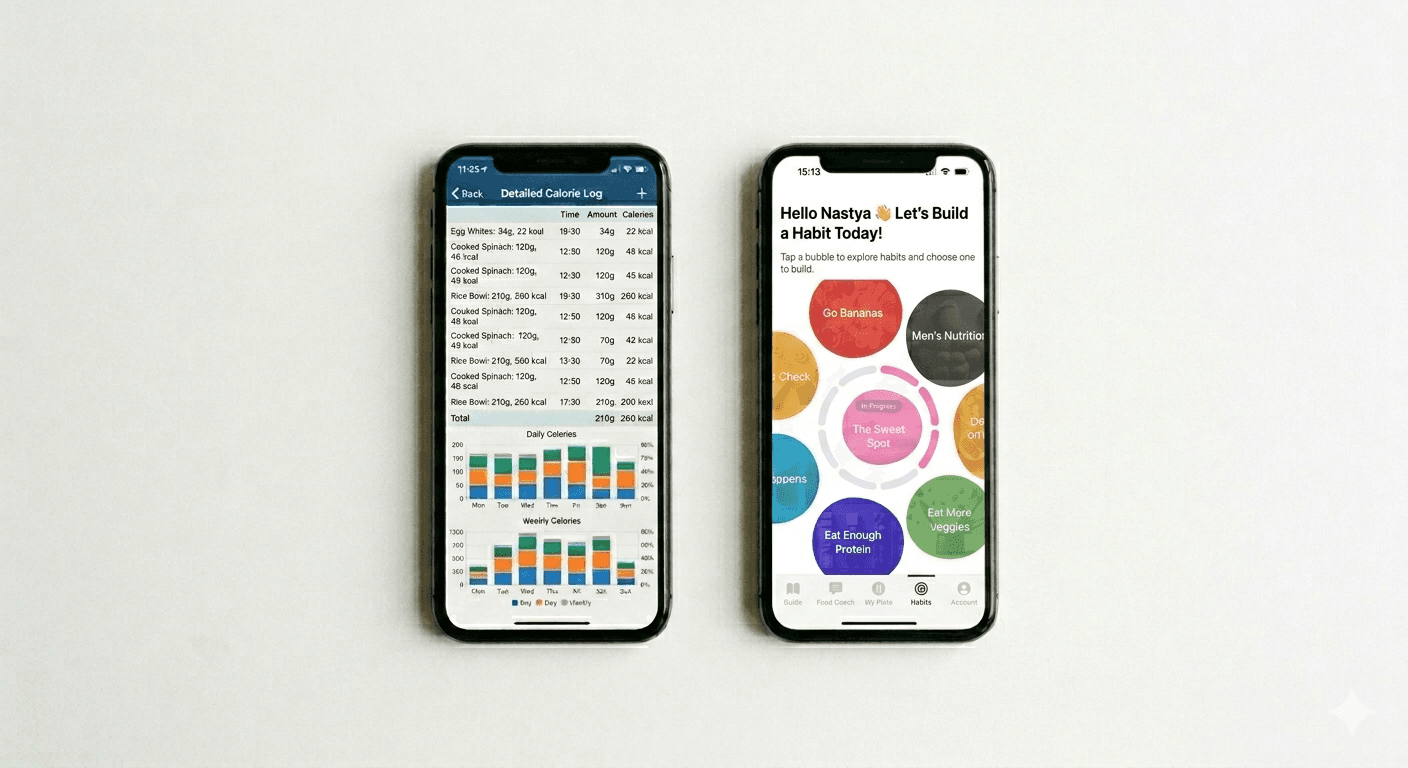
The two dominant approaches to weight loss apps work through completely different mechanisms. Calorie tracking apps (MyFitnessPal, Lose It!, Cronometer, YAZIO) create a numerical record of what you eat and compare it against a target. Habit-based apps (Eated) focus on building the behavioral patterns that make calorie targets unnecessary. Both produce results. They produce different results over different timeframes, for different types of people. This post covers what the evidence shows about each approach — and how to decide which one is right for you.
How Calorie Tracking Apps Work
Calorie tracking apps operate on a simple premise: measure intake against a target, create a deficit, lose weight. The best ones — MyFitnessPal, Cronometer, Lose It!, MacroFactor — have databases of millions of foods, barcode scanning, photo recognition, and macro breakdowns. The 2026 versions use AI photo logging that can estimate calories from a picture of your plate.
The evidence for calorie tracking is solid in the short term. Research consistently shows that people who track calories lose more weight in the first 12–16 weeks than those who don't. The mechanism is awareness — tracking reveals caloric patterns that would otherwise be invisible, and the daily target creates accountability.
The limitation is also well-documented. Tracking requires permanent maintenance. The moment logging stops — on holiday, during a stressful period, when the habit breaks — the information disappears and intake tends to revert. The research on why calorie counting doesn't work long-term points to this as the core problem: the tool requires ongoing effort that most people can't sustain indefinitely, and the psychological relationship with food it creates can increase food preoccupation and anxiety.
How Habit-Based Apps Work
Habit-based apps don't measure calories — they build the behavioral patterns that change what and how you eat automatically. Eated specifically uses BJ Fogg's Tiny Habits framework: one habit at a time, starting small enough to be impossible to fail, building gradually until the eating behavior changes at the level of routine rather than conscious decision-making.
The behavioral science behind this approach is grounded in the same research that underpins most behavior change interventions. The habit building evidence shows that habits formed gradually — with small, consistent behaviors rather than comprehensive overhauls — produce more durable outcomes because they don't rely on sustained cognitive effort to maintain.
Where calorie tracking produces results by creating awareness and a mathematical target, habit-based approaches produce results by changing the default. When your default eating behavior produces a reasonable energy balance, you don't need to monitor the numbers — the behavior does the work.
What Each Approach Actually Produces
Calorie Tracking: The Realistic Outcomes
Short-term: Consistent results for most people who maintain logging. The awareness effect is real — seeing caloric content of foods changes choices, particularly for people who underestimated how much they were eating.
Medium-term: Results depend entirely on adherence. Studies on calorie tracking app users show significant drop-off in logging frequency after 8–12 weeks. Users who maintain tracking show maintained results; users who don't show regain.
Long-term: Mixed at best. The fundamental problem is that tracking measures behavior rather than changing it. When tracking stops, the underlying eating patterns — which haven't fundamentally changed — reassert themselves. This is why weight regain after calorie-counted diets follows the same pattern as all restrictive approaches: more than 95% of people regain lost weight within 3–5 years.
Who it works for: People who genuinely enjoy data, find tracking motivating rather than stressful, have no history of disordered eating, and can maintain logging as a sustainable long-term practice. Athletes and people with specific body composition goals benefit most from precise tracking.
Habit-Based Apps: The Realistic Outcomes
Short-term: Slower visible results than calorie restriction, because the approach doesn't produce the rapid initial deficit that aggressive calorie targets create. Behavioral changes take weeks to establish and weeks more to produce measurable scale movement.
Medium-term: Compounding. Each established habit changes the baseline eating pattern. By month 3–4, the cumulative effect of multiple established habits (more protein, slower eating, better satiety awareness) produces a meaningfully different eating pattern than existed at month 1.
Long-term: The primary advantage. Habits don't require ongoing monitoring — once established, they run automatically. The behavioral change is durable in a way that tracking-dependent results are not. The 5 Best Alternatives to MyFitnessPal post covers the landscape of apps that work this way if you want a broader comparison.
Who it works for: People who've tried calorie tracking and found it unsustainable, anxiety-inducing, or ineffective. People who want a changed relationship with food rather than a monitoring system. People with a history of disordered eating for whom tracking is contraindicated. People who want a long-term solution rather than a fast short-term result.
The Honest Comparison Table
Calorie Tracking Apps | Eated (Habit-Based) | |
|---|---|---|
How it works | Count calories against a target | Build eating behaviors one at a time |
Short-term results | Fast — deficit is immediate | Slower — behavioral change takes time |
Long-term results | Depends on sustained tracking | More durable — habits run automatically |
Effort required | High and ongoing — every meal | Decreasing — habits become automatic |
Suitable if | You like data, tracking feels motivating | Tracking feels stressful or unsustainable |
Not suitable if | History of disordered eating, tracking causes anxiety | You want rapid short-term results |
iOS/Android | Both | iOS only |
Price | Free–$70+/year | Free + 7-day trial |
Calorie counting | Yes — core feature | No — by design |
The Research on Long-Term App Use
The calorie tracking app market reached $4.14 billion in 2026, growing at 9.27% annually — which reflects how many people are looking for solutions, not necessarily how well the solutions work long-term. A 2024 study in the Journal of Medical Internet Research found that users of AI-assisted tracking maintained behavior changes for 6–12 months at 64%, compared to 23% with traditional manual tracking. That's an improvement — but 64% at 12 months still means over a third of users have fallen off by one year.
This is the relevant comparison: not which app produces better results at week 8, but which approach produces maintained results at year 2 and year 3. The behavioral evidence consistently shows that approaches that change underlying habits outperform those that require ongoing monitoring when measured at that timeframe.
Who Should Use a Calorie Tracking App
If any of the following apply, a calorie tracking app is the better starting point:
You've never tracked before and genuinely want to understand what you're eating. The awareness phase of tracking is valuable even if you don't intend to track permanently. Two to four weeks of tracking reveals patterns that inform everything else.
You have specific athletic or body composition goals that require precision. Protein targets, macronutrient ratios, calorie periodization for performance — these need numerical tracking that habit-based apps don't provide.
You find data motivating. Some people genuinely enjoy the gamification of hitting daily targets. If that's you, it works — use it.
Who Should Use a Habit-Based App
If any of the following apply, a habit-based approach is the better fit:
You've tracked calories before and stopped — more than once. Pattern recognition: if you've tried tracking repeatedly and it hasn't held, trying it again is unlikely to produce different results. The problem isn't the tracking; it's that tracking isn't the right mechanism for you.
Tracking makes you anxious, obsessive, or guilty about food. These are signals that the monitoring dynamic isn't working in your favor. A 2019 study in Eating Behaviors found significant associations between calorie tracking behavior and disordered eating patterns.
You want to change your relationship with food, not just your calorie intake. These are different goals. Tracking optimizes for numbers. Habit-building changes the underlying patterns that produce the numbers.
"I see both in my coaching practice — people who track beautifully and people for whom the app becomes the obsession rather than the food behavior. The honest answer is that tracking is a tool, not a solution. For the people who get lasting results, it's either because they genuinely enjoy tracking permanently, or because they used tracking to understand their patterns and then built habits that made tracking unnecessary. The habit side is more work upfront. It pays off later."
— Irene Astaficheva, PN1, PN-SSR, GGS-1
Honest Limitations
This comparison favors habit-based approaches for long-term outcomes. That's where the evidence points — but it's worth being honest about what the habit-based research shows: behavior change takes longer, results come more slowly, and the approach requires patience that calorie tracking's immediate feedback doesn't ask for.
Eated is iOS only. If you're on Android, the habit-based alternatives are limited.
The comparison table simplifies a genuinely diverse market. Calorie tracking apps vary enormously — MacroFactor's adaptive algorithm is meaningfully different from basic manual logging, and Noom's behavioral psychology layer is different from either. The binary framing is useful for clarity, not a perfect representation of every option.
FAQ
Can I use both — track calories and build habits at the same time? Yes, and some people find this combination effective: use tracking for the awareness phase (2–4 weeks), then transition to habit-building once you understand your patterns. The risk is trying to do both permanently — which is double the cognitive load without proportional benefit.
Does Eated work if you've never tracked before? Yes. You don't need a tracking history to benefit from habit-based eating. The Habit Wheel identifies your highest-leverage habit regardless of whether you have calorie data, and the app builds from there.
Which app will make me lose weight faster? Calorie tracking apps, in the short term. A calorie deficit produces faster initial weight loss than behavioral habit change. If speed in the first 8–12 weeks is the priority, tracking wins that comparison. If durability at 2–3 years is the priority, the evidence shifts toward behavioral approaches.
Is calorie tracking dangerous for someone with disordered eating history? For many people, yes. Research links calorie tracking to increased food preoccupation, anxiety around eating, and disordered eating patterns — particularly for people with prior restriction history. This isn't universal, but it's significant enough that people with that history should approach tracking cautiously and consider habit-based alternatives as the lower-risk starting point.
How long does it take to see results with Eated? Habit formation takes an average of 66 days per behavior. Visible weight changes typically begin appearing at weeks 6–10 as multiple habits compound. This is significantly slower than calorie restriction — which is the honest answer, not a selling point.
Bottom Line
Calorie tracking apps and habit-based apps solve different problems. Tracking solves the awareness problem — you can see what you're eating and measure it against a target. Habit-building solves the behavior problem — it changes what you do automatically, without ongoing monitoring.
For short-term results, tracking has the edge. For results that hold at year three, the evidence points toward behavioral change. Choosing between them is a question of what you've tried before, what your relationship with food monitoring is like, and how patient you're willing to be with slower initial progress for more durable long-term outcomes.
Download Eated
The Eated app is free to download on iOS. No calorie counting, no food logging — just one eating habit at a time.