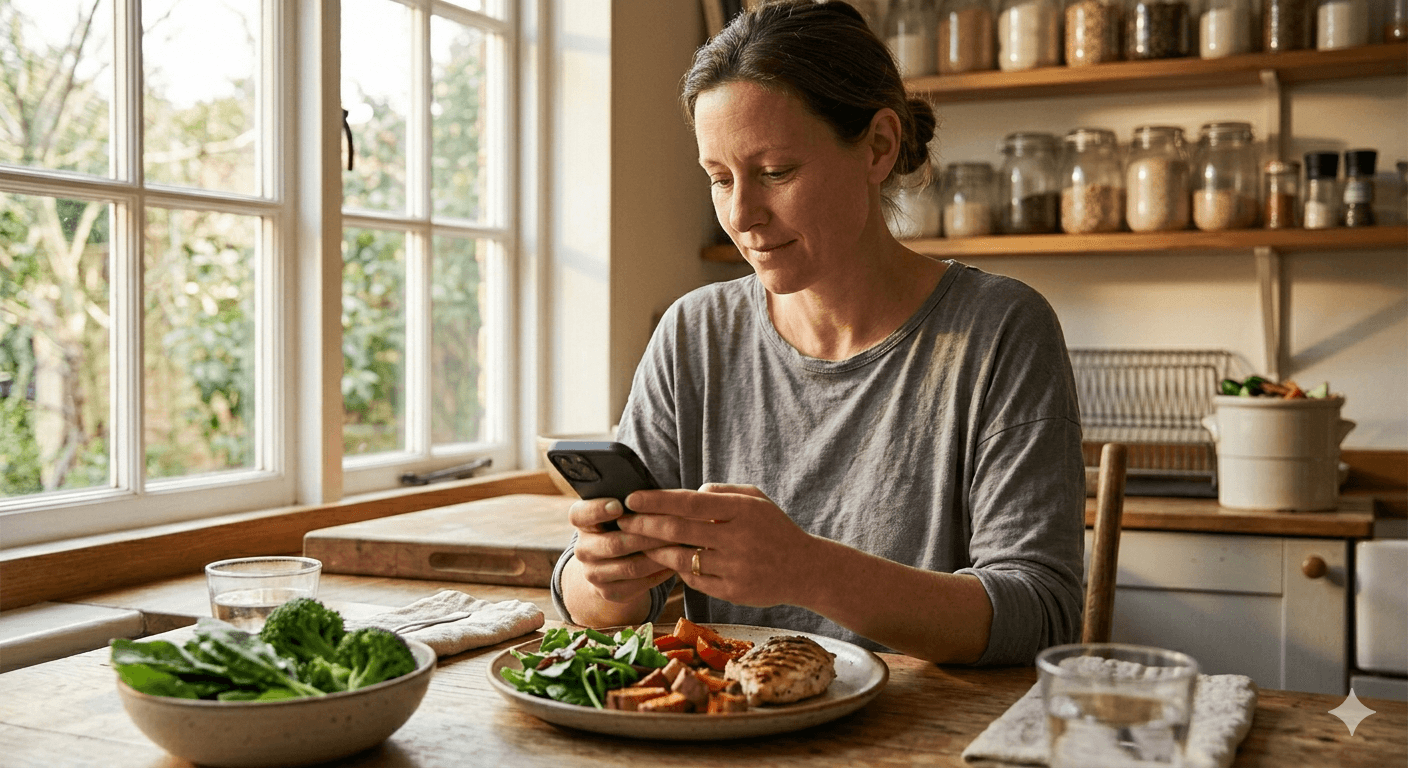
Most nutrition apps were built on research conducted predominantly on men. The calorie targets, macro ratios, and weight loss timelines embedded in their algorithms reflect male physiology as the default — and women's bodies don't work that way. Hunger, satiety, protein needs, and the behavioral response to restriction all differ meaningfully by sex, and they shift across the menstrual cycle, into perimenopause, and beyond. An app that ignores this isn't just incomplete — it's likely to produce exactly the frustration that makes most women give up on nutrition tools entirely.
This is what actually matters when choosing a nutrition app as a woman, and why most popular options fall short of it.
Why Most Nutrition Apps Don't Work Well for Women
The problem starts with how nutrition research has historically been conducted. A 2021 narrative review on sex-specific nutritional strategies noted that most nutritional recommendations and guidelines for women have been derived from male-dominated study populations — and that female hormonal fluctuations across the menstrual cycle and lifecycle require meaningfully different nutritional considerations than those currently embedded in most tools.
In practice, this creates three specific problems for women using standard nutrition apps:
1. Calorie targets don't account for cyclical variation. Energy needs fluctuate across the menstrual cycle — progesterone in the luteal phase increases basal metabolic rate and raises hunger, particularly for carbohydrates. A fixed 1,500 calorie target treats every day of the cycle as identical. Hunger that exceeds that target in the luteal phase isn't a lack of discipline — it's physiology. Apps that frame it as a failure create a cycle of guilt that has nothing to do with actual eating behavior.
2. Calorie restriction raises cortisol — and women are particularly sensitive to this effect. A controlled study involving 121 female participants found that calorie restriction significantly increased cortisol output — even without psychological monitoring. Elevated cortisol promotes fat storage, increases appetite, and impairs the hormonal signaling that regulates hunger and satiety. For women already managing stress, this is a meaningful physiological problem, not just an inconvenience.
3. The behavioral profile of disordered eating skews female. Research comparing calorie tracking to intuitive eating approaches found that more frequent calorie counting predicted higher eating disorder symptom severity — and clinical eating disorders affect women at roughly twice the rate of men. An app that uses restriction as its primary mechanism carries real risk for a significant portion of its female user base.
"I work almost exclusively with women, and the pattern I see constantly is that calorie restriction works for a few weeks and then backfires — not because of willpower, but because the restriction itself is stressing their system. When cortisol goes up, appetite goes up. When appetite goes up and they try to restrict harder, cortisol goes up more. It's a loop, not a failure of character." — Irene Astaficheva, PN1, GGS-1, co-founder of Eated
What a Nutrition App for Women Actually Needs to Do
Rather than listing apps and rating them on features, it's more useful to define what the right approach looks like — and then match apps to that standard.
It needs to work with hormonal variation, not against it.
Hunger in the week before your period is not a problem to override. It's a signal to work with. The right app either acknowledges this explicitly or uses a framework flexible enough to accommodate it — a plate-based visual approach, for example, adapts naturally to different hunger levels without creating guilt around eating more on high-hunger days.
It needs to support adequate protein without obsessive tracking.
Women's protein needs are frequently underestimated, and they increase with age — research shows protein needs are higher in older adults to maintain muscle mass, which declines at 3–8% per decade from age 30 onward. Most women consistently under-eat protein, particularly at breakfast. An app that makes protein a habit rather than a calculation is more likely to address this than one that assigns a daily gram target.
It needs to reduce stress around eating, not add to it.
Given the cortisol-restriction relationship, any app that increases food-related anxiety is working against itself physiologically. This rules out most strict calorie trackers for most women, particularly those who already have a complicated relationship with food.
It needs to support sustainable behavior, not short-term restriction.
Dietary patterns that support hormonal balance emphasize consistency, variety, and adequate intake across food groups — not restriction of specific foods or aggressive calorie reduction. The apps most likely to support long-term results for women are those that build eating patterns, not those that enforce targets.
What This Looks Like in Practice: Eated
Eated was built specifically with women's nutritional needs in mind — its co-founder and lead nutritionist, Irene Astaficheva, is a Certified Women's Coaching Specialist (GGS-1) with over 5,000 hours of individual coaching experience, predominantly with women.
The app uses the Harvard Plate Method as its structural framework — half the plate vegetables and fruits, a quarter protein, a quarter whole grains, healthy fats alongside. This visual approach adapts to different hunger levels across the cycle without requiring recalculation. On higher-hunger days, a larger plate with the same proportions provides more food without triggering the guilt response that comes from exceeding a fixed calorie number.
The habit layer addresses the specific patterns most common in women Irene sees clinically: under-eating protein (the Eat Enough Protein habit), defaulting to the same foods repeatedly (the Don't Eat on Repeat habit), and overreliance on sugar as a reward mechanism (the Sweet Spot habit). Each habit runs for 24 days — 8 days across three cycles — which aligns with research showing that habit automaticity develops over roughly 66 days of consistent practice. The goal is to make better eating patterns automatic rather than effortful, which is exactly what's required for long-term results.
The Food Coach feature delivers a daily personalized insight based on what you actually logged the day before — one thing you did well, one small shift for today. After 7 days of logging, you receive a full weekly nutrition report. This is the closest thing available in an app to having a nutritionist review your actual eating patterns rather than just your calorie count.
If you've been using nutrition apps that make you feel like you're constantly failing — the issue is almost certainly the framework, not your effort. Eated's approach works with your physiology rather than against it.
Download Eated free on the App Store → · 7-day free trial · $9.99/month or $59.99/year after trial
What to Look For (and What to Ignore) When Choosing
Look for:
No fixed daily calorie targets — or at minimum, explicit flexibility for hormonal variation
Protein emphasis built in, not just tracked
Habit-building framework rather than pure restriction
Built or advised by credentialed women's nutrition specialists
Low-guilt approach to food — no "red foods," no daily failure notifications
Ignore:
"Personalized" plans that ask only your height, weight, and activity level — these use male-derived formulas with a female checkbox
Apps that promote rapid weight loss as a primary feature — aggressive restriction is the mechanism most likely to backfire hormonally
Streak mechanics that punish missed days — this adds stress that is physiologically counterproductive
A Note on Life Stage
The right app also depends on where you are hormonally. The considerations above apply broadly to women in their reproductive years. Perimenopause and menopause introduce additional changes — declining estrogen affects insulin sensitivity, bone density, and fat distribution — that warrant different nutritional priorities. If you're in perimenopause or post-menopause, see our dedicated guides on eating during perimenopause and nutrition for women over 30.
Honest Limitations
No app replaces a registered dietitian for complex clinical needs — PCOS, hypothyroidism, a history of disordered eating, or significant perimenopause symptoms all benefit from personalized professional support that no app provides.
Eated does not track micronutrients, account for cycle-phase variation automatically, or integrate with hormonal health data. What it does — build consistent eating habits around a nutritionally sound framework, without the restriction-cortisol loop — addresses the most common failure pattern Irene sees clinically. For most women who've cycled through tracker apps without lasting results, that's exactly where to start.
FAQ
What is the best nutrition app for women specifically? The best option depends on what's driving the problem. For most women whose eating problems are behavioral — skipping protein, plates consistently heavy on processed foods, eating on autopilot — Eated addresses this directly through habit formation and plate-based tracking. For women whose eating is primarily driven by emotional or psychological patterns, Noom's CBT curriculum is more directly relevant.
Do nutrition apps work for women with hormonal issues like PCOS? Eated is compatible with PCOS management — the Harvard Plate framework supports the whole-food, lower-glycemic dietary patterns associated with better PCOS outcomes. For a detailed look at the research, see our post on intuitive eating and PCOS.
Why does calorie counting feel harder for women than men? Partly physiology — cyclical hunger variation means fixed daily targets will be wrong roughly half the month. Partly the cortisol-restriction relationship, which is well-documented in female study populations. And partly because the behavioral research on disordered eating consistently shows women are more vulnerable to the psychological costs of restrictive tracking.
Is there a nutrition app that adjusts for the menstrual cycle? Most apps that claim to do this do so superficially — adjusting calorie targets up slightly in the luteal phase without changing the underlying tracking mechanism. Eated doesn't claim cycle-syncing features, but the plate-based visual approach adapts naturally to different hunger levels without creating guilt around eating more on high-hunger days.
How long before I see results with a habit-based nutrition app? Most people notice changes in their eating patterns within 3–4 weeks of consistent use. Weight changes typically follow over 6–12 weeks. The pace is slower than aggressive restriction — and significantly more durable, particularly for women given the hormonal dynamics of restriction-based approaches.
Bottom Line
Most nutrition apps were designed around male physiology with a female option bolted on. For women, the calorie-restriction model they use has specific physiological downsides — elevated cortisol, cyclical hunger that doesn't fit fixed targets, and behavioral risk that skews female.
The right app for women works with hormonal reality rather than against it. That means building eating habits around food quality and composition rather than enforcing daily calorie targets — and doing so in a way that reduces food-related stress rather than adding to it.
Done with apps that make you feel like you're constantly failing?
Download Eated free on the App Store · Free to download · 7-day free trial · $9.99/month or $59.99/year after trial